Shiloh: the Man of Sorrows

3%

Pacific Press Publishing Association · Mountain View, California · Apr 19, 1910

FromSigns of the Times, Vol. 37, No. 15.

Read the full edition

Shiloh: the Man of Sorrows

Copyright, 1910, Pacific Press Publishing Association
By Mrs. L. D. Avery-Stuttle

Chapter VII. The Death of Herod

HARDLY a month has passed away since occurred the horrible massacre of the innocent babes of Bethlehem. Herod the king, weakened by age, dissipation, and disease, is about to die. He lies upon his luxurious couch in the chamber of death in his palace at Jericho, a bloated, festering mass of corruption.
Even in his sleep, the figures and faces of his murdered victims disturb his uneasy slumbers; but he only seeks by fresh atrocities to cover the memories of the past.
Suddenly turning his face from the wall, and toward his attendants, he calls hoarsely: "Send me Salome, my sister, and her husband Alexis."
"Thou seest me, my sister," he began, when he found himself alone with his guests. "Surely I shall die in a very little while, so great are my pains. But I am an old man, and should be ready to die. But the certainty that mine own nation careth not—"
"Speak not of death, O king," interrupted Alexis. "Surely the baths of Callirrhoe must yet be of benefit to thee. Thou art scarce threescore and ten years old; why speakest thou of death? Verily thou needest fear no rivals; Antipater is safely lodged, and—"
"Yes," agreed the king, speaking with difficulty, "yes, Alexis; but all the virtue of the baths of Callirrhoe is not for me; neither can the physicians do aught for me. Verily my complaint is horrible, and Jehovah hath set His mark upon me. Truly, mine Alexis, I fear no rival but death. I have had no difficulty in ridding from my path the young Babe lately born in Bethlehem of Judea, whom the princes of the East were pleased to call King of the Jews. Surely these princes thought to do me great despite. But now hath the young King perished,—so saith Varro the centurion,—with all the babes of Bethlehem and the coasts round about. But I would speak, before I die, of mine ungrateful nation."
"Verily, O king, thou hast loaded them with benefits," declared Alexis, unwilling in any manner to offend his royal brother, not being unmindful of the punishment which he well knew would follow a contrary course.
"Verily," puffed the vainglorious king, "I have rebuilt and adorned the temple of Jehovah, until it is a structure, this day, which the kings of the earth must envy. By the strength of my might have I done this; but hear me: that which renders my death most bitter is the certain knowledge that there are none to bemoan me."
Then for a little time the monster gave himself up to cries and lamentations. "Promise me, O my Salome, swear to me, O mine Alexis, that ye will carry out my dying wish. Why should I, King Herod, rest in a tearless grave—I who have made glorious the temple of God?" And again the aged monarch bedewed his pillow with the tears of a monster.
"What wilt thou, O Herod, that we do for thee?" asked Salome, placing her hand upon the bloated face; "what wilt thou?"
"Thou knowest that I sent letters to all the principal Jews in my province that they should hasten into my presence on pain of death. These men are now shut up in the Hippodrome, and they are great men in Israel, and at their death there will be deep lamentation. Now tho I be king, yet I forget not that I am of humble birth; and tho I have beautified the temple, and lavished many gifts thereon, yet shall I not be mourned by Israel. Therefore, when I shall die, which I am assured by my increasing pains will be very soon, cause ye my soldiers to fall upon those men and slay them. Then shall there be great mourning upon the occasion of my death, and my funeral shall be such as becometh my pomp and position."
Salome and Alexis had scarcely given their word to accomplish this deed of horror, and left the room, when the attendants ushered a man into the royal chamber. He was in great excitement, and his words were almost unintelligible. That Herod was well acquainted with this man, was very evident, and he turned himself upon his bed, and regarded him steadfastly, as he inquired: "Thou art come from the prison of my son, even Antipater. What knowest thou? Speak."
"Thy son, O king, already believeth that thou art dead, and he desireth even now to take thy kingdom without any further ado. Moreover he offereth me many presents if I will open the doors of his prison this hour, that he may take the throne. And so, O king, have I hasted to bring thee word."
With a howl of rage, like that of a wild animal, Herod raised himself upon his elbow.
"Call me Varro, the centurion!" he bellowed. An attendant made haste to do the royal bidding. Meanwhile the rage of the king was horrible. With loud cries, he beat his white head, and tore at the straggling gray locks with his stiffened and bloated fingers.
"Ha, Varro," he cried, "thou didst make short work of the enemies of Herod at Bethlehem, and I wot the would-be usurper of my throne hath perished at thy hand. And now, O Varro, up! take thou thy sword and slay me Antipater mine own son; for, behold, he reckoneth on the kingdom, even now."
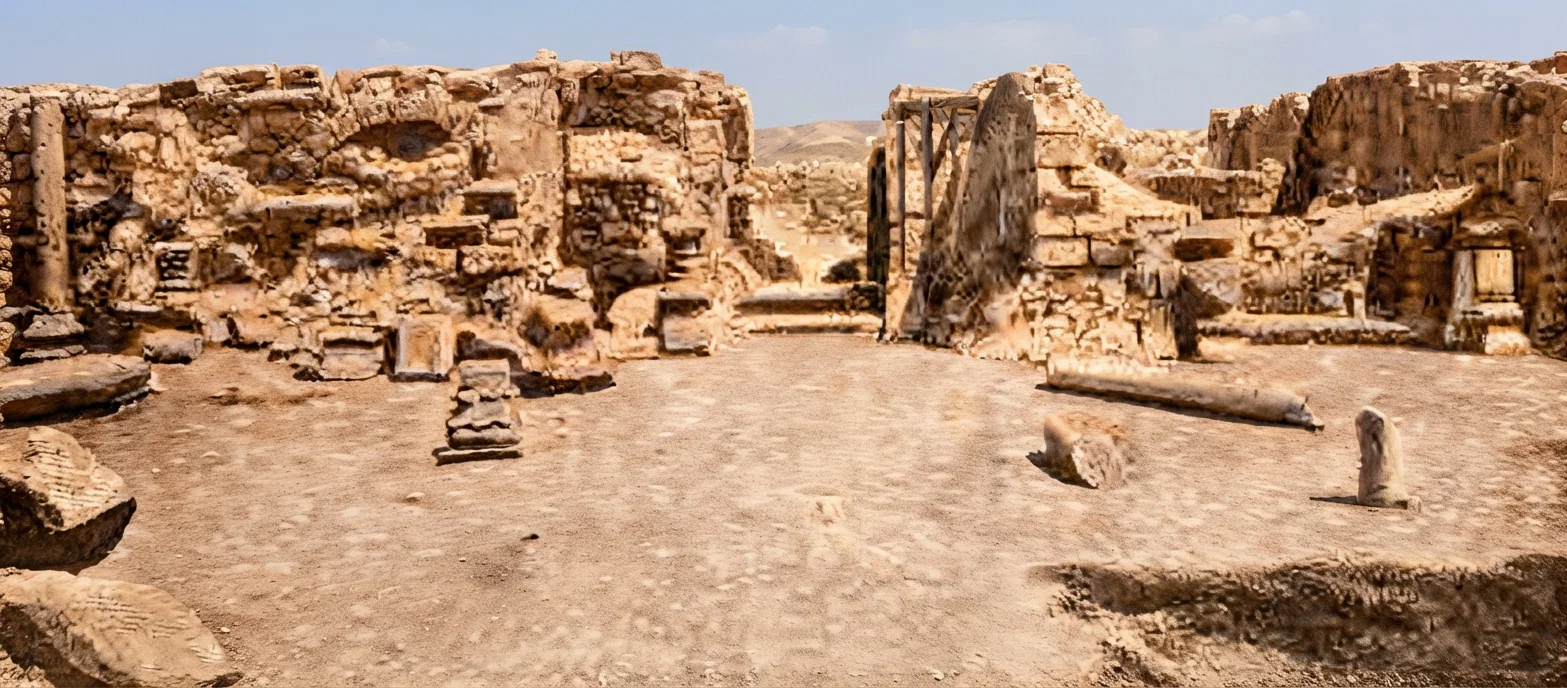
Ruins of Herod's Palace, near Jericho, unearthed by German archeologists. Here Herod the Great held some of his bestial feasts. The ruins indicate that it was a structure of great magnificence.
With a nod of satisfaction that he had been entrusted by the king with still another horrible commission, the centurion departed on his bloody errand.
Five short days had rolled away. Herod the Great, the bloody king, was no more, and his son Archelaus had been appointed to the kingdom. Flattered by the great honor which had been conferred upon him, and influenced by a love for display more than by any respect which he felt for his father, Archelaus determined that the funeral should be one of royal magnificence.
But before the arrangements for the funeral began, even the same hour in which the breath left the decaying body of the old king, there was a meeting between Alexis and Salome in a little room far removed from the chamber of death. "What sayest thou, Alexis, my husband? thou rememberest the command which the king my brother gave unto us."
"Yes; and there are now many of the best and wisest men among the Jews imprisoned in the hippodrome, that their cruel and unjust death may cause mourning on the occasion of thy brother's funeral."
"But who shall release us from the vow which is upon us?" protested the woman.
"Did not Solomon, the wise king, say: 'Enter not into the path of the wicked, and go not in the way of evil men. For they eat the bread of wickedness, and drink the wine of violence'?"
"Behold, now, we will call Marcus the centurion. Surely he delighteth in deeds of mercy, and he shall open the doors of the hippodrome to these men."
Wending its way slowly toward Herodium from Jericho, comes a brilliant retinue. It is the funeral procession of Herod the Great. Burnished helmets and swords and glittering armory gleam in the April sunshine. All along the route bloom the many colored wild blossoms of spring, while the lark and the nightingale among the trees and the hedges of cactus, vie with each other in singing sweet songs.
The bier upon which rests the royal casket, is surrounded by the relatives of the king; while the centurions, with their soldiers, armed and equipped as for war, march after them in gorgeous array. Behind them are hundreds of the household servants of the king.
The royal retinue moves slowly, coming only about eight furlongs each day,—a journey of about twenty-five miles.
Let us step nearer, that we may view the royal personage stretched upon the bier. Above the rugged brow shines a diadem of great value; and still above it, a crown of gold; and as if to defy death, the king of terrors, a shining scepter has been placed in the rigid fingers. A purple covering is draped across the golden bier, which bier is ornamented and bedecked with costly gems of every kind; and thus, in mock power, and amid all the shining pageantry of earth, is buried the vainglorious monarch.
There lack no emblems of sorrow in that vast pageant; but not one real mourner follows to his last resting-place Herod, called the Great.
Cover the loathsome and festering body with the gaudy trappings of royalty,—but hasten to hide it from the sight of men. But for him, the women at Bethlehem would not be childless, nor the Shiloh of Jacob driven into exile. But for him!—
But why blot the page or drag into the unpitying light of day an account of crimes and horrors so great that even the dimming hand of the centuries can not cover them? Only so far as it affects the interests of our narrative shall we pry with curious eyes into the sickening record which the historian has made. And so we repeat sadly, "Ashes to ashes, dust to dust." Let the dead rest. But when that fast hastening day shall dawn when the murderer and his victim stand side by side to listen to the awfully truthful record of the angel scribe, what disclosures will be made!
(To be continued)