His Promise for the Boy at the Plow—His Life-Work Sheds Its Blessings on Us Still—His Martyrdom
WE who thank God to-day for the open Bible and the liberty to turn its pages, must never cease to give thanks also to God for the testimony of those servants of His who gave their lives in the dark times of papal supremacy to spread abroad the blessed Word that has brought light and liberty over the world wherever it has gone.
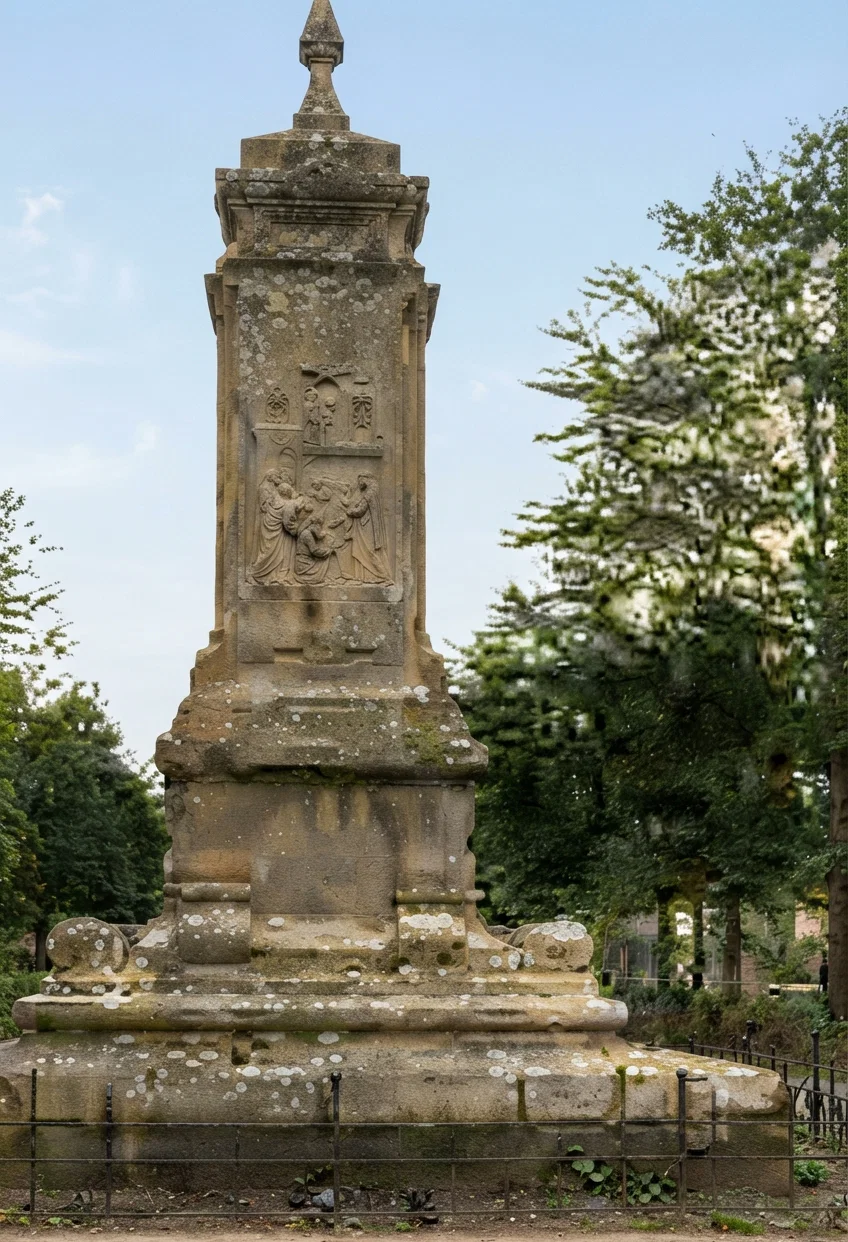
One of our workers in Belgium, Evangelist R. G. Klingbeil, sends us a photograph of a monument to William Tyndale, recently erected at the place of his martyrdom in Belgium. It will be recalled that when young Tyndale in England was rebuked by his bishop for reading the Greek New Testament, he declared that he would, by the grace of God, make it possible for the boy at the plow to become more familiar with the word of God than the bishop in his palace; and to this end he fled, an exile from England, to the continent of Europe, there to bring out edition after edition of the New Testament in the stately English which became the foundation of our common King James Version. Evangelist Klingbeil writes:
TYNDALE'S MONUMENT AT VILVORDE, BELGIUM
"The monument to William Tyndale was set up near the place of his martyrdom, in the town of Vilvorde, Belgium. William Tyndale was put to death on the sixth of October, 1536, in this little town, about five miles from the city of Brussels. The Trinitarian Bible Society of London and the Belgium Bible Society have erected this monument. There were about one thousand Protestants in attendance at the dedication of this memorial. Thousands of New Testaments were distributed in the place, and we hope for better days for Belgium, where infidel unbelief and Catholic superstition make the work so difficult. Our efforts are, however, being blessed of the Lord in Belgium, and we have at present seven churches, whose members are endeavoring to spread the light. We are now commencing our own evangelistic work in this little city of Vilvorde, and the Lord is blessing."
Near the memorial is the site of the old castle of Vilvorde, where Tyndale spent his last months, following his arrest by the Spanish authorities in Flanders, at the request of the king of England. The only letter of Tyndale's that has come to us from this period of imprisonment affords an interesting parallel to that last epistle of Paul to Timothy, written from the prison in Rome, asking him to bring the cloak that had been left at Troas, and the books, but "especially the parchments." William Tyndale wrote to the governor of the castle:
"I entreat your lordship, and that by the Lord Jesus, that if I am to remain here during the winter, you will request the procureur to be kind enough to send me from my goods which he has in his possession, a warmer cap, for I suffer extremely from cold in the head, being afflicted with a perpetual catarrh, which is considerably increased in the cell. A warmer coat also, for that which I have is very thin; also a piece of cloth to patch my leggings. My overcoat has been worn out. My shirts also are worn out. He has a woolen shirt of mine, if he will be kind enough to send it. . . I wish also his permission to have a candle in the evening, for it is wearisome to sit alone in the dark. But above all, I entreat and beseech your clemency to be urgent with the procureur that he may kindly permit me to have my Hebrew Bible, Hebrew grammar, and Hebrew dictionary, that I may spend my time with that study."
So faithful servants of God overcame by the blood of the Lamb and the word of their testimony, loving not their lives to the death; and to-day we honor their memory in the truest way by loving the blessed Word which they have passed on to us, and by following its precepts and proclaiming its message. Tyndale's last words at the stake, Foxe says, were the prayer, "Lord, open the king of England's eyes." And truly the prayer was answered when the version that still is our daily treasure, of which Tyndale's work was the foundation, was christened the King James Version, because brought out under royal direction and authority.
While the word of the King of kings and Lord of lords can receive no glory or honor from earthly kings, it is nevertheless interesting, in recalling Tyndale's last prayer, to note that in the form of service for the coronation of the kings of England occurs the passage:
"Last of all, the Holy Bible is brought from off the altar, and delivered to the king by the archbishop and bishops, with the words:
"'Our gracious king, we present you with this Book, the most valuable thing that this world affords. Here is wisdom; this is the royal law; these are the lively oracles of God.'"
The Reformation is not ended yet; and we who enter into the heritage of the open Bible left us by those who toiled and suffered in olden times, may show ourselves children of the Reformers only by following the teachings of the blessed Word for our day and generation, as they loyally followed the light that came to them.
W. A. S.