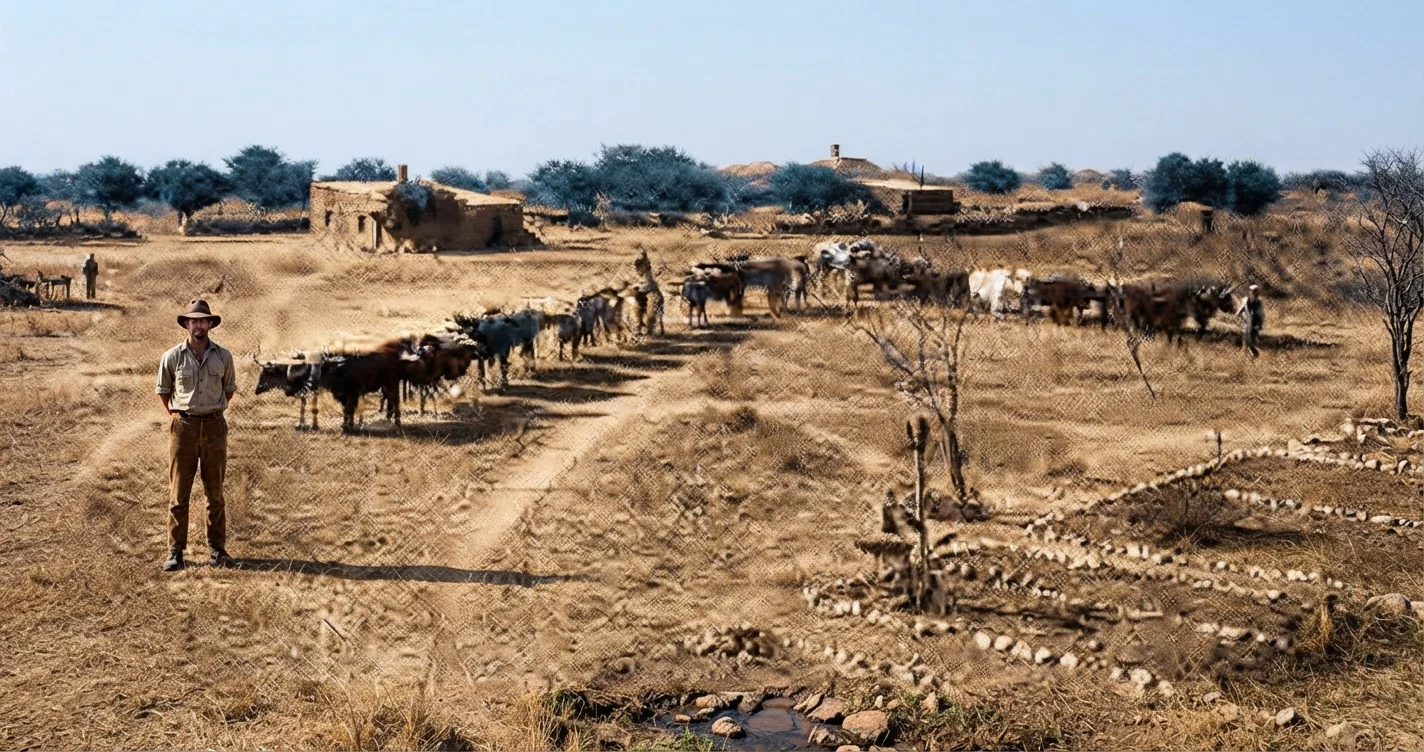
ELDER A. BOEKHOUT gives an interesting account of a recent itinerating trip which he made through the jungles of Africa, among a number of native villages, for the purpose of obtaining pupils for the Barotseland Mission school, South Africa. We condense from his article as follows:
He and one of the mission boys started the first of July, taking with them their blankets, and food for two months. They went a hundred miles by train, and then trekked in ox wagons the rest of the journey. He gives a touching account of his visit to some of the villages, and the eagerness of the people to have schools started among them. “Yes, they wanted a school very badly, but ours was too far away.” So the women began to argue. “What if their children died so far from home? Would I not come and build a school near?” As Brother Boekhout returned to the wagons, he was followed by some who were eager to go to school; but their mothers called them back, being afraid to let them go, and kept close watch that none should leave.
He encountered difficulties and discomforts all along the road. There were many lions in the forests, and he saw a number of fresh lion tracks on the trip. He sometimes went for miles without finding water, and what he found was not fit to drink. In one place he found just a little black water dripping from a stony place, but it was all they had, and being thirsty, he was glad for a sip of even this.
After traveling several days, Brother Boekhout was seized with an attack of black-water fever, and suffered considerably from the jolting of the wagon. His mission boy came up alongside of the wagon, and said: “Missionary, we are troubled. We are praying much for you.” He was carried in his blankets to a small village, by the native boys that had joined him at the different villages, and was laid down on the outskirts of the village, where they had a meeting every evening, and his mission boy preached to the villagers.
IN THE THRALDOM OF DEMONS
We quote his own words relating some incidents of the trip, as follows:
“On the march, we arrived one evening at a village off the road. After our evening meal we had hymn-singing and service. As we were all tired, we soon spread our beds. It is a rather funny experience to travel as we did. There the boys lay, some with blankets, some without any covering, but all closely huddled together around a huge fire. Yet, as I watched them, the thought came to me how the Lord Jesus watched them too, how He yearned to rescue them. O, wonderful love of God! And that we should be the channels of that love, coworkers with God—is not that wonderful too?
“We had very little rest that night. In one of the huts there was a sick woman. The chief told me how the spirit of a great induna ‘Murandu,’ who died lately, had entered that woman. In honor of the fact, many women were singing praises to that spirit, in front of the sick woman’s hut. ‘He had come down in their midst again. He would give them fruitful seasons again. O, praise him!’ Such and many more exaggerated expressions I caught as I listened. By midnight it was quiet.
“At four o’clock in the morning I awoke, and heard a shrill voice crying out: ‘Why don’t they praise me? Why are all the people lost in slumber? Go and wake them.’ Up came a man armed with a spear. He returned to that hut. And again that voice sang out those same words, but with anger this time. At this the boys awoke, and did not lie down again, but sat around the fires. Were they afraid? I could not make it out. Soon the whole village was astir, and the old singsongs of praise to that spirit started again. Does not the word of God truly say that they are taken captive by the devil at his will? 2 Tim. 2: 26.
“Passing that hut next morning, I went in to see what old hag had thus disturbed the night. To my surprise I found a young girl sitting on a mat. She was adorned with beads, and looked like a queen. Out of her eyes shone that weird light for which I can find no word, but which convinced me that the poor girl was indeed ‘captive at his will.’ I asked her what ailed her. She answered, ‘Jesu,’ that is, ‘Jesus.’ So I told her about Jesus.
CLAIMED TO GO TO HEAVEN AND RETURN AGAIN
“It is a remarkable fact that the natives call everything supernatural by the name of ‘Jesus.’ Here is another instance. I had noticed the absence of grown-up boys of say from twenty to twenty-five years; and while I was staying at Mpiri, some eight were going on the march to a place one hundred and fifty miles west. There, so they told me, a man went up into heaven and down along a wire. That man had told them all to come and bring a few mealies, Kafir-corn, and peanuts, then they would have a fruitful season. If they refused to come, surely their crops would be a failure next year. And that man they also called ‘Jesus.’ And nothing could keep them from going. I argued half an hour with twenty-five boys that had come all the way from Broken Hill, but to no purpose. Go they must. And from nearly every village on the road some had gone or were going to see this wonderful ‘Mwami Jesu,’ that is, ‘the Lord Jesus.’ This story afforded me an excellent opportunity to speak freely about the true Lord Jesus and His coming. Let us pray that some have not been forgetful hearers.
“More boys joined us, even from that village of the sick woman, bringing our number up to twenty. Next we had to pass a stretch of eighteen miles without water. We walked it in one afternoon, arriving after sunset at the village of Kabwenga. Hardly had I sent the boys off to fetch wood and water, when the chief came. Old Kabwenga sat down, clapped his hands, and offered a big basketful of meal. He had heard that the missionary was coming, and ordered his women to grind meal that day. He was so pleased that we had come to visit him too! O, how well the Lord cares! Our supply of meal was just exhausted, and there were twenty hungry mouths to be fed. But here was the provision. Praise Him! Supper finished, we had a grand service; for many, many came, and the songs were good, and our hearts were glad.
“The old induna was very obliging, and brought something every day—peanuts, sweet potatoes, pumpkins, etc. They wanted a school very badly there.
HEATHEN EAGER TO LEARN
“At Makusa’s the induna besought me to stop. He would build me a house and a schoolhouse, help me with the gardens—in one word, do everything to please us—if we would only build a school there. I had not seen such eagerness before. But we had to go on. Three of the chief’s sons joined us, with full consent of their father. From another village a family entrusted three sons to me, but O, the pitiful tears that ran over that mother’s cheeks when we left!”
Brother Boekhout taught the boys a number of gospel hymns, and in his services they assisted him with their songs, and people came from other villages around to hear them sing.
On the evening of their arrival at Lusaka, where they took the train for the mission, the boys sang hymns, and the white people gathered from all around to listen, and they would not believe that the boys who sang without hymn-books were a fortnight ago “raw” in the villages.
They arrived at the mission on August 13, all in good health, and with hearts filled with gratitude and praise to God, who so marvelously cares for us all.
We who live in lands surrounded with all the blessings of Christian civilization can scarcely realize what a “trekking” expedition of this sort involves, nor what hardships and sacrifices the participants are obliged to endure; but we can give substantial aid in procuring for the natives not only temporal but eternal benefits, in extending the light of the gospel to their darkened but receptive hearts.