SPEAKING of the condition of the Papacy at the close of the fifteenth century, a writer of that period says: 'Certainly the wars fought to maintain the temporal power of the popes have cost more lives than all the present inhabitants of Italy. And the wars will not cease as long as the pontiffs hold the temporal dominion. And if any one maintains that the pontiffs are compelled to make war to defend themselves, we would say that they certainly ought to make war if there is no other way out of the difficulty. But very few have been the wars waged on the pontiffs; for almost all the wars fought in times past have been waged or instigated by the pontiffs with or without reason.'
Times of Alexander VI.
If, then, we open a page of history of the sixteenth century, we find corruption continued. For, as the historian says: 'With a renewal of studies and the awakening of new forces of civilization, the times began to change for the better; but the popes remained always more or less immoral, covering themselves with the vices of the times, which are almost always inseparable from men of power. And as their rule accorded them an exceptional power, either because they had a double office, or because they were princes elected, they contaminated themselves with exceptional vices which were possible only to themselves.' 'Nephewism' expresses the desire on their part to raise their relatives to the dignity of princes and sovereigns, and to enrich them in a fabulous way. This was always a source of scandalous dissipation of the public money of the church, and a fountain of corruption and rascality which has rendered abominable the names of Borgia, Farnese, Medici, Borghese, Pamphili, Barberini, and other papal families.'
Of this epoch it is but necessary to recall the names of Alexander VI. and his wicked and nefarious son and daughter, Cæsar and Lucrezia Borgia (for this pope had five recognized children), to form an idea of the depravity of this period. The corpse of Alexander VI., who died from the effects of taking a dose of poison that he had prepared for one of his cardinals, was taken out of St. Peter's and buried in another church, as he was considered unworthy to be associated with the other popes in his death. Speaking of the event, a great writer has well said: 'All Rome ran with indescribable gladness to visit the corpse. Men could not satiate their eyes with feeding on the carcass of the serpent, who, by his unbounded ambition and pestiferous perfidy, by every demonstration of horrible cruelty, monstrous lust, and unheard-of avarice, selling without distinction things sacred and profane, had filled the world with venom.'
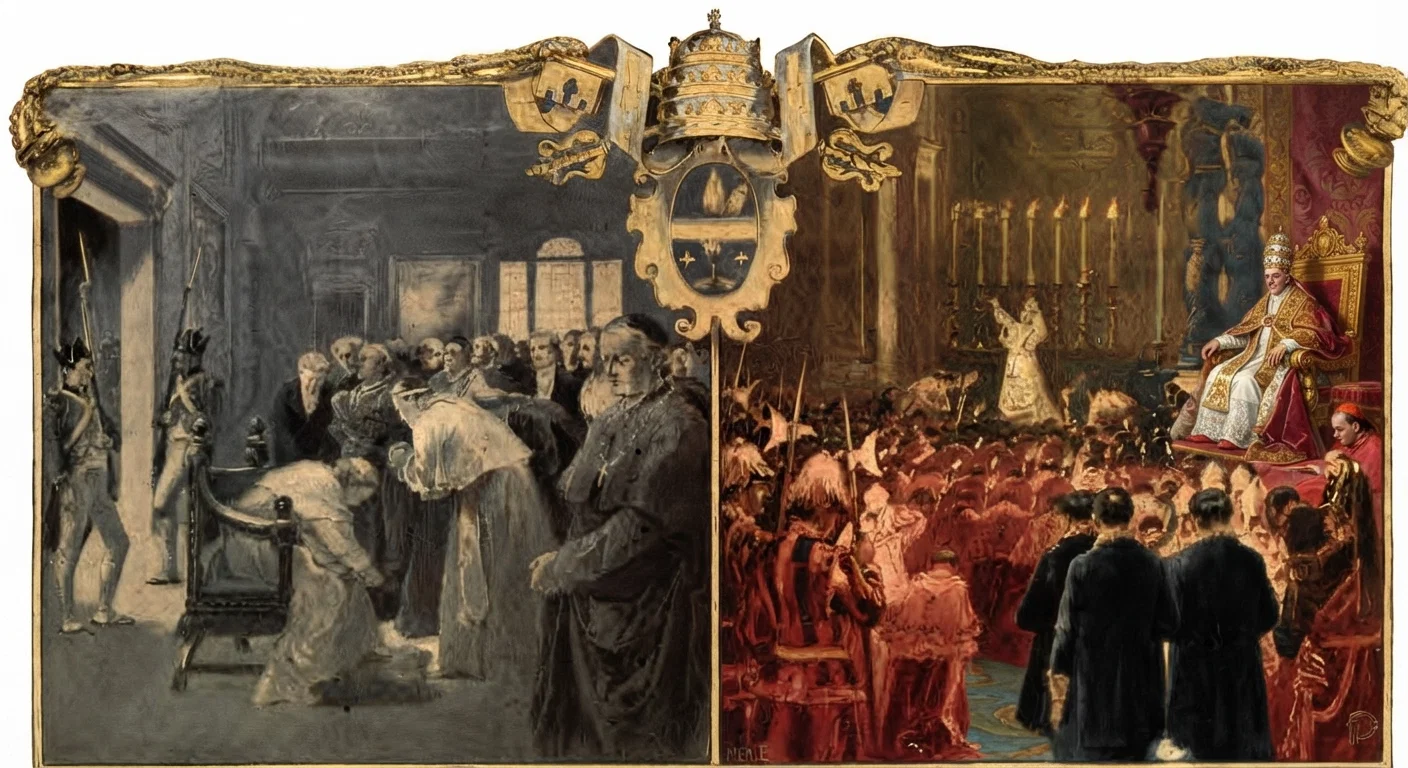
Our twofold picture is a fair representation of the Papacy at two different phases of its history; the one at the left, 1798, when the pope was taken captive, and died in captivity. Little honor was then paid the Papacy by the powers of Europe. The picture at the right represents the Papacy as it is at the present time with the world bowing before it. Soon we shall see fulfilled Rev. 18:7: "I sit a queen, and am no widow, and shall see no sorrow."
Coronation of Clement XIV.
Of the pomp and luxury of the papal court of the last part of the eighteenth century, we have a good description given by a prelate of the church who lived at that time. We shall take but a few extracts of his splendid description of the coronation of Clement XIV.:
The sounding of trumpets, the beating of drums, the ringing of bells, the booming of cannon, triumphal arches, flaming banners waving from hundreds of towers, flags floating from the forts, the houses richly draped with elegant tapestries, golden powder strewed along the streets, the people gathered in great crowds, and a confusion of plausible voices that announced that something extraordinary was to take place in the Eternal City. It was the coronation of an obscure monk who, under the name of Clement XIV., ascended the papal throne. From the palace of the Quirinal to the Lateran church the pope was to ride on horseback. The procession was headed by horsemen with long lances from which floated silk banners of red and blue, while the silvery plumes of their helmets sparkled in the sun. They were dressed in red costumes adorned with crimson, fringed with gold. After them followed four horsemen clad in brilliant armor trimmed in gold; then came the relatives of the cardinals richly dressed, and the artisans of their palaces and their secretaries clothed in velvet and gold. After these came the nobility of Rome, surrounded by a large group of attendants in grand livery. Next followed the private attendants of the pope, carrying the pontifical miters, in crimson velvet, closely followed by a part of the Swiss guard, clad in armor and with shields and lances. Then came the prelates mounted on black mules, richly equipped. Following them came attendants of the pope wrapped in their sumptuous robes and riding upon mules with purple equipage. Then came the ambassador and senator, dressed in black, with togue of velvet, and surrounding them were their courts.
Prince Don Lorenzo Colonna, of the kingdom of Naples, followed mounted upon his noble Spanish steed, and he fairly sparkled on account of his highly-burnished arms and the many jewels that adorned his person. His proud horse stepped lightly upon the golden sand strewn along the line of march. After him came the masters of ceremony mounted upon mules, with pontifical equipage and a prelate carrying the papal cross, at the sight of which the people became greatly agitated. For in the midst of a group of footmen dressed in red, and the Swiss guard clad in shining armour, came the pope mounted upon a white pacer, covered with a caparison of crimson velvet embroidered in gold. He was dressed in a white robe with surplice and mantle of red velvet adorned with emerald, over which was a stole of gold garnished with large pearls, and on his head he wore the miter. The pope was followed by twenty-four pages, who wore10red silk stockings, while the white plumes of their caps touched the shoulders of the youth who belonged to the best families of Rome. On each side of the pope rode his private secretaries, while the Gestatorial throne followed, borne by nobles. Then came the cardinals, two by two mounted upon mules equipped in red, ornamented in gold, with two footmen before and following, carrying their stems and ensigns. Then followed the officers of state,—the patriarchs, archbishops, and bishops with their attendants. After the pontifical cortege came the elegant carriage of the pope, covered with red velvet and adorned with gold figures, and lined within with brocade silk, drawn by six large Phrygian horses, covered with red velvet trimmed with tinsel and fringe of gold and embroidered within and without. After another group of princes in medieval costumes of great pomp, came forty-eight carriages containing other nobility clad in the richest vestures. And the procession closed with the papal infantry and the Swiss guard clad in shining armor.
For lack of space I have abbreviated very much the above description, but enough has been said to show something of the luxury and pomp of the papal court of that period. And yet this epoch will not compare with some of the preceding for extravagant pomp and display.
Just Previous to the Fall of the Temporal Power.
Let us now take a look at the last part of the papal history just before the fall of the temporal power. Of the papal government of that time, Cardinal Pacca says that the pope allowed himself to be dominated by his favorites. The French writer De Montalembert says: 'The abuse of the Papacy is the very existence of the Papacy itself. The antagonism of the people is not artificial, but is true and just. The government is intolerable. The people are discontented, oppressed, agitated, and it is not longer possible for the papal government to maintain itself except with the arms of foreign powers, because the Papacy is without power, moral or material.'
Monsignor Liverini, a Roman prelate, writing in 1861 of the feeling of the people ruled by the Papacy, says: 'If the army of France were withdrawn without putting in its place a strong force that assured the life of the clergy, in one week all the priests and monks would be exterminated, so fierce and savage is the public indignation against the papal government in these years.' And again he says: 'If the papal states should need to be administered as they were for fifteen years under Cardinal Antonelli (secretary of state under Pius IX.), it would be much better for the people subject to the Holy See, and the pope himself, if he had lost these states in the revolution of 1849. Or rather it would be better that he had never possessed them. For this reason from one end of Italy to the other they cry, 'Death to the priest.''
The historian Macchiavelli, says: 'The ecclesiastical states were acquired either by virtue or fortune, but without either they are maintained; for the cardinals are the only princes that have states and do not defend them; have subjects, and do not govern them.'
The Marchus of Pimodan, who fought for the papal cause, says: 'I am glad to place my all for the aid of the cause of the Holy See; only once in a while a doubt torments my mind, that we have come here to confirm abuses that we would not tolerate in our own home,' that is, in France.
And of the morality of Rome at that time we are told that the city was full of harlots that paid a regular revenue into the papal treasury in order to receive permission to carry on their life of sin. Drunkenness was very common both in priest and people; and, in short, we might say that the papal government was rotten and corrupt to the core; the people themselves were sick of papal rule, and hailed with great acclamations of joy the entrance of the Italian troops into 'the Eternal City' in 1870 to relieve them from a government that under the cloak of religion maintained a rule of abuses and corruption.