SANTA ROSA'S SAD STORY

5%

Pacific Press Publishing Company · Mountain View, Cal. · May 23, 1906

FromSigns of the Times, Vol. 32, No. 20.

Read the full edition

SANTA ROSA'S SAD STORY.

THE city of Santa Rosa, county seat of Sonoma County, Cal., with a population of 10,000, has a thrilling earthquake story which we barely noted in our first edition. In some respects this place fared worse than San Francisco in proportion to size. This is especially true of its death-roll, which a week after the disaster was officially reported as fifty-six. This is on the authority of Mr. Geo. E. Peery, who reported the names of the dead, injured, and missing to the Oakland Herald. The injured and missing numbered eighty-seven. The death-roll is much larger in proportion to the population than that of the Bay City.
From Mr. Peery's general report we take the following extract:
The appalling immensity of San Francisco's catastrophe obscured Santa Rosa's sorrow from the world's attention. Tho less in extent, it was greater in degree than that of the metropolis. The loss of life was proportionately greater, and the business part of town was absolutely annihilated. Santa Rosa differed from most towns of similar size in being more compactly built. All its business houses were closely grouped about the center, where stood the county courthouse. So, when this group of business blocks was tumbled into blazing ruin, there were no suburban stores to supply the pressing needs of the moment.
There was neither bread nor meat for the living; there were no coffins for the dead. The breaking off of communication left the world in ignorance of Santa Rosa's destruction; and beyond mere surmises, this city's first intimation of San Francisco's disaster was the arrival of a train load of nearly a thousand refugees, wounded, sick, half-clad and half-starved, seeking shelter where there were no houses, and begging help that none could give. Before Santa Rosa had begun to put water upon her own fires, or to drag her own dead and wounded from the ruins, she was called upon to help San Francisco.
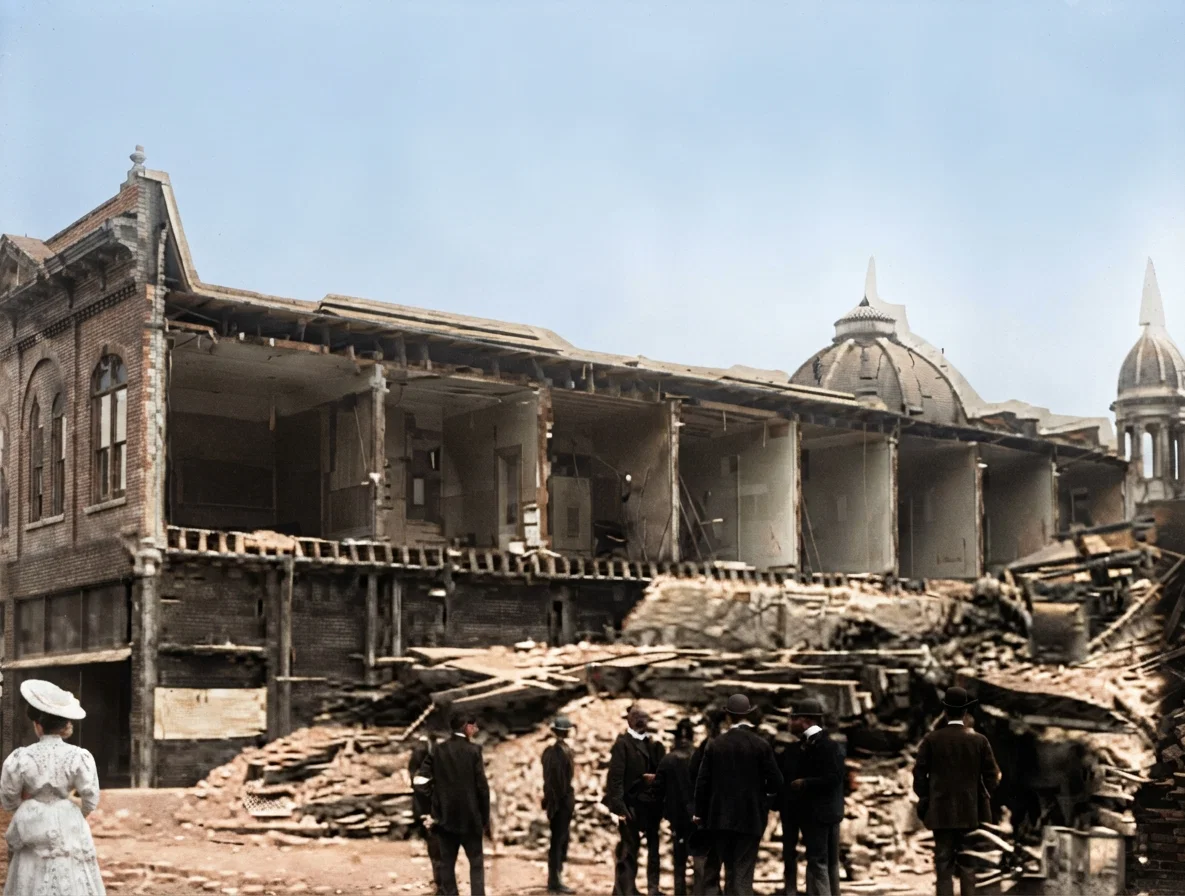
Hobson's Store—a complete wreck, under which three persons were buried. Two of these were rescued alive.
San Francisco's call for aid was heard far and wide, and spendthrift hands responded, but Santa Rosa's moaning reached only her own ears at firstand the suffering was intensified as it lengthened.
The earthquake shock buried firemen, horses, and engines under their own walls and roofs. Frantic efforts freed them, and valiantly they served. There were two steamers in Santa Rosa, and Sebastopol sent a third—Sabastopol, which had so often called upon her neighbor for help, was at last able to pay the debt she owed.
The water system was unimpaired, and the supply sufficient, and within three hours the three engines had twenty scattered fires under control. Just how many lives those three hours cost can not be told.
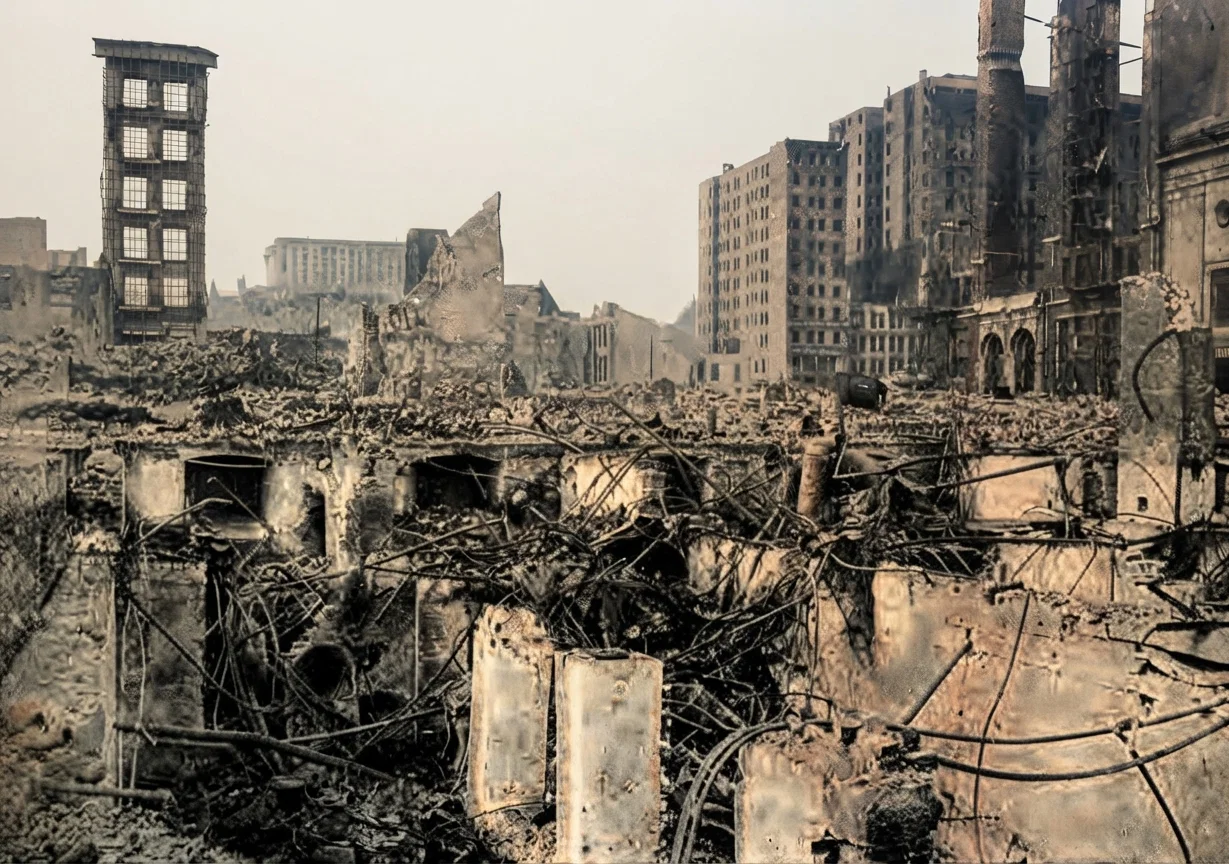
A typical wreck and tangle to be seen in the manufacturing districts of San Francisco.
Many of the corpses found in the ruins had been crushed when the buildings fell; but many others had been living survivors of the earthquake until the fire reached them.
Harry Newman was one of these tortured victims. He slept in a gallery over his drug store in the Doyle & Overton building. The crash penned him in, unhurt, but unable to escape. The chemicals in his stock ignited, and the flames encompassed him, stilled his cries for help, and drove back those who with desperate and frantic efforts tried to set him free. The hideous remembrance of the awful torture that ended his life will never be forgotten by those who witnessed it, and who knew the man and loved him.
In the office of the Press-Democrat newspaper, four lives were lost. The night's work was finished for compositors and for members of the staff. These had gone home. There were left in the office the pressman and three carriers. The night foreman and the circulating manager were leaving the building.
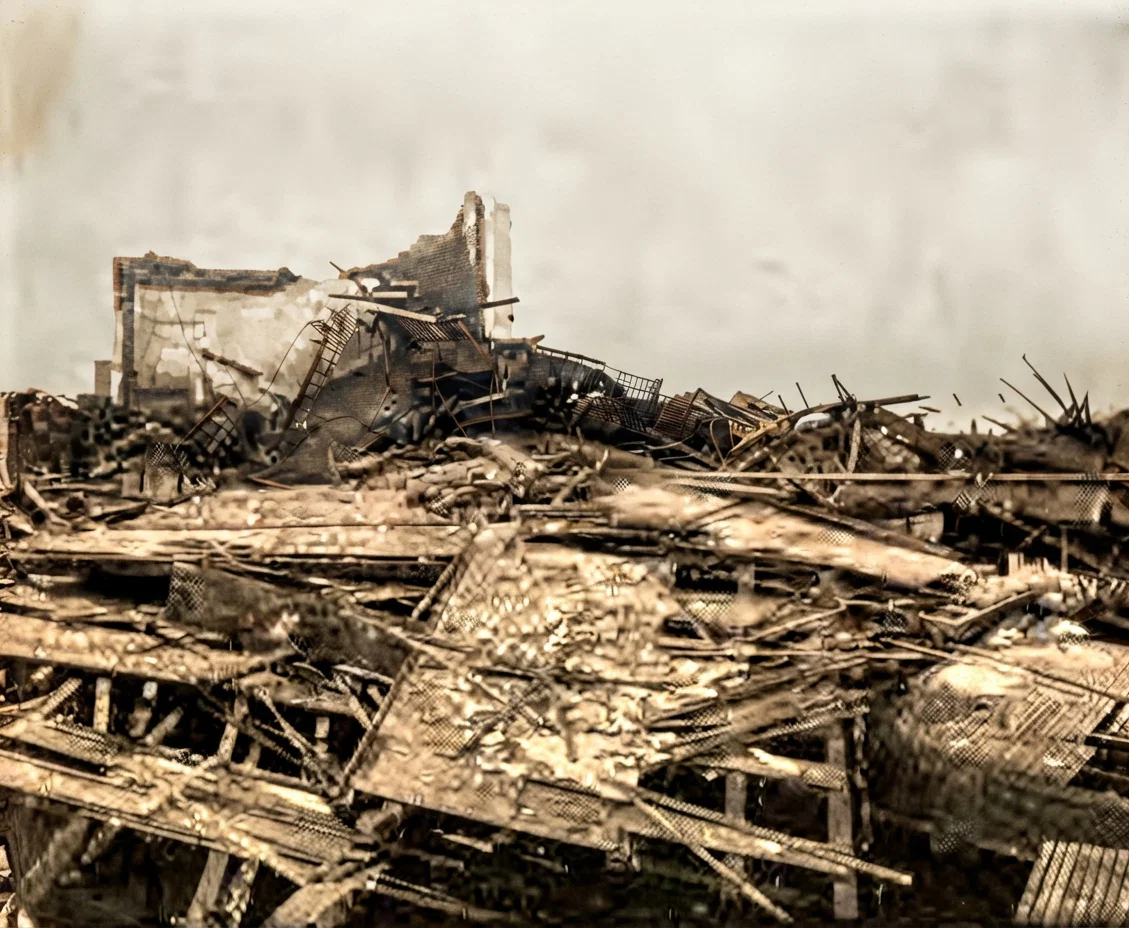
Wreck of Occidental Hotel, Santa Rosa.
While they were still under the steel lintel of the pressroom door, the structure thundered down, covering them with black-and-blue bruises, but sparing their lives. Five or six of the carriers were already upon the streets. All of these escaped but one. He was caught under the outward-falling front of the telephone building as he pushed a paper under the door.
Milo Fish was a printer and pressman who had quit the trade after years of service, and had bought a restaurant. Just for one night—the fatal night—he went back to run just one edition, and give his successor a night off. Three carriers—George Bluth, Willie Bluth, and Chester Shepard—were still in the pressroom waiting for their papers. These, with the pressman, were crushed to a pulp when the three-story building slid backward with its thousand-ton weight upon the one-story press room.
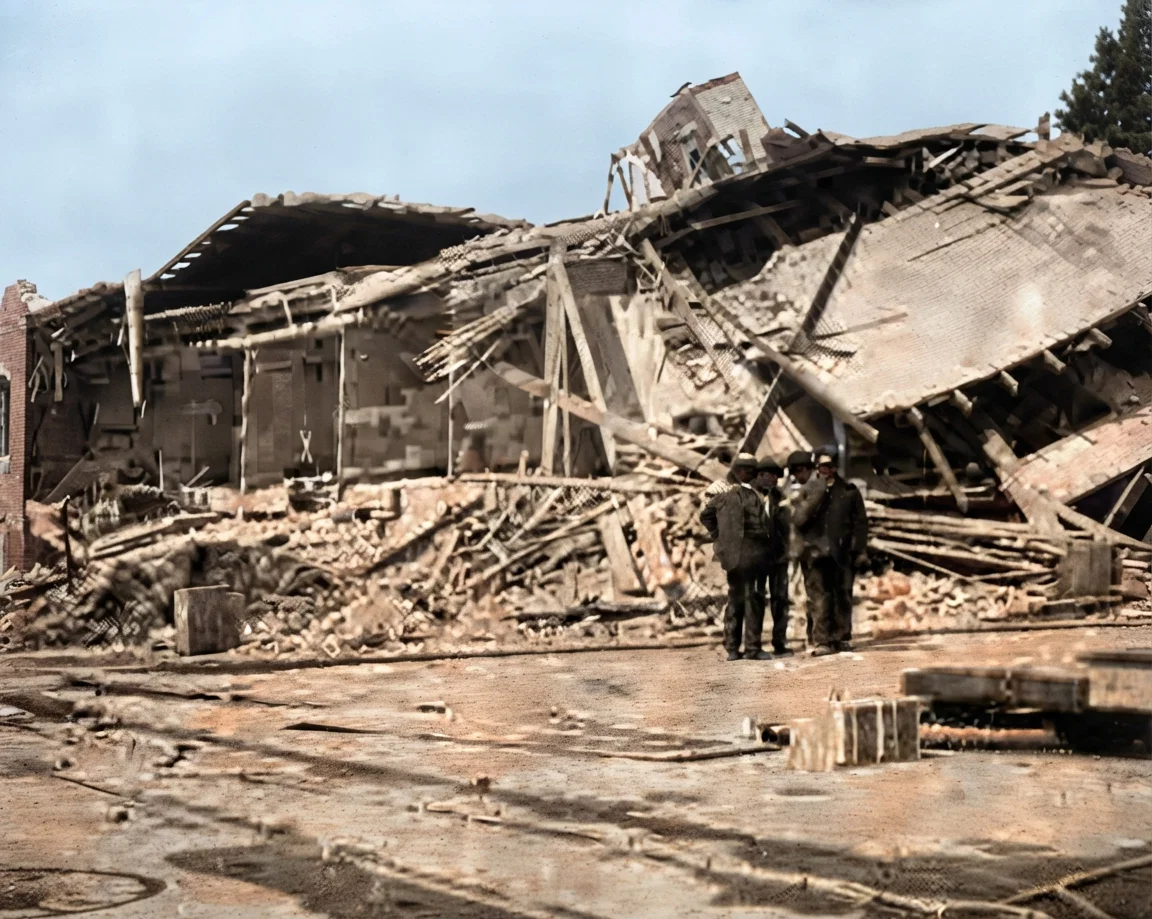
St. Rose Hotel, Santa Rosa. Fine modern building, third story on the ground.
The Hotel St. Rose was a new building, four stories high, and believed to be of modern, scientific construction. It crumpled as a pasteboard box, imprisoning some of the hundred guests within its walls, and sliding others outward into the street unhurt. It required hours to free some of those shut in. Dr. Light, a Butte County physician, lay for nine hours with a beam across his hips. The fire drew near and was quenched, while he was nearly drowned in the floods the engines poured upon him. Finally he was freed, and afterward read his own obituary. He had been a guest at the Metropolitan Hotel in San Francisco, and had left unexpectedly without giving notice. He was published in the list of those who perished in the Metropolitan.
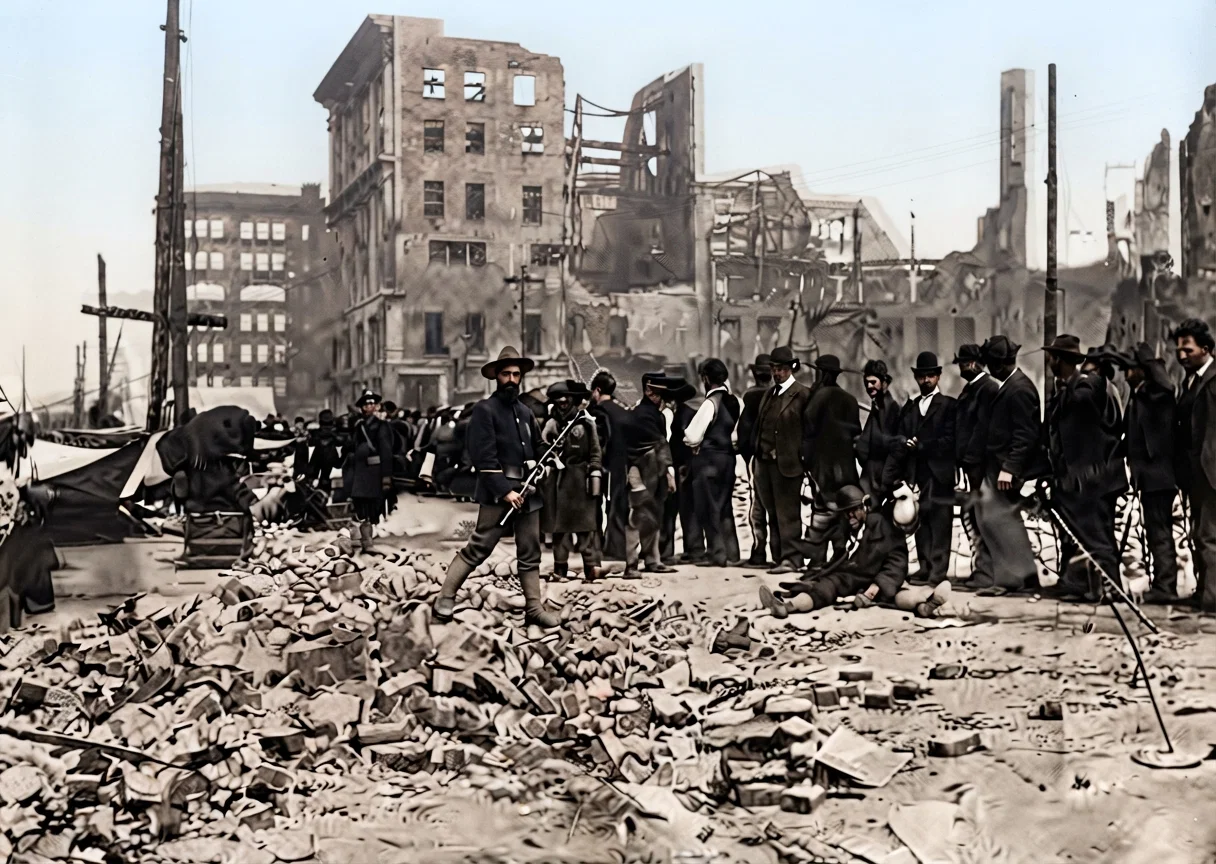
A view in San Francisco showing the reign of martial law and the needs of the survivors of the awful calamity. The men with muskets are soldiers standing guard over a typical bread line, men in rank receiving bread as it is dispensed at one of the many temporary commissary departments. Such ruins as these may be seen everywhere in the burnt district.
The courthouse lies a mighty heap of ruin, its massive dome sank nearly out of sight, with its summit resting against the eastern wall, which bulges with the weight. The new Masonic Temple, in which the mortar on the topmost course of yellow stone was scarcely dry, now lies as tho battered by a month's bombardment. One block east is a heap of blue basalt, that a week ago was the public library. The earthquake's vibrant swing flung blocks of stone that weighed a quarter of a ton apiece, across the street.
Five banks with deposits aggregating nearly nine million dollars, were in the earthquake's path. Now, five naked steel vaults, loom among a chaos of shattered walls, guarded by sentinels with rifles. Three brick hotels, three and four stories high, one hotel of stone, and two that were built of wood, are all laid low by earthquake shock and fire. The big brewery, five stories high, the shoe factory, a three-story building only a year old, a four-story brick
flour mill, two theaters, five public halls, the Odd Fellows' Temple, and a score of office buildings, retail stores, and flats and lodgings—all are gone, and nothing left but rubbish.