TOUCHED by the sad plight of their sister city, San Francisco, the Bay cities came nobly to her assistance. Oakland, Berkeley, Alameda, and other sister cities less afflicted, vied with each other in their warm-hearted efforts to extend shelter, treatment, food, and comfort to the refugees from San Francisco. Owing to their close proximity, it was but natural that
These Cities
should lead in this noble work. Tho badly shaken up, Oakland escaped with the loss of only seven lives. Her large public buildings were greatly damaged. Having escaped the scourge of fire, the people across the Bay immediately forgot their own woes in the effort to relieve the awful distress. Homes, churches, hospitals, public halls, and the parks, were thrown open to the refugees; and rich and poor strove with each other to excel in deeds of kindness. Storekeepers stripped their shelves and gave their goods away; householders emptied their wardrobes and pantries to relieve distress. Every citizen seemed to belong to the Relief Committee. Every house of worship not condemned as unsafe was turned into a hospital, restaurant, and lodging-house. The popular churches threw aside their thumb-worn creeds, and forgot their large profession and their little deeds, in their zeal to minister to afflicted humanity the milk of human kindness. All-told, these cities cared for about 50,000 refugees.
Further Particulars.
All of the great San Francisco newspaper plants having been wiped out of existence by the great temblor and the flames, the Call, Chronicle, Examiner, and Bulletin, were obliged to remove their headquarters to Oakland. The publishers immediately had their papers printed at the offices of the Oakland Tribune and Herald. Thursday morning, April 19, in fact, the three leading dailies of San Francisco printed a combination, four-page paper, entitled The Call Chronicle Examiner.
A Hopeful Spirit
seems to pervade the atmosphere. The newspapers breathe a spirit of buoyancy and good cheer, and seem to hurl proud defiance even at the elements, boasting of their tall sky-scrapers as “great, scarred giants that withstood the shock of earthquake and the destructive flames.”
So Many People Are Blind
to the meaning of these catastrophes. They refuse to accept them as warning from the Almighty to get ready for the great consummation of all things earthly. I was standing with a physician on Washington Street, Oakland, when another prominent physician stepped up to talk the situation over with us. My friend and I remarked that this great disaster was but an introduction to other worse ones that are to precede the second coming of Christ. The newcomer sneered and said: “I don’t think God had anything to do with this earthquake! If I thought He did, I would have no respect for such a God.” We answered: “No doubt, my friend, many people in Noah’s day said they had no respect for a God who would bring a great Flood upon the earth.” “I don’t believe there ever was a Flood,” rejoined the physician. This is but one of many like remarks that I heard during these days following the earthquake. So many are determined to ridicule and scoff at the Bible and all that it predicts concerning the last days. On the other hand,
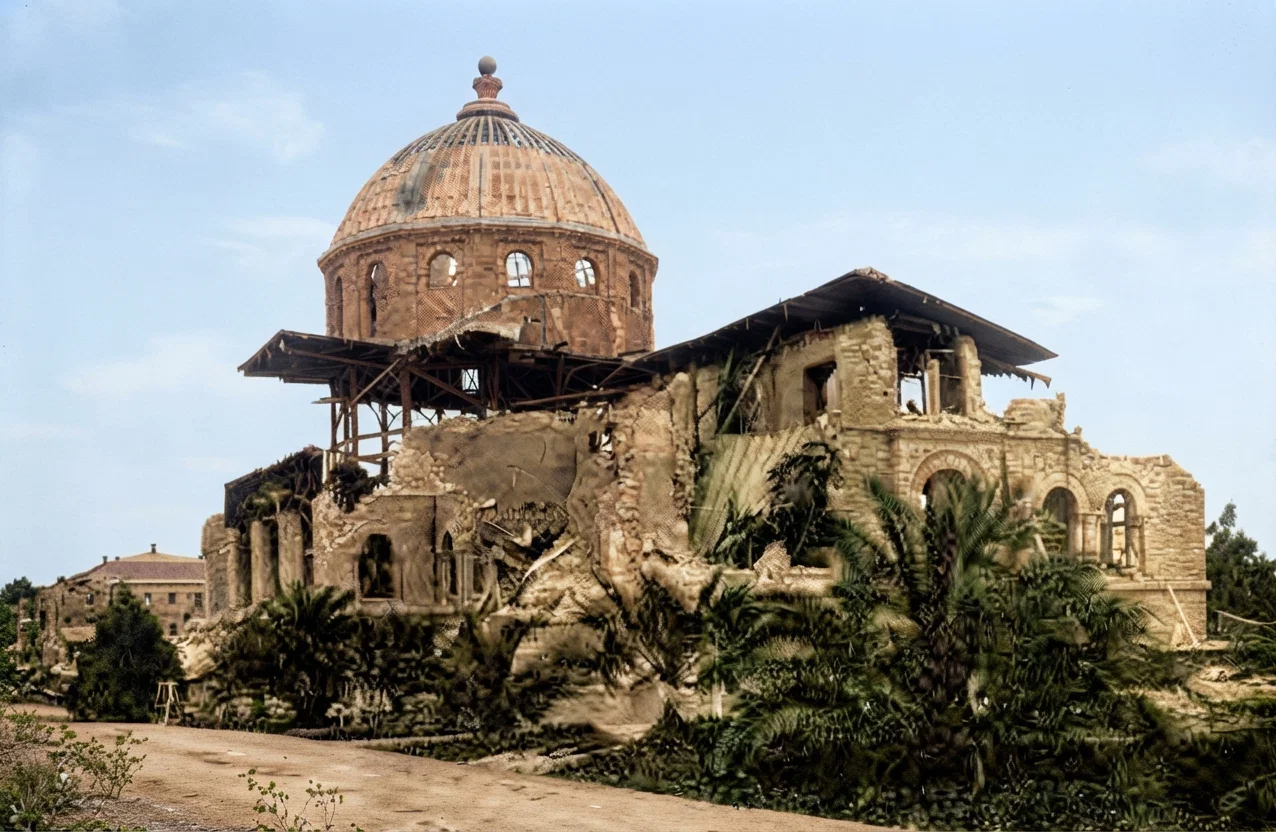
The wreck of the new Library Building at Stanford University, Palo Alto, Cal.
Many Interpret Aright
the catastrophe of Wednesday, April 18, 1906. Scores have said, within my hearing: “God wants to remind us that He is running things.” “I thought surely the end of the world was upon us!” “God made the country; man made the cities.” “This made us remember our God.” “We all began to pray to our forgotten God.” And other like expressions.
Governor Pardee, whose headquarters are in Oakland, issues, from day to day, a proclamation making every day a legal holiday, thus closing all banks in the state until the great San Francisco banks can be opened.
Martial Law.
The cities about the Bay have now become great military camps. Every attempt to enter a public building without the proper pass from the police or military authorities, is promptly met by a soldier presenting the flat of his gun to your chest. Bayonets are fixed. All guns are loaded with ball cartridges. All instructions are to shoot to kill. Every one in San Francisco is at liberty to leave the city, but no one from the other cities about the Bay is allowed to enter the ruined city without a military pass from the governor of the state. Each morning a line of about 2,000 men and women may be seen slowly winding in and out of the City Hall in Oakland, all waiting for a permit to go to the burned metropolis. A curious crowd they are—mothers anxious to return to find their children or husbands, eastern relatives searching for dear ones that lived in the burned district, laborers looking for work, etc. Many are refused the passes.
The Oakland Chamber of Commerce, 12th and Franklin Streets, Oakland, was like a swarming bee-hive from morning till night. Throngs of refugees registered there and found at the hands of willing volunteer clerks vital information regarding their loved ones. Many, however, turned away with sad, tearful faces, not having heard any news, good or bad. By recommendation of the Relief Committee, any destitute person was secured free transportation to any part of the state, and often to remote parts of the United States, all of the great railways being generous to the extreme. The railway officials collected no fares from refugees on all out-bound trains from San Francisco, on either side of the bay. One paid if one chose—otherwise it was all right. The great ferry systems did likewise on the bay.12
Our Denominational Property in Oakland including the large church on 12th and Brush, the former buildings of the Pacific Press Publishing Company, and the headquarters of the Pacific Union Conference, at 1059 Castro Street, all escaped without any damage to speak of. All of these were frame buildings.
Each day the newspapers are filled with long lists of names and addresses of the dead, of relatives missing and found, and other desired information—page after page, each page containing nearly 1,000 names and addresses, etc. Nailed on the walls of each church or public building are to be found alphabetical lists of the refugees housed within.
Oakland's Probable Gain in Population.
Not counting the thousands who will return to San Francisco to help rebuild the ruined city, many other thousands will, without doubt, make Oakland their future home. The fact that it escaped most of the evils of the great disaster, together with its proximity to San Francisco for business purposes, will aid materially in building up Oakland, Berkeley, Piedmont, and Alameda. But, who can say where the next earthquake will be? There is safety only in Him who is our Rock.
A. J. S. BOURDEAU.