OUR home town is fortunate in having but few brick houses. Of these few, four are in heaps of ruins, and the others are seriously damaged. One two-story structure, tho not demolished, was so damaged as to be immediately abandoned. An adjacent building was also abandoned.
One building with a general merchandise store and the post-office on the first floor, and a lodging-house upstairs, was thrown into a miscellaneous heap. Some of the lodgers were injured, but none fatally.
Another building, containing two stores below and a large hall above, was mostly tumbled into the street. A large two-story furniture establishment fell flat to the earth. A large fruit-drying and packing house was also totally wrecked.
Two two-story frame buildings were ruined, and many others more or less damaged. Broken windows, dishes, or furniture were the order common to all houses. Many windmills and water tanks were thrown down, and fallen chimneys are to be seen anywhere, as also broken plaster in plastered houses.
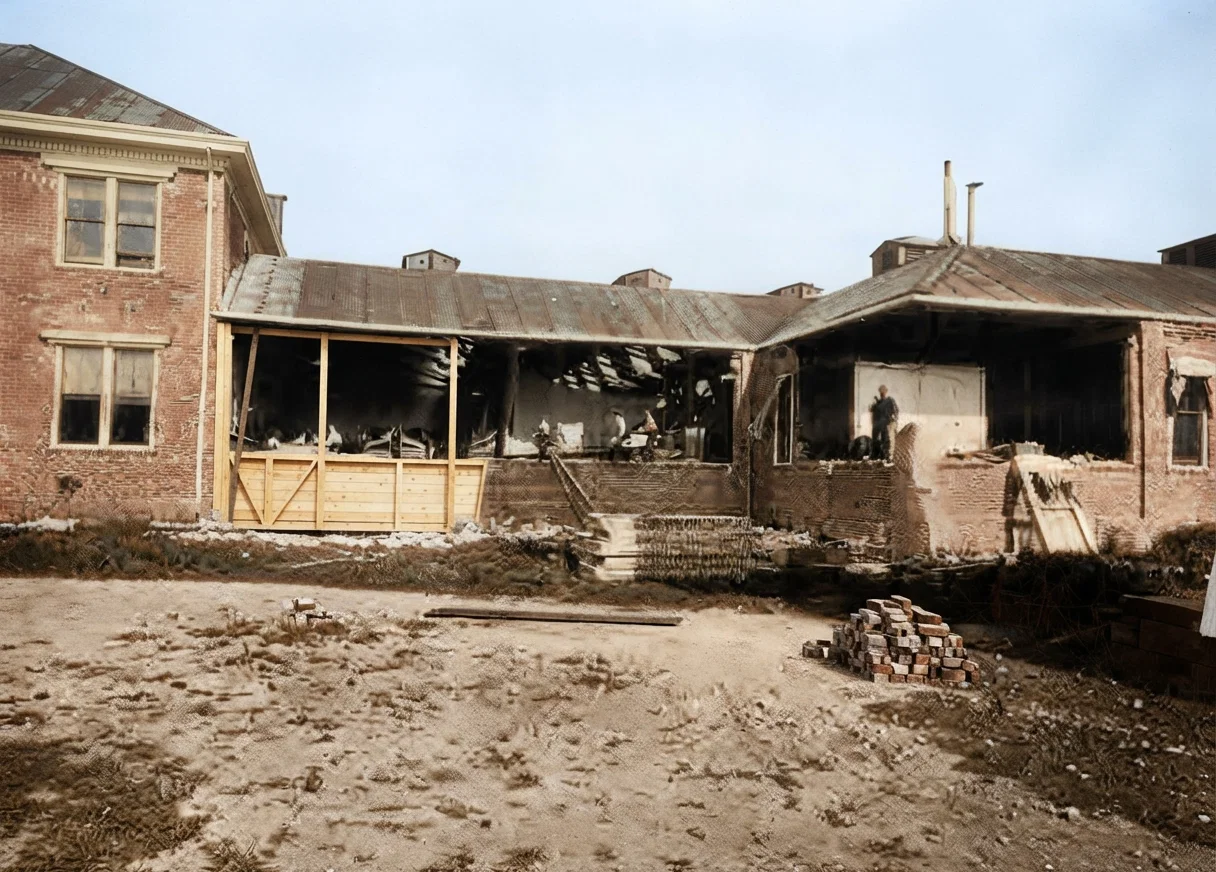
East wall of the Pacific Press Building, looking into the type room and foundry. The front wall is the only part of the outside of the structure saved.
The two large tanks of the town water-works—100 feet high, and containing 70,000 gallons—fell to the ground. However, the pumping apparatus was not injured, and water for the town is pumped directly into the mains.
The financial damage, estimating all losses, will reach approximately $175,000, to say nothing of loss of business for a time. There was no loss of life, altho a dozen persons were more or less injured.
Our own building, the Pacific Press Publishing Company's plant, was terribly shaken. The east and west end walls were, in the main, thrown to the ground; and so badly wrenched were the remaining portions of these two ends that they had to be torn down and replaced with wood frame. The back wall on the side next to the railroad is also being replaced with wood. This is a one-story wall, 175 feet in length. The front two-story wall will be saved by reinforcing it on the inside with independent frame floor support.
Fortunately the roof was not injured, and enough sound wall was left to support it until the frame could be built under it. The foundation was also uninjured, so the frame was rapidly adjusted by a large force of carpenters.
With the exception of our two linotype machines and a small quantity of type, our working material is practically uninjured. These machines will be out of use for some time, as there is no place on the Coast where they can be repaired at present. They were broken by a portion of the brick wall falling in upon them, and they are damaged to the extent of several hundred dollars. Operators had been working all night, and had left their posts but half an hour before the crash came. Aside from these machines, work could proceed in all departments after clearing away the debris. Of course this was aside from the possible danger of succeeding shocks, which might complete the wreck; and this led to some timidity as to continuing work.
Had we been in some incorporated city, the authorities would not have allowed us to go to work on the inside at all; but as it was, working or not working was voluntary only as individuals felt impressed to service because of the urgent need. The response was quite general, and the clearing out was done in short order. As light temblors were felt during Thursday, the workers would lose little time in getting outside, but most of them would return as soon as it appeared that the shocks were past. Quite naturally, tho, some preferred to sit at a supposedly safe distance and watch for further results, and perhaps they were the wiser ones. Some had work that could be done at a little distance from the shattered structure.
As the editors sought their offices they were confronted by a distressing sight. In one room large book-cases and their contents were piled in the middle of the floor. The books were mingled with broken plaster, broken glass, and splintered wood. In another room a glass-front book-case lay face downward across the desk and chairs of the proof-readers. The result can be imagined. In the hall, in front of our doors, lay an immense pile of miscellaneous engravings. The cabinets of drawers containing hundreds of these had fallen forward from the wall, and lay in a miscellaneous heap.
In the reading-room and in an adjoining room, that had been occupied by a children's division of the Sabbath-school, the "baby organ" and other furniture, including a steam radiator lay on the floor. The chapel-room, also used by the Mountain View church, which is in the second story, was entirely open at one end, the wall being upon the ground.
In the manager's room, counting-room, and job proof-reading room, there was extensive fall of plaster, and some overturning of furniture. In the Book Department one entire side was laid open, besides the falling of plaster. The same was the experience of the bindery, the composing room, and the foundry. The power house was left in running order, altho the brick walls were cracked and otherwise injured. About half of the brick smokestack came down in two pieces, one piece upon the roof, breaking it in, and the other breaking in the frame carpenter shop close by.
The main tank house, which is of frame, is uninjured. Another high tank tower, about sixty rods distant, also the property of the Press, is thrown out of plumb, and will have to be strongly anchored, or perhaps taken down. It cost over $2,000. Had it been as thoroughly braced as the other tank tower by the office, it would have stood as well.
Our new two-story boarding-house, frame and plaster, suffered no damage to speak of. It stands within a hundred feet of the brick publishing house. This emphasizes the impracticability of brick buildings where there is liability to earthquakes,—and that is everywhere in these last days. The wise will note this fact, and act accordingly.
As to loss, that is to some extent a matter of conjecture. It is variously estimated according to the standpoint of the estimator. We hope to make all repairs come within $15,000; but the loss of business is another item to be considered. Our commercial work comes largely from San Francisco, and all manner of business is at a standstill there—for how long no one knows. Old customers are ruined for the present, if not permanently. Accounts for work done, and pay for jobs partially done, are matters of uncertainty. Losses in the way of business in the near future will equal, if not double, the property loss. These losses time alone will determine.
But, praise the Lord, "we are all here," and all alive, and, we hope, have profited by the experience. The church held Sabbath service in a nearby grove, and Brother J. O. Corliss preached a ringing discourse on the general theme of what these things mean. It was a real "message" sermon, and it surely did the believers good in the way of encouragement and reassurance in the way. "O that men would praise the Lord for His goodness, and for His wonderful works to the children of men!" Ps. 107:8, 15, 21, 31.