The ROYAL LAW

5%

Pacific Press Publishing Company · Mountain View, California · May 9, 1906

FromSigns of the Times, Vol. 32, No. 19.

Read the full edition

The ROYAL LAW

BY F. C. GILBERT. (A Hebrew Christian.)
Mount Sinai
Mount Sinai

II. THE LAW GIVEN TO ADAM AND HIS POSTERITY.

THE prayer of David needs oft to be repeated at the present time: "Uncover mine eyes and I shall see attentively wonders out of Thy law." Ps. 119:18. There is much in God's law at the present time that needs to be seen; and there is much in that law which God desires to reveal. The purpose of this article is to deal with the law from the time of the creation of man to Sinai, and God's dealing with man as regards the law of Jehovah.

Adam and God's Law.

Did Adam know anything of God's law? Were its precepts made known to him? Was he governed by this law? Were its commands obligatory upon him and his posterity prior to the time when Jehovah came down upon Mount Sinai in blazing glory and delivered these precepts orally to the multitude? If we were to answer the question from the narrative in Genesis without close examination, we should doubtless reply in the negative; for there the Scripture tells us very little of the history of God's dealing with Adam and the early peoples for nearly two thousand years. Tho we may not find it there, we do know it from other parts of the Bible.
In Isa. 43:27 we read, "Thy first father was a sinner." Hebrew translation. Who was the first father of men? "And God said, Let us make man in our image, after our likeness. . . . So God created man in His own image, in the image of God created He him. . . . And the Lord God formed man of the dust of the ground." Gen. 1:26, 27; 2:7. "For Adam was first formed." 1 Tim. 2:13. "And so it is written, The first man Adam was made a living soul. . . . The first man is of the earth, earthy." 1 Cor. 15:45-47. We see, therefore, that Adam was the first man, the first father, and the first man of the race to sin. But sin is the transgression of the law. 1 John 3:4. And the law which defines sin is the law which is known as the moral law, the Ten Commandments. James 2:10, 11; Rom. 7:7.
Again: We read that "where there is no law, there is no transgression." Rom. 4:15. This is because by the law is the knowledge of sin. Rom. 3:20. And, moreover, where there is no law, there "sin is not imputed." Rom. 5:12. This statement must be apparent on the face of it. But God says that Adam sinned. It is perfectly clear, therefore, that Adam knew God's law; he violated that law, and as a result became a sinner. "Wherefore, as by one man sin entered into the world, and death by sin; and so death passed upon all men, in whom [margin] all have sinned." "For all have sinned, and come short of the glory of God." Rom. 5:12; 3:23.

Why Not in Genesis?

It may, however, be asked, Why was not the law placed in the first part of Genesis? Simply because the story of Creation is not to tell us about God's law in detail, as it is to tell us the cause of man's fall, and the plan of God in devising a way of escape. But this is not the only place in the Bible where things have been omitted, and more of the details have been learned later. For instance: in Gen. 5:18, we are told of the birth of Enoch. In verses 21-24, we are informed of the rest of his life on earth. But in reading later Scriptures, we are told of other things about him which we do not find in Genesis, as in Heb. 11:5 we are told something of the testimony he received before his translation, and in Jude 14, 15 we are made acquainted with the fact that he was a prophet, and there is given a remarkable prophecy he uttered. Again: in Deut. 34:5-7 we are told of the death of Moses, and that God buried him in a valley in the land of Moab. But when the Saviour was on earth we find at His transfiguration that Moses was on the mount with Elijah. Matt. 17:1-13. But how came he to be there if he had died and was buried? There is one, and only one, way that a person can live again who has once died, namely, by a resurrection. This information is supplied to us also by Jude, verse 9.
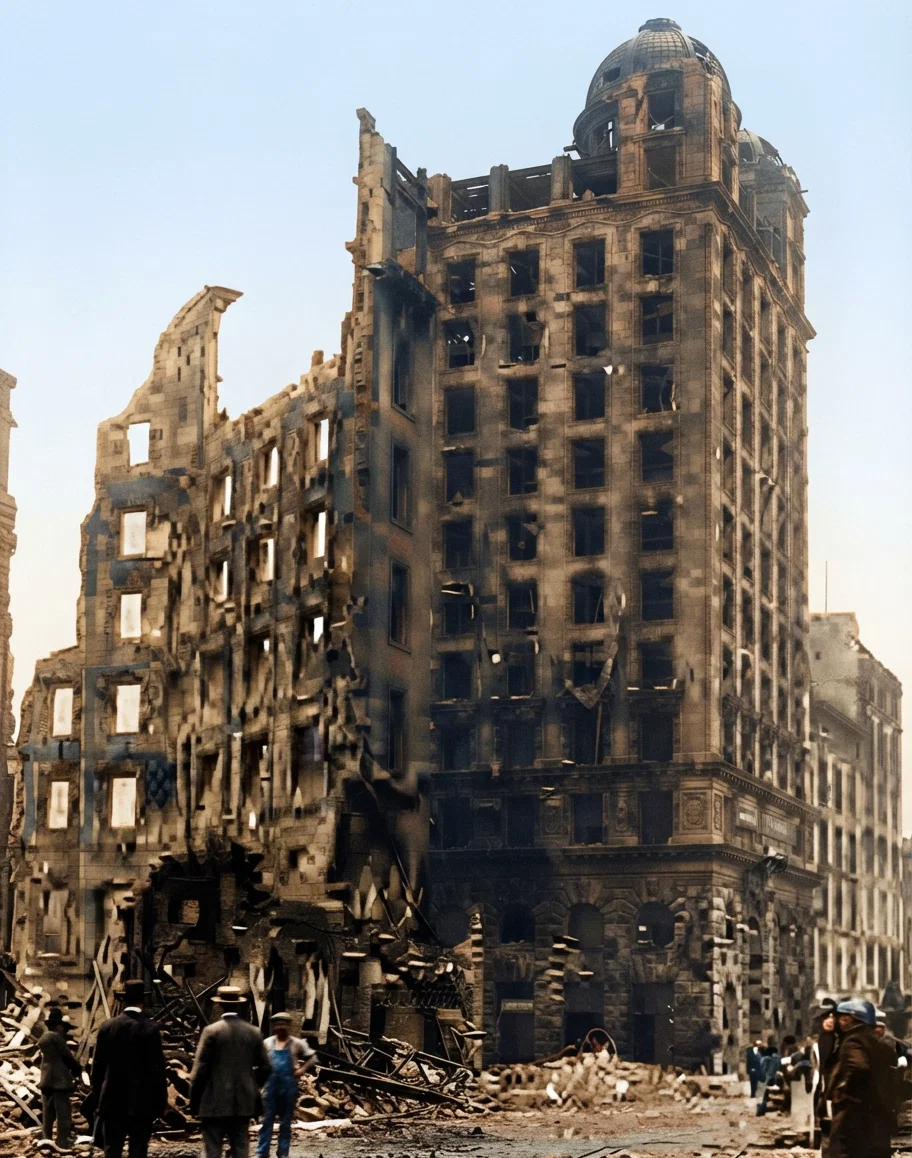
A view in San Francisco. The empty shell of the Call Building after the fire, on the right; the front wall of the Examiner Building on the left.
Once more: in Acts 20:35 Paul tells us of one statement that Jesus made that none of the evangelists or other apostles record, that the Lord Jesus said, "It is more blessed to give than to receive." But even tho these things are told us by later writers, they are just as truly inspired of God as tho we had read them in connection with the lives and history of the people when they were in activity. Even so it is with Adam and the law. The Holy Spirit inspired these men to supply these facts that were lacking, and what was involved by the action of Adam as regards the law.
Let us carry this still farther: We read that Cain was a murderer, because he killed his brother. 1 John 3:12, 15. But how could Cain be regarded as a murderer if there was no law against killing? "Where there is no law, there is no transgression," because "by the law is the knowledge of sin." Paul says: "I had not known sin, but by the law." Rom. 7:7. Cain himself finally admits that he did kill his brother, and recognized the punishment that was inflicted upon him for it. Gen. 4:13-15. God certainly would be unjust to accuse Cain of being a murderer, if he had never informed him against killing? But we know that God is just (Rom. 3:26), and will never condemn any one for what they did not know, nor could not know.

All the Law Violated.

But we find that before the law was given on Sinai every one of these precepts was violated, as will be seen by the following: Jacob accused his sons of having strange gods in the camp; and before he and his family could go to Bethel to worship the true God, they must first remove the strange gods from their midst. Gen. 35:1, 2. Joshua accused the ancestry of the Israelites of worshiping other gods on the other side of the river. Joshua 24:2. Then it is evident the first commandment must have been known, and been in force.
A view of the Call Building burning. The clock in the foreground marks the hour, 10:40 a. m. The structure on this side is the Mutual Life Insurance Building.
Laban accused Jacob of stealing his images; and went so far as to investigate all his goods to see if he could not find them, he was so desirous of having these teraphim. Rachel, having some knowledge of the true God and not desiring her father to be a worshiper of images, took them along with her. Gen. 31:19-35. Therefore some persons must have known the law of Jehovah concerning the second commandment. The third commandment is against swearing and profanity. Yet the Lord tells us that Esau violated this command-ment, for he was a profane man; and the sin of profanity was so awful that when he sought to recover his birthright he could not secure it, tho he wept most bitterly in order to gain it. Gen. 25:31-33; Heb. 12:16. If Esau had not known the law of the third commandment, how could he have been guilty of being a profane person? He certainly knew it, violated it, and lost his life.
["Why the Law Was Given on Sinai" is the subject of the next article.]