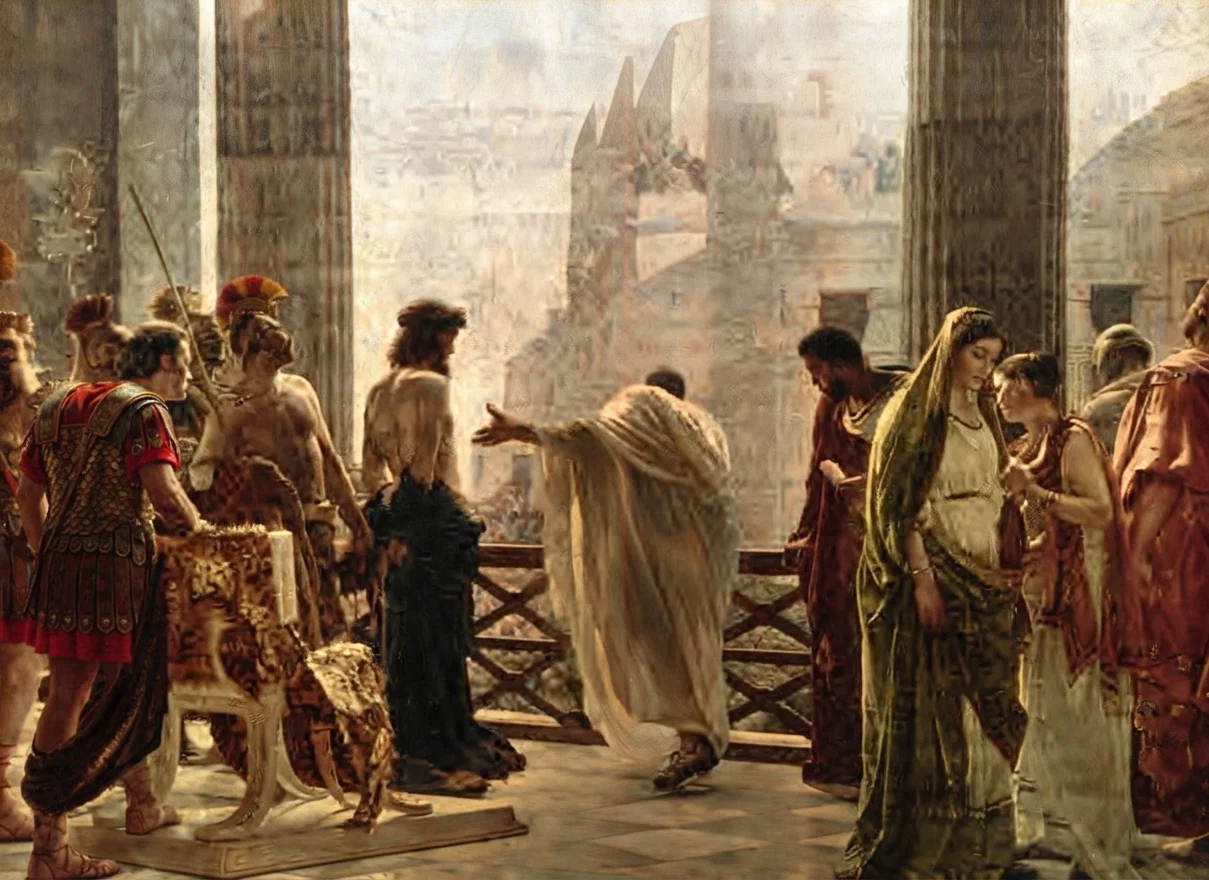
BEHOLD, THE MAN!

7%

Pacific Press Publishing Company · Mountain View, California · Mar 21, 1906

FromSigns of the Times, Vol. 32, No. 12.

Read the full edition

"BEHOLD, THE MAN!"

IT is said that nearly every artist who has sought to depict the Christ, pictures Him as a man of his own nationality, an ideal man of the artist, but one whose individual characteristics stamped the portrait as of One of the same nation as the artist. Consequently we have pictures of our Lord in Italian, Spanish, German, French, Russian, Dutch, etc.
ART may criticize, but heart will not. He was the one Man of the nations, embracing in His plan of salvation, His purpose, His sympathy and love, His power to save, the whole race of mankind. He was, on His human side, brother to them all. And so the apostle does not say that Jesus was born of an Egyptian woman, or a Syrian woman, or a Jewess. No; not so do we read. "He was born of woman, born under the law" (Gal. 4:4), the very place occupied by all men.
"WHEREFORE when He cometh into the world, He saith, Sacrifice and offering Thou wouldst not, but a body Thou didst prepare for Me." No blood of bulls or goats could take away sin; they could only faintly typify the perfect offering to be made. But when the Offering of God came, He took the body divinely prepared, which included in itself all the weaknesses and tendencies and proclivities and needs of humanity.
“BEHOLD, THE MAN!”
“BEHOLD, THE MAN!”
THAT body came through one of the wickedest lines of ancestry. Jesus was "made of the seed of David according to the flesh." Rom. 1:4. Trace through the unholy ancestry, going back even to the licentiousness of Judah; through the Canaanite harlot Rahab, the Moabitess Ruth, the licentious Solomon, and all the idolatrous kings which followed in the Judean line. Think of the wickedness of an Ahaz and a Manasseh; the weakness of a Jehoiakim or a Zedekiah. Who could have recorded a worse ancestry? Truly in a double sense He bore our grief and carried our sorrows, and the Lord hath made "to light [to meet, to focus] on Him the iniquity of us all."
THEREFORE, while He was the divine Son of God, He was also "the Son of Man," "the Man Christ Jesus." As He was the Son of God in the truest, fullest sense, so when He became the Son of Man, He also became man in the truest, fullest sense. Neither did He become man as was Adam before the fall, but man as pertaining to the flesh, as man was when Christ came into this world, "born of the seed of David according to the flesh;" "born of a woman," as were all other men; "born under the law," condemned by it, because He had taken man's place and identified Himself with the whole human family. "Since then the children are sharers in flesh and blood, He also Himself, in like manner partook of the same." The flesh and blood He possessed was like the flesh and blood of all God's children, and He partook of it in the same manner that they did—by birth. Nay, more, "it behooved Him [it was duty, necessary, essential] in all things to be made like unto His brethren, that He might become a merciful and faithful high priest."
THIS Man suffered in the flesh. "Himself took our infirmities, and bore our diseases." Matt. 8:17. "Surely He hath borne our sicknesses." Isa. 53:4, marginal Hebrew. "He was . . . a Man of sorrows, and acquainted with sickness." Verse 3, marginal Hebrew. He suffered from the mighty temptations which sweep over humanity; "for in that He hath suffered being tempted, He is able to succor them that are tempted." Butwhen thus tempted, He did not yield, He did not sin. "Who in the days of His flesh, having offered up prayers and supplications with strong crying and tears unto Him that was able to save Him from death, and having been heard for His godly fear, tho He was a Son, yet learned obedience by the things which He suffered."
BUT this Man "did no sin." He was in the flesh, but He was not dominated by the flesh. The flesh might clamor for the mastery, He yielded not. The Spirit controlled the flesh. The Spirit put to death the deeds of the body. The Spirit wrought in the flesh the righteousness of God and demonstrated the power of God through faith to be sufficient to overcome sin where sin had become intrenched, incarnated. The Incarnate Word overcame the incarnate sin.
IN this is man's hope. God gives not the regenerate sinner a different flesh; but he puts into the flesh a different spirit, a different life, a different power. Convicted by the law of God through His Spirit, the sinner longs to do right, tries to do right, and fails. But let him yield all to Christ Jesus, and receive Christ's presence, power, Spirit, and law, and a new life takes possession of him. Before this, the flesh ruled. His mind was the fleshly or carnal mind; after that the Spirit rules the flesh, the Christ rules in the flesh.
THE how of all this, the modus operandi of Jesus, in His own life and experience, or in ours, we will not speculate upon. When we can tell how two exactly similar seeds, so far as we can see, can extract in their growing from the same soil and sunshine entirely different colors and shades, then we may attempt to analyze the mystery of godliness in Jesus of Nazareth, or through Him in the hearts of poor humanity. We take the revealed facts of the Word as they are, gloriously demonstrated through varied and regenerate souls through all the ages.
JUST how Jesus was divine without using His divine power save through faith, we do not know, but He was the Son of God; He did become flesh; He did completely, gloriously, conquer sin in sinful flesh in our behalf. He is the God-man, the Man Christ Jesus, our Brother, Redeemer, Saviour, Friend, King. "Behold the Man!" He embraces within His flesh, with its tendencies, every class and grade of men. He overcame for all. Little did Pilate know the depth of truth he uttered when, to appease the mad mob by appealing to their sympathy, he pointed to the Suffering One, and cried, "Behold, the Man!" The full-orbed Man in all His trials and temptations, in all His sympathies, in all His excellences of character. The full-orbed man in all strength and victory and helpfulness and leadership! The same always, whether thorn-crowned in Pilate's judgment hall, or triumph-crowned in the courts of God. The same whether rebuking the lust of the flesh in Peter, or comforting the mourning, or bestowing His Spirit upon His appointed ones, or coming in glory to receive them all.
BEHOLD, the Man! Crowned with thorns in this world; He is coming again in glory.
"There is a King of glory, Ere long on earth to rise. Sung in prophetic story, Descending from the skies; The Babe of Bethlehem, 'tis He; It is the Man of Calvary,— Not crowned with thorns and gory, But crowned with glory now! Not crowned with thorns to-day, Not mocked and led away, But crowned with everlasting glory now."