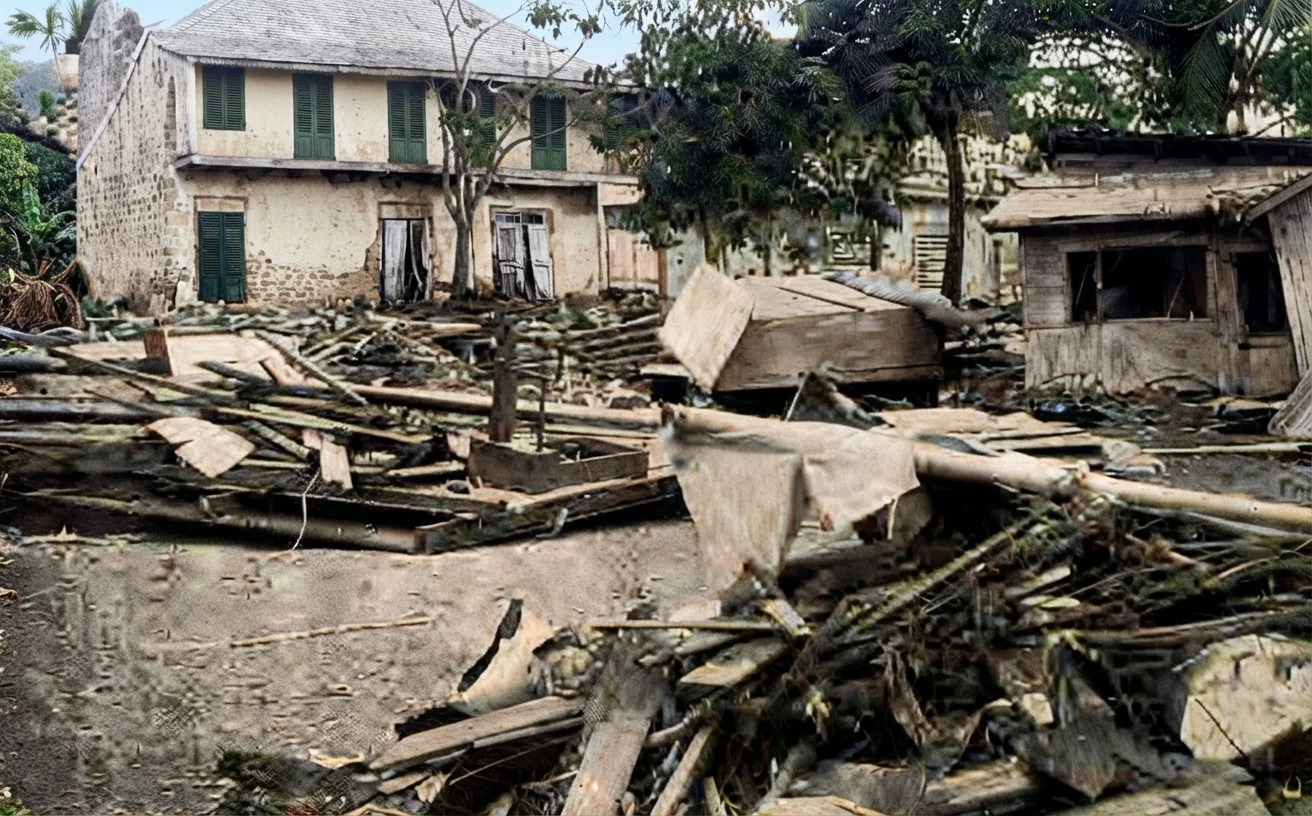
THE Society Islands and Tuamotu Archipelago have recently been visited by a hurricane, the like of which has never been known here, as far as we have been able to ascertain. During the night of February 7th, and the day following, the wind did its work in the vicinity of the Society Islands. The mountains of Tahiti are high, and during the night the wind came from such a direction that it was shut off from the city of Papeete by the mountains, so it was quite calm and still here. The raging sea outside was driven in on the side of the island where there was no wind, and as the reef is low outside of Papeete, the sea soon began to rise. The most of the large business houses are along the water front. In the evening the sea was up in the road, and young people were riding along the street in canoes, and having considerable sport over it. But it kept rising higher and higher until eight o'clock the next morning, when the wind changed to a position where it struck Papeete. This seemed to drive the sea back, for it soon commenced to go down quite rapidly.
But in those few hours, the sea had wrought quite a change in the appearance of things along the beach. The waves had battered against the buildings and gradually broken the weaker and less substantial ones. Some were washed all to pieces, and many others were moved from their foundation, and more or less injured. The heavy stone buildings still remained, but their great doors had been broken open by the waves, and goods washed away or damaged. Thousands of dollars worth of goods were destroyed that night. After it was over, the road along the beach was impassable, being filled with the débris, and in some places the road itself is washed away.
Nothing was left of the office of the American Consulate but the flag-staff. The re-organized Mormon Church people were very unfortunate. I think that every house in their little colony was broken down, besides their church and mission house. Many people were left homeless. Some remained in their homes as long as they could, and then fled, passing through water up to their necks, and others had to swim for their lives. Providentially, only two lives were lost in this place. These islands have been passing through some hard times since the fall in the price of vanilla and pearl shells some time ago, so the government is not in a condition to help its poor, as they might under other circumstances; but they took a part of them into government buildings, and did something toward supplying their wants.
Our church and mission house in Papeete are situated far enough from the sea so as not to be affected by this calamity. We felt very thankful for this, and believe the providence of God was in our locating where we did.
A Scene in Papeete after the Storm. The large building in the background was moved from its foundation.
In other parts of Tahiti and the Leeward Islands, the wind did the most damage. Many houses were blown down, roofs were blown off, and trees were uprooted and broken off. I think what is felt the most in these parts is the loss of the food-bearing trees,—breadfruit, coconut, banana, etc. On Raiatea, one man lost sixty breadfruit trees, and another, thirty. Another man lost over two hundred coconut trees. The loss to our plantation at Avera was very small. Only about twelve of our coconut, and three breadfruit trees were blown down. The roofs of some of our out houses were blown off, but the larger buildings remained intact. Much fruit, both green and ripe, was blown from the orange, mango, lime, coconut, and breadfruit trees, and of course this is a little loss. But we all feel very thankful for the protecting care of God, and that it was no worse. Our people in general suffered the least. These words from the forty-sixth psalm seem to have been written for just such times as these: "God is our refuge and strength, a very present help in trouble. Therefore will not we fear, tho the earth be removed, and tho the mountains be carried into the midst of the sea; tho the waters thereof roar and be troubled, tho the mountains shake with the swelling thereof." We know that these things must come, but God is our refuge.
Tuamotu Islands.
The saddest part of this is the news that comes from the Tuamotu Islands, which are nearly all low and almost on a level with the sea. They were devastated by the wind and sea, and on one of the largest, ninety-five people were either drowned or killed. Many went into the Catholic church for safety; it being a stone building, they thought it would withstand the sea; but the wall was broken by the waves and fell in on them, crushing many to death. A man-of-war has twice visited these islands, and brought many of the people to Tahiti, as they lost their homes, clothes, and everything, and have nothing to live on there. All buildings and nearly all of the coconut trees are now gone, and the islands are nothing but dreary wastes of bare sand.
Four schooners, belonging to merchants and traders of Tahiti, are missing. One has just been heard from, two of the native sailors having arrived. They tell how the vessel went down, and they made a raft, and finally all were washed away but these two. One was a large vessel, and had quite a number of Europeans on board. Nothing has been heard from it, but at last they have discovered a piece of a vessel supposed to be a remnant of this one. A large English vessel was overtaken by the storm, and finally washed on the reef of one of the Tuamotu Islands, a complete wreck. Ten of their men were lost, and the rest have reached Tahiti by means of a small native boat.
We believe that this is one of the many signs given to show that we are living in the last days. It is a warning given in mercy to cause people to pause in their mad race after worldly gain and pleasures, and consider eternal things. Tho many will not heed the warning, I am glad to say that some have been led to think more seriously of their relation and duty to the Creator. B. J. CADY.