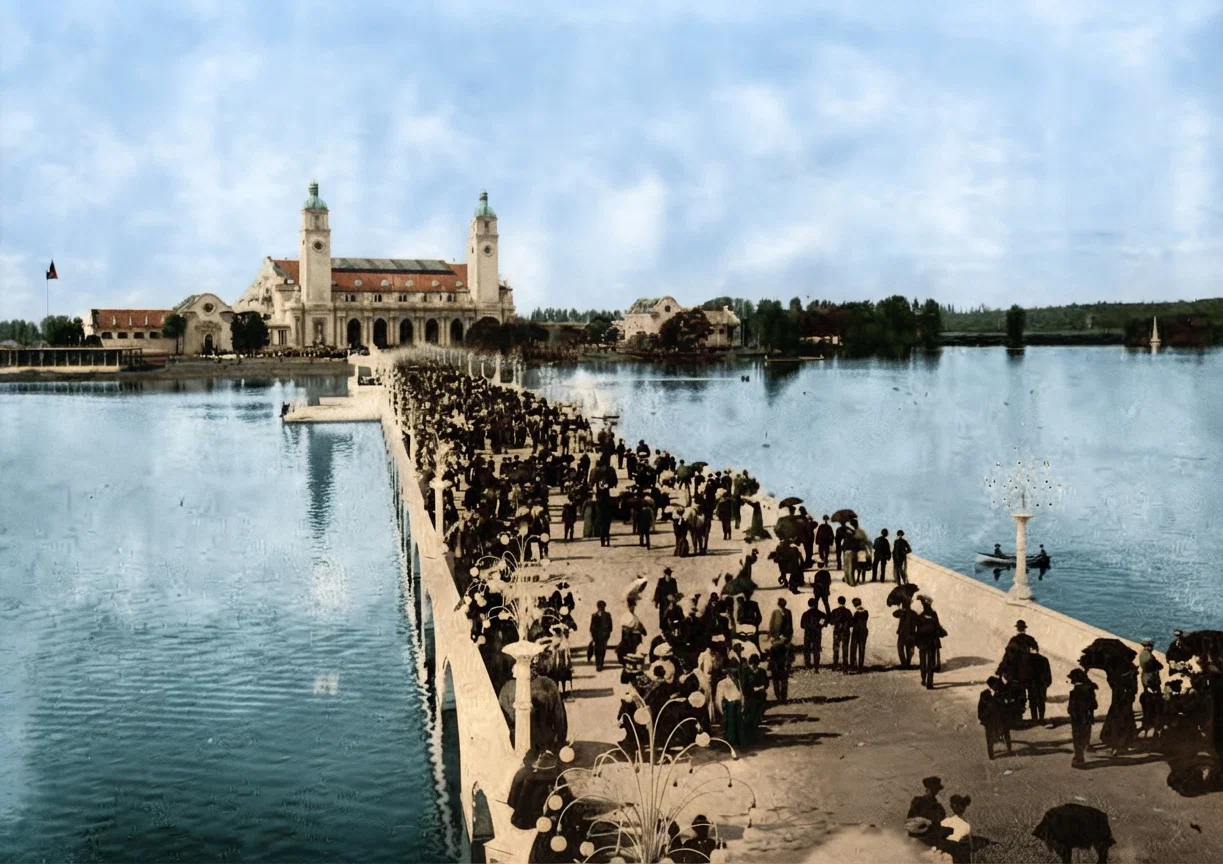
VERY pleasing, indeed, is our illustration on this page; and it will be readily recognized by all our readers who visited the Lewis and Clarke Exposition at Portland, in 1905. It is the great bridge, or broadway, which connected the two parts of the Exposition grounds. At the one end was the "Trail," or the "Midway," the place of folly and fun and fakirs, of iniquity, of wantonness, of vice. At the other end were the government buildings. On the broadway of the bridge were the people of the nations in singles, in couples, in trios, in groups, in crowds, mostly on pleasure bent. On either side, the bright waters rippled and danced in the sunlight or electric glare; overhead bent the blue dome in the day, or the star-bespangled sky at night.
WHAT a picture it is of this present world and the great life-way of the nations. Well is the world represented by the "Trail." Some were there engaged in serious businesses of buying and selling, of providing food and drink to the madding crowd. Some were there for knowledge, picking up a thought, an idea, here and there, which in time they might use for profit. But the greater number were there either to make pleasure or to get pleasure, from the harmless donkey rides to the wicked exhibitions of despoiled virtue, to which the passer-by was invited on every hand.
THE way of the nations is a broad way.
There is plenty of room, plenty of company, smooth and easy to the feet, and straight ahead, but it is comparatively short and soon over. So it is in this life. The broad way is an easy way, filled with a multitude of people whose minds are bent on the things of time, things which perish with the using. The Trail may be likened to the Vanity Fair of this world, the bridge to death, the government buildings to the great judgment of the government of God which lies beyond. All the nations of earth must pass over the bridge of death; for "it is appointed unto men once to die, and after this cometh judgment."
BUT it is not the death we have to fear. Its gloomy way lies before us all, bright tho a perverted theology has pictured it. It is the way on this side of death which counts. One is the broad way which our Lord tells us "leadeth to destruction, and many are they that enter in thereby." Matt. 7:13. That way is "the way of sinners," of "transgressors" (Ps. 1:1; Prov. 13:15), hence it is a hard way, ending in death. It is the way of a fool, which seems right in his own eyes, but the end is the way of death. Prov. 12:15; 14:12; 16:25. Sometimes it is the way of the harlot, which leads down to death and hell. Prov. 7:27. It is the way of "evil men," "the way of the wicked," perverted by the folly of man. Prov. 4:14; Ps. 146:9; Prov. 19:3. Those who follow that way will eat of its certain fruit, and perish in the corruption of the path they have chosen. Prov. 1:31.
THE other way is "the narrow way" "that4leadeth unto life, and few are they that find it." Matt. 7:14. It is the perfect way for character building. Ps. 18:30. It is the way of His "precepts" and "commandments." Ps. 119:27, 32. It is the way of peace and rest, of which the wicked know nothing, because it is the way of righteousness and life. Isa. 59:8; 32:17; Prov. 10:17; 12:28. It is the way of "His steps." "Righteousness shall go before Him, and shall make His footsteps a way to walk in." Ps. 85:13. It does not always lie beside the "still waters" or pass through the "green pastures." It climbs steep ways, over ragged rocks, down Hills of Difficulty into Valleys of Humiliation. It leads along by the enemy's land, and there are many smooth by-paths to allure us away. It passes through Gethsemanes of darkness and up Calvarys of crucifixion. But every foot of the way is marked by the oftentimes bloody footprints of Jesus our divine Lord, and always hallowed by the fragrance of His holy presence.
IN His infinite mercy God calls us from the broad way of folly, defeat, disaster, deceit, disappointment, despair, death, to the blessed way of the cross and the crown, to the way of righteousness and life. With infinite love He pleads: "Let the wicked forsake his way, and the unrighteous man his thoughts; and let him return unto Jehovah, and He will have mercy upon him; and to our God, for He will abundantly pardon. For My thoughts are not your thoughts, neither are your ways My ways, saith Jehovah of hosts." The way of the world may be broad and pleasing, and men accept it because they can see more or seemingly present worth in it. The end thereof is death and oblivion. The way of God is narrow, and the selfish heart sees so little in it that it rejects it. But "the true gain is the long gain;" the narrow way broadens out into the unfenced fields of God's Paradise, into the boundlessness of eternal life. Why not choose it now?