INDIA

7%

Pacific Press Publishing Company · Mountain View, Cal. · Jun 13, 1906

FromSigns of the Times, Vol. 32, No. 23.

Read the full edition
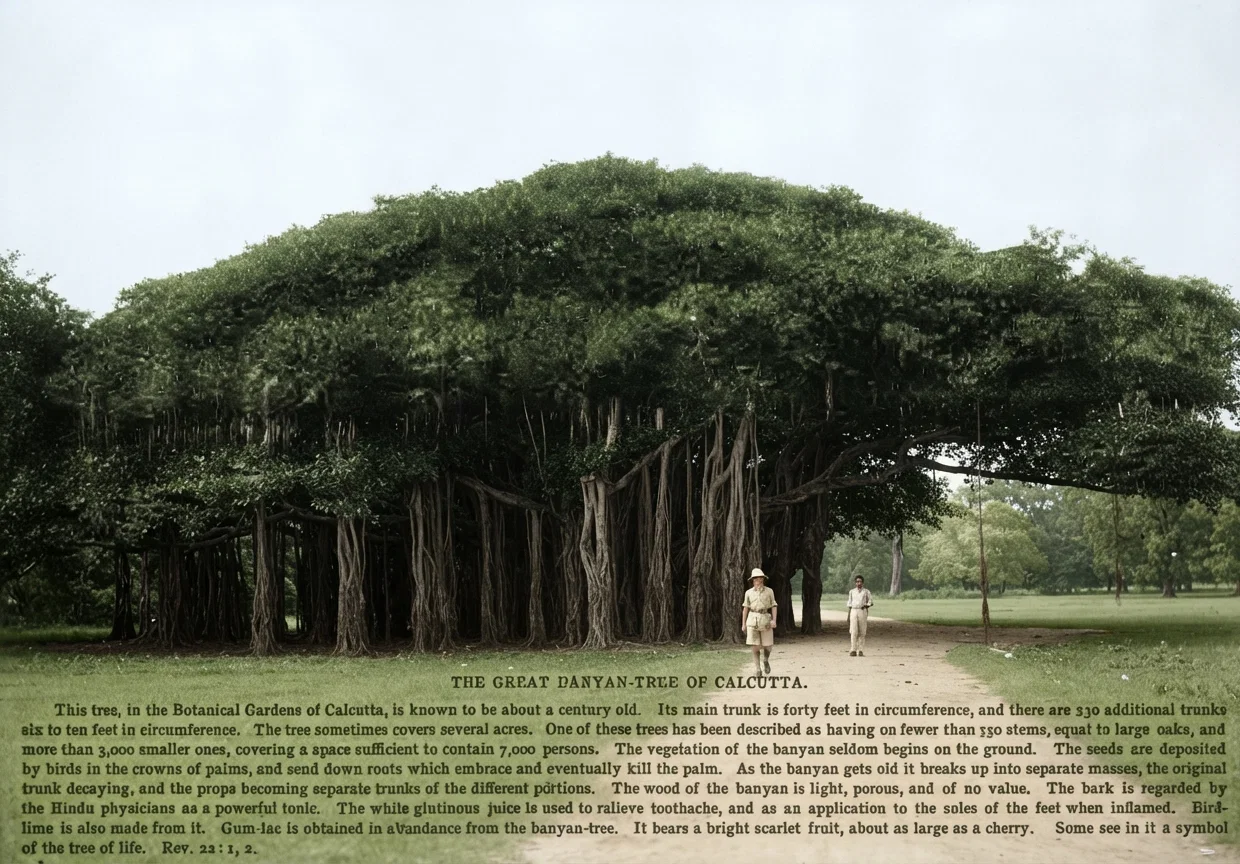
THE GREAT BANYAN-TREE OF CALCUTTA.

INDIA.

LANDED in India, we are surrounded with a new life in a new world. Wherever we turn our eyes, we are greeted with things never seen before. An array of different faces, a chatter of strange voices, a land covered with a new and varied vegetation, with multitudes of men and women and children, differing in color, clothes, and customs, convince us that we have placed our feet in a strange country.
Tho Indians are not historians and have scarcely written a page of history, preferring rather to delve into philosophy and write credulous tales and questionable legends, India has, we all know, made many volumes of history.
When our forefathers were uncivilized, Aryans had governments, laws, and schools, and encouraged art and literature. The book of Esther mentions India. Scholars in the dark ages divided the world into three parts, of which India was said to be one. Peter the Great of Russia appreciated her and her wealth. In his will, he said: "Take every possible means of gaining Constantinople and the Indies, for he who rules there will be the true ruler of the world. Advance to the Indies which are the great depot of the world. Once there we can do without the gold of England."
This mighty empire, for such it may well be called, comprises Asia's south central peninsula, and extends some distance into the Indian Ocean. From the Himalayas in the north to Cape Comorin in the south is a distance of 2,000 miles; and from Quetta in the northwest to the southernmost point of Burma, a province of India, is about 2,500 miles. The area of India is 1,559,603 square miles, or more than three-fifths of the United States, not including Alaska; comprising fully one-fifteenth of the habitable part of the globe.
Forming its northern boundary are the lofty Himalaya Mountains, whose many snow-covered peaks appear to the beholder as a wall of snow mounting into the heavens. The grandeur and beauty of this range of mountains can not easily be surpassed. Their lower slopes have a wealth of vegetation, which to the eye of the traveler is beautiful to behold. To go up into these cool refreshing mountains, from the monotonous burning plains is a delightsome pleasure to the European, who possibly for several months has been sweltering in the heat of the plains. Not only are the Himalayas a retreat from the heat for the multitudes of India, they are also her great fortress in the north. Russia might easily have swept down upon the quiet people of India, had not these many mountain monarchs in the north presented an insuperable barrier. There are passes here and there among these mountains, and it is in these that England has placed fortifications, and stationed men at great expense to prevent invasion. All India is benefited by these mountains. When the monsoon winds blow across the peninsula and strike the mountains, their moisture is condensed and sent back to the plains in refreshing showers, which causes a wealth of tropical vegetation to spring forth and grow.
On the west of India lies the Arabian Sea, which together with Baluchistan and Afghanistan form its western and northwestern boundary. Stretching eastward a distance of more than 2,000 miles across the Bay of Bengal and the province of Burma, we come to China, which isthe eastern boundary of the Indian empire.
The three most important rivers of India are the Indus, from which India gets her name; the Brahmaputra, which in Sanskrit means the son of Brahma or god; and the Ganges. These with many of their tributaries have their sources in the Himalaya Mountains. The Indus and Brahmaputra rise not far from each other, and flow almost in opposite direction, emptying, one into the Arabian Sea, and the other into the Bay of Bengal.
In the rainy season, the rivers of India are filled to their utmost capacity. Along the Ganges, the heavy rains cause the river to break from its bed. Many times a poor farmer sees a beautiful crop taken from him, and the very ground itself washed away, and his small farm become the river bed, while on the other side a fellow farmer adds to his land as the river changes its channel. Perhaps in no place in the world is there so heavy a rainfall as in parts of India. Cherra Punji, in Assam, has an annual rainfall of 523 inches. In the year 1861, as much as 805 inches is said to have fallen. Such pouring rains make the clouds very heavy. We have been in Darjeeling, a hill station in the mountains, which has a heavy rainfall, when the clouds were so low and heavy for days that we could almost dip water from them.
If there were even distribution of rain there need be no famines in India. As a whole the land is productive, and where rain is plenty crops are large. To be sure the implements for farming used by the natives are crude and primitive. When the rain begins to fall in Bengal, the farmers with their poor wooden plows begin to stir the mud in their paddy (rice) fields. Round and round with a yoke of tawny oxen and wooden plow, the Indian ryot wades through mud, stirring his muddy soil preparatory to planting rice. The westerner watches almost with disgust such seeming child play. Unmindful of the white man's deriding smile the Aryan muddles on in his muddy mud. In a few weeks the rice is planted, and miles and miles of the beautiful green rice appears, which, with an abundance of rain, yields a bountiful harvest.
It is not that India lacks in natural resources that her people are poor. The wealth of India is immense, and the 40,000,000 who are said to go to bed hungry every night, might have plenty if the tillable land were cultivated. Nearly one-fourth of the land lies idle, which if cultivated, would produce two and three crops a year. Among the chief products are: rice, wheat, cotton, oil seeds, sugar cane, indigo, tobacco, and tea. The fruits are many and varied, and some have a delicious taste. Any one visiting Calcutta will see perhaps as large and varied display of tropical fruits as can be seen anywhere in the world. Oranges, pomelos, mangoes, pomegranates, guaras, kalas, limes, bales, custard apples, leaches, and many other varieties of fruit, come each in their season to satisfy the craving for fruit in the tropics.
The reader may ask why it is, with rich soil and land uncultivated, there should be so much poverty. We need not look far for the cause. Hinduism probably more than anything else has brought the multitudes of India to their present condition of wo and misery. Departing from God, their foolish hearts have become darkened. Useful employment such as tilling the soil is looked down upon as degrading, and is left almost entirely to poor ignorant ryots. Mann's code, which has some of the chief injunctions of Hinduism, contains the following:
"83. A Brahman (the highest caste) or even a Kshatriya (a high caste) when living for a life (enjoined) for a Vaisya should carefully avoid agriculture (as it) causes great pain (and) is dependent on other (creatures)."
Dr. Murdock's conclusion that according to Mann, the Hindu people ought to starve is not wide the mark. In fact, if the woes of the Hindu people were summed up, their troubles could largely be spelled in the one word Hinduism. Known only to God are the results of this fatalistic philosophy. It has brought a cry of hunger in the land and downright poverty is on every hand. No power of man can free these millions from the Hinduistic shackles which bind them. Nothing but the Gospel of Jesus Christ can bring freedom. "Christ, only Christ" can break the bands of idolatry and raise these people to the liberty there is in Jesus Christ. We are thankful that some have turned to Christ. When we look back over a hundred years in Christian missions and see what God hath wrought, we have every reason, as followers of Christ, to be devoutly thankful. There are now more than 3,000 missionaries of different societies working in India where a hundred years ago there were scarcely a dozen. We are not speaking of impossibilities when we say that the final Gospel will go to all these people in this generation. Those who are watching the hand of God among the heathen can see many and manifest evidences that Providence is going on before and preparing the way for a short and speedy work among these people. J. L. SHAW.