A Century of Missions

4%

Pacific Press Publishing Company · Mountain View, California · Oct 30, 1907

FromSigns of the Times, Vol. 33, No. 44.

Read the full edition

A Century of Missions

THE history of a “century of missions” is a story so full of church activity, of organized labors, and of heroic self-sacrifice that it reads more like romance than real history.
The morning of the nineteenth century gave promise of great things. The Revolution in France, together with the wars and conflicts of Napoleon I, had awakened every nation in Europe and alarmed the civilized world with fear of what might take place. The United States of America had just shaken off the shackles of Old World tyranny, and launched itself upon the ocean of time as a nation whose destiny lay entirely before it.
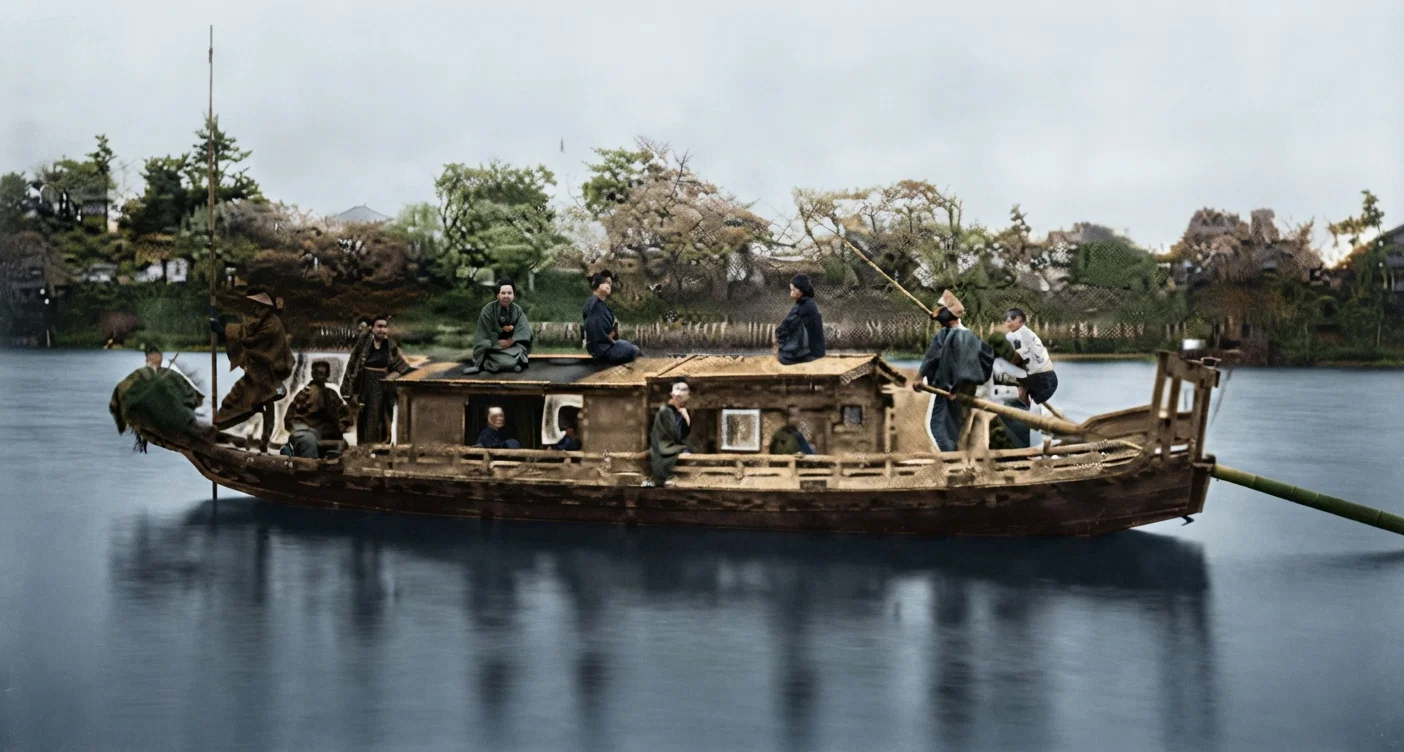
Ferry on the Sunida River, Tokyo. (See Page 22.)
Yet no prophet nor seer ever divined the mighty accomplishments of the nineteenth century. Year by year, in its onward march, it marshaled its forces along all lines of material development, scientific investigation, and the increase of national wealth. Nearly every year astonished the beholders with the inventions it thrust upon the world. Steam, electricity, railroad engineering, telephony, telegraphy, and new manufacturing machinery came so fast that old formulas were completely revolutionized, and the world stood in silent amazement at its own progress.
Greater growth was made in all material things during the century just closed than in all the six thousand years of earth’s previous history. The wealth of nations multiplied amazingly. The population of the civilized nations of the world increased more than in all their preceding history. The ages never saw such wide diffusion of knowledge, of toleration and liberty in religious beliefs, such growth into almost universal political freedom, and such liberty of the press, as were worked out during the nineteenth century.
For a thousand years preceding the days of the Reformation, the professed church had confined itself largely to political intrigues, with the supreme idea of securing political prestige and “exterminating heresy.” During this time scarcely anything had been done for the spread of the Gospel among those who were beyond its influence. The dawn of the Reformation in the sixteenth century placed the word of God in the hands of the laity, and there was a great spiritual awakening thruout Europe. But so fiercely did the war with Catholicism rage that for nearly two centuries Protestantism did little but battle with existing errors among so-called professed believers in Christ, and hardly held its own. The close of the eighteenth century found but few missionaries among the nations of heathenism. Ziegenbalg and Carey and a few others had entered India, but little had been done in any land. A beginning had been made, and what had been so sadly neglected for ages in the past, the church of the nineteenth century undertook to accomplish.
Think of the Herculean task that lay before the churches. Almost nothing was known of the Dark Continent except of the countries bordering on the Mediterranean, the extreme southern point in Cape Colony, and what knowledge the wicked slave-traders had gained of eastern Africa. No Livingstone, no Stanley nor Gordon, had yet explored its interior. Burton, Speke, and Baker were yet unknown for half a century. The languages, dialects, and religions of interior Africa were an unknown quantity.
India, with its more than 300,000,000 of human beings, was almost a total stranger to Europe. The great East India Company had been operating in parts of India for some time, but their control wherever they were only made it all the more difficult to introduce the Gospel.
There was no Bible nor parts of the Scriptures in the languages of India. Before much could be done, some one must learn the native language, and translate the word of God into the native tongue. On the other hand, India did not speak a universal language, but there were scores of dialects spoken by colonies scattered in various parts. Again, but few of India’s millions could read even their native tongue; hence when the word of God came to them, they were wholly unable to receive the help it would have been to them had the masses been able to read. The same conditions existed in China, Japan, and Korea, and in the islands of the Pacific Ocean. Besides, in the early part of the nineteenth century, many of these doors were closed to the missionaries and to all missionary efforts. A foreigner could teach the Gospel in scarcely any of these countries. Even his life was unsafe, and it was with the greatest danger that any foreigner could enter these forbidden fields.
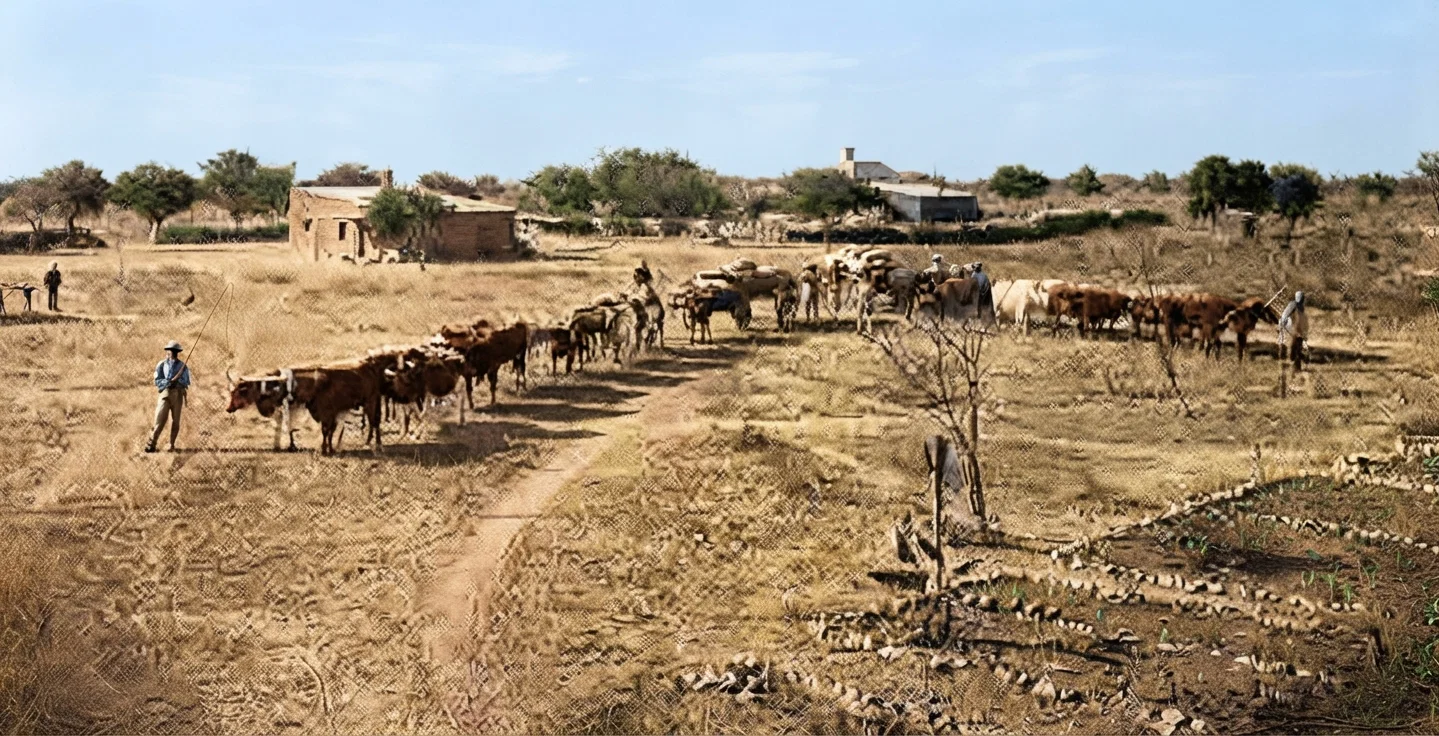
Ox Teams Starting to the Railroad with Grain, Solusi Mission, Matabeleland. (See Page 25.)
Many of the islands of the Pacific Ocean were given up to cannibalism and the lowest forms of idolatrous worship. They did not desire light from the word of God, and considered it a part of their religion to take the life of any one who should bring to them teachings contrary to that which had been taught them by their priests for generations in the past.
But Christ said before He ascended to His Father, “This Gospel of the kingdom shall be preached in all the world for a witness unto all nations; and then shall the end come.” To one who is familiar with human history, it would seem impossible that this text of Scripture could ever reach fulfilment. But what seemed an insurmountable task at the beginning of the nineteenth century looks quite easy to us who are living at this time and know what mighty things God hath wrought in our day.
Early in the nineteenth century there came a great missionary awakening among the strong Protestant churches, and an earnest zeal to go out and carry the Gospel to the heathen nations. Carey had already goneto India, and was sending back earnest appeals for additional help. The English Church, together with others, was already coming to realize the great need of getting the Scriptures into the hands of the laity, and many organizations had been created to extend the circulation of the Scriptures in the languages of the people. The British Bible Society, and later the American Bible Society, came into existence, and have proven mighty factors in the building up of the Gospel of the kingdom in all these foreign fields.
The Scriptures have been already printed in more than 500 of the languages and dialects of the earth, so there is scarcely a country in the world but has some part of the Scriptures in its own original tongues. The results of the work put forth by missionaries in these foreign fields have been so marvelous, and the reception of the Gospel in the hearts of those who have heard it has worked such transformation of character, that it is almost impossible to believe what we know to be facts.
There is already working among these benighted nations of earth a mighty army of well-trained, consecrated workers. No fewer than 40,000 professed Christian men and women are engaged in extending the Gospel to the benighted millions of the earth. These 40,000 workers are assisted by more than 80,000 native helpers, giving their lives to the accomplishment of the same end. Among these workers there are more than 6,000 clergymen, 8,000 women, and 700 physicians.
Twenty-four thousand professed Christian schools are in operation in these heathen lands, of which more than 1,000 are institutions teaching advanced work. These schools are giving instruction to no fewer than one million of students, who are being both educated in and won to the teachings of God's word. About 1,000 hospitals and dispensaries are maintained by the home land, where the poor and sick receive medicine and treatment, either entirely free or at a nominal cost. Annually there is being contributed more than twenty millions of dollars for the maintenance and extension of the work in foreign fields.
At the beginning of the nineteenth century there were very few church communicants in all these heathen lands, while at its close there were 1,317,684 communicants. In the year 1899 there were received into the church more than one hundred thousand believers. The number of church communicants does not cover the total amount of work done by these missionaries in foreign fields. There are those who have not yet joined the church who are greatly benefited by the preaching of the Gospel and by the teachings of the word of God.
There have been scattered copies of the Bible either in its entirety or in portions to the amount of over 320,000,000 copies. There were ten translations in foreign fields before the nineteenth century, there have been 466 during the nineteenth century. More than 14,494,000 books and tracts bearing on the Christian religion have been circulated. There are 148 publishing houses and printing-presses engaged in printing the Gospel to be scattered to these people, which annually circulate more than 375,000,000 pages of Christian reading-matter. There are being printed in the native languages 366 periodicals, with an annual circulation of over 297,000 copies.
The thousand Christian hospitals and dispensaries above mentioned give treatments in a single year to more than 2,579,000 patients. Over 213 orphanages have been established in these heathen lands, which are caring for over 13,000 orphans. There are ninety Christian leper-homes and hospitals, caring for more than 5,000 inmates. Besides these, there are 67 steamers and ships used in evangelistic, medical, and other departments of missionary service in the foreign field.
In Europe and America, there are 87 institutions of training where missionaries going abroad can receive a training for their future work.
One can imagine something of the tremendous growth of interest in foreign missionary work on the part of the professed Christian churches, when it is known that from the year 1649 to the year 1800, only twelve missionary societies were formed. From the year 1800 to the year 1900, therewere organized 387 missionary societies. During the last decade of the century, one hundred missionary societies in the home lands were organized for the extension of the work in foreign fields.
These agencies, which have been scattered to almost every heathen nation under heaven, have done a great and mighty work for God. The light of the Gospel of Jesus Christ is breaking thru the darkness that has enshrouded these millions of our fellow beings for ages, and the heathen are appealing to the followers of Christ for help. That the church militant intends to answer this Macedonian cry is evidenced by what we see on every hand. What has been done is only a beginning of what will be done in the near future.
The great Threefold Message of Revelation 14, which is to go to every nation, kindred, tongue, and people, has already entered most of these great heathen lands. India has already nearly forty laborers. China has about the same number. Japan and Korea have been entered, and many of the islands of the Pacific have received the living messenger and heard of the thrilling truths for these days. Nearly every country in South America has been entered, and God is greatly blessing the work in Brazil, in Argentina, in Chile, in Ecuador, in Peru, in Bolivia, in Guiana, and in the islands of the Caribbean Sea. We also have our stations planted in Central America, in Mexico, and in all the countries of British America and Alaska, while in Africa the Lord has done a great and mighty work in establishing missions at various central points for future work and missionary extension. Cape Colony has long since been an organized conference, while important out-stations have been planted in the Transvaal, in the Orange Free State, among the Matabele people, among Zulus, up in Victoria, Rhodesia, Nyasaland, German and British East Africa, the Gold Coast, and Sierra Leone, in Egypt, Algeria, and in various other places in Africa.
No people in the world are doing so much for the preaching of the Gospel to the heathen lands, measured by their numbers and material wealth, as those who believe in the soon coming of Jesus Christ. Last year the Seventh-day Adventists contributed $333,378.12 for the extension and maintenance of the work in foreign fields.
We believe the preaching of the Gospel to the heathen nations of the world is a sure sign of the soon coming of Christ. Let us not forget His saying that the “Gospel of the kingdom shall be preached in all the world for a witness unto all nations; and then shall the end come.” To this end let us live and pray.