THE DIVINE PROVIDER

6%

THE DIVINE PROVIDER.

THE revelation of God's character in Jesus Christ in time is a revelation for eternity. What God was then He is still. "I am Jehovah; I change not," is His message to us by His messenger. Mal. 3:6. He loved then; He loved before; He loves still. He is the "same yesterday, and to-day, and forever." He has lost nothing by age in eternal youth, in plenitude of power and wisdom.
GREAT and infinite as He is, with His greatness unsearchable, He cares for poor finite humanity. Not even a sparrow escapes His notice, and the hairs of our head are all numbered. Truly we can say with the psalmist, "Such knowledge is too wonderful for me, I can not attain unto it."
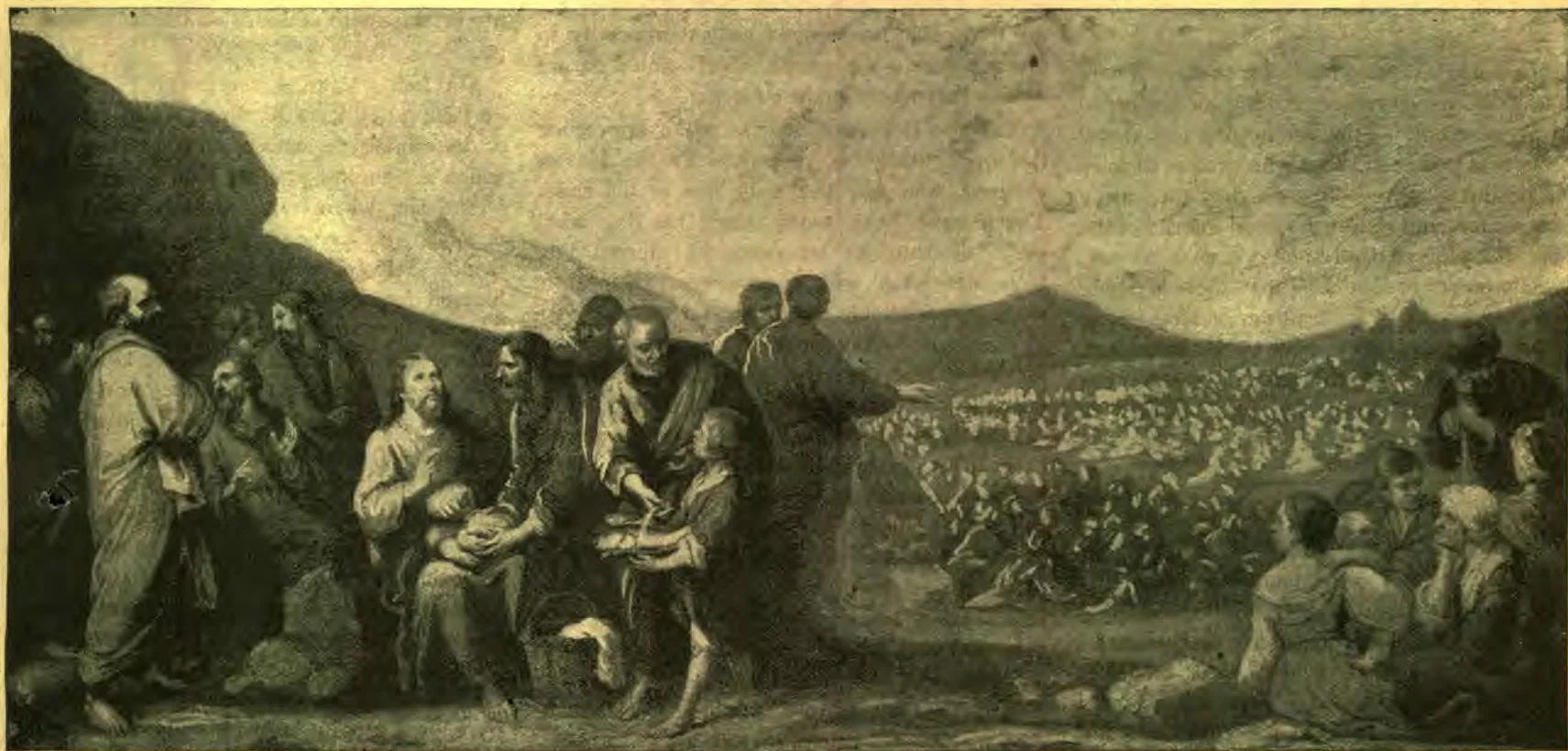
AN instance of God's care for the children of men, and His ability to feed them, is recorded in all the Gospels, Matthew 14, Mark 6, Luke 9, and John 6. The story runs thus: While Jesus was teaching, there came to Him messengers who bore tidings of the death of John the Baptist. Jesus takes His disciples and starts for some quiet retreat where He can instruct them better concerning the nature of His kingdom and work. Doubtless He and they had become physically weary, because of the great throngs of people who constantly came and went.
But the people anticipated them and went before. And as the Master saw the great multitude, as sheep without a true shepherd, His great heart of compassion was moved, and He taught "them many things, and healed their sick." So the day was spent till the even came. Doubtless His disciples grew hungry as the long hours passed. They went to Jesus and asked Him to send the multitude away, so that they could buy food.
A STRANGE reply came from the lips of the Master: "They have no need to go away; give ye them to eat." And the disciples declare that two hundred shillings (about $34.00), probably the whole sum in their treasury, would not suffice to give each one a little. And then, too, where could the bread be obtained? He asks them how much food they have. And they reply that a lad has five barley loaves and two small fishes, but what is such a small quantity as that among so many?
Surely, the Master's judgment was greatly to be questioned.
Feeding the Five Thousand.
BUT Jesus was neither surprised nor frustrated. He commands His disciples to arrange the people in groups of fifties on the grass. This done He takes the bread and the two small fishes in His blessed hands, looks up to heaven, invokes God's favor upon the coarse food, breaks it, and distributes to His disciples, and they to the multitude. As He breaks the small, thin loaves to the disciples, the food multiplies. As they break from the pieces they hold, they multiply. As the people receive the food and eat it, it multiplies, till the five thousand men, and the women and children unnumbered, are fed and filled. Then, a lesson in economy; "Gather up the fragments that remain, that nothing be lost." And twelve baskets were gathered.
WE must either deny the record or admit the miracle of creative power. By no juggling of words can we distort the four Gospel records to make them mean something else. The record declares that out in that Syrian country, away from all towns, Christ Jesus caused thousands upon thousands of hungry people to be fed to fulness from five thin barley loaves and two little fishes, which a lad brought with him, — fed them all and still had left more than twelve times the original quantity. To us the record is true, the Master fed the multitude. The creative word multiplied the food.
THERE was a divine spiritual lesson in it for all time which the people there failed to receive, and which it is as easy for us to reject.
The multitude then wanted to make Him king. John 6:15. They sought Him for the loaves and fishes, as many have sought Him since. Verse 26. Having before them one of the most conclusive evidences of His connection with God, they were still demanding signs that they might believe. Verse 30.
THEN He tells them that there was a higher thing to seek than the food which perished. They must eat of the flesh of the Son of Manand drink His blood. Unless they did this, they had no life in them. But if they fed upon this Living Bread, they had eternal life. Verses 33 to 59.
AND then there came more questionings, and by some, rejection of His word. He makes His meaning still plainer: "It is the Spirit that giveth life; the flesh profiteth nothing; the words that I speak unto you, they are spirit and they are life." Verse 63. Some would pervert the words of the Master as did the grosser ones of old. His flesh must be eaten; but as there is no way by which we can do this save by making it, the people have been made to believe in the transmuted wafer through priestly prestidigitation. Still others would have us believe that all physical food and drink are His flesh and blood, and that in them we may obtain eternal life. Not so. The flesh profiteth nothing beyond this life. Material food and drink and air feed the physical man, and at the end he dies. But to live eternally man must feed upon the spiritual Bread of God, Jesus Christ in the Word. The Word is spirit and life, and only as souls feed upon it in faith and assimilate its creative power do they live.
BUT where the Word of God is truly eaten, day by day, when it becomes a part of the man, then do we behold again the miracle of the loaves repeated. He who truly feeds upon Jesus Christ himself becomes a living epistle, a new translation, so to speak, of God's Word. He gives it to others, and they feed upon it and live, and so the food multiplies through men and women regenerated by the power of the word of Jesus Christ.
THE world is waiting in hunger to-day. There are breadlines everywhere waiting for the bread that perishes not. They are hoping that it will manifest its power in those who profess to minister it; but alas, too often do they turn away disappointed, and doubt the word instead of the feeble disciple. To all such we wish to say, There is power in God's Word; there is power to cleanse, power to feed, power to strengthen, power to keep, power to save to the uttermost. O taste, and see that the Lord is good. Eat and drink direct from the great Source of supply and live.