SENTIMENTAL EVIDENCE

7%

SENTIMENTAL EVIDENCE.

COMMENTING on the response to the call for relief of sufferers by the earthquake, the Commoner says:
Confronted by such generosity as this the pessimist must stand silent, and he who constantly insists that the world is growing worse is answered by a million generous acts. Our common humanity is more than a sentiment—it is a fact.
We would not detract one scintilla from the credit due to those who nobly and bravely helped in the great emergency. But to give a universal credit to the world, or even to the United States, for innate generosity because of what a comparatively few have done in this case, is "sentiment" pure and simple. Perhaps not one in a hundred even in California so much as raised a finger in the way of genuine help. If the circumstance of the earthquake and the fire are to be taken as in any way adducing evidence that the world is not growing worse, what meant the necessity for the great aggregation of federal and state troops, and municipal and volunteer police, to keep the poor sufferers from being robbed and murdered? Why was it necessary for those who had food and other necessaries for sale to be officially enjoined, and otherwise compelled, not to charge exorbitant prices? It was evident that extortion would have been the order of the day, on the part of merchants and house owners, and those who had their services for hire, but for the appeals and orders of influential men. Armed protection and enforced generosity are not necessary under any conditions when men are growing better, especially when the calls of hunger and nakedness and exposure are filling the air.
What about the great lack of generosity, the absolute oppression of the poor, the general inclination to take advantage wherever opportunity opened, of which dire complaint has long been made from pulpit, press, and rostrum? And certain political journals have been the loudest in the pessimistic cry, if it is to be called by that name. So far as the money response is concerned, the bulk of it has come from sources that have been most bitterly denounced. Surely the generosity that has to be stimulated by disaster, that is not moved until a general sentiment is forced by the disrupted elements, is not the kind to boast of as evidence that the world is better at heart.
A generosity that would equalize the condition of mortals in the matter of earth's common resources, and labor to that end from voluntary impulse in ordinary times, in ordinary business and social life, would better prove that the world is growing better. The spirit that feeds the poor and clothes the naked and ministers to the afflicted, and deals honestly and liberally at all times with all classes, is the true test of generosity. A general spirit of this character would better prove a generally enhanced moral condition.
Such evidences as are being presented to show that the world is growing better are not at all complimentary. They rather indicate that men's consciences must be frightened and their nerves racked by some over-awing phenomena of nature in order to call out any sentiment of sympathy and generosity at all. They emphasize, rather than rebut, the sure testimony of Scripture, that "in the last days perilous times shall come. For men shall be lovers of their own selves, covetous, boasters, proud, blasphemers, disobedient to parents, unthankful, unholy, without natural affection, trucebreakers, false accusers, incontinent, fierce, despisers of those that are good, traitors, heady, high-minded, lovers of pleasures more than lovers of God, having a form of godliness, but denying the power thereof."
Such is God's prophetic picture of the general conditions of our time, and we know that it is a true one, however much men may try to cover it. It does not say that there is no generosity in the world at all, or that all men are hardened against real sympathy for the suffering and the needy. But it does say and mean just what it says, and it is due to the world that it be kept before the people. Be not deceived; the whole world, or even the whole nation, will not be accredited with generosity because a few thousand of them are moved to help the sufferers in a great disaster. Do not forget that where dollars are going to San Francisco for charity, thousands are going for profit. Do not forget that men of business are far more concerned as to what they can make out of the situation—even to profit by the disaster—than they are to assist somebody that is in need.
Let us give due credit to every one who so much as expressed a word of sympathy for the unfortunate, but let us not carry it to the extreme of concealing from the world God's faithful testimony as to its true condition. There can be no worse robbery of the poor than this.

"SABBATH DESECRATION."

[From the Indianapolis Star.]
G. [[FIGURE]]
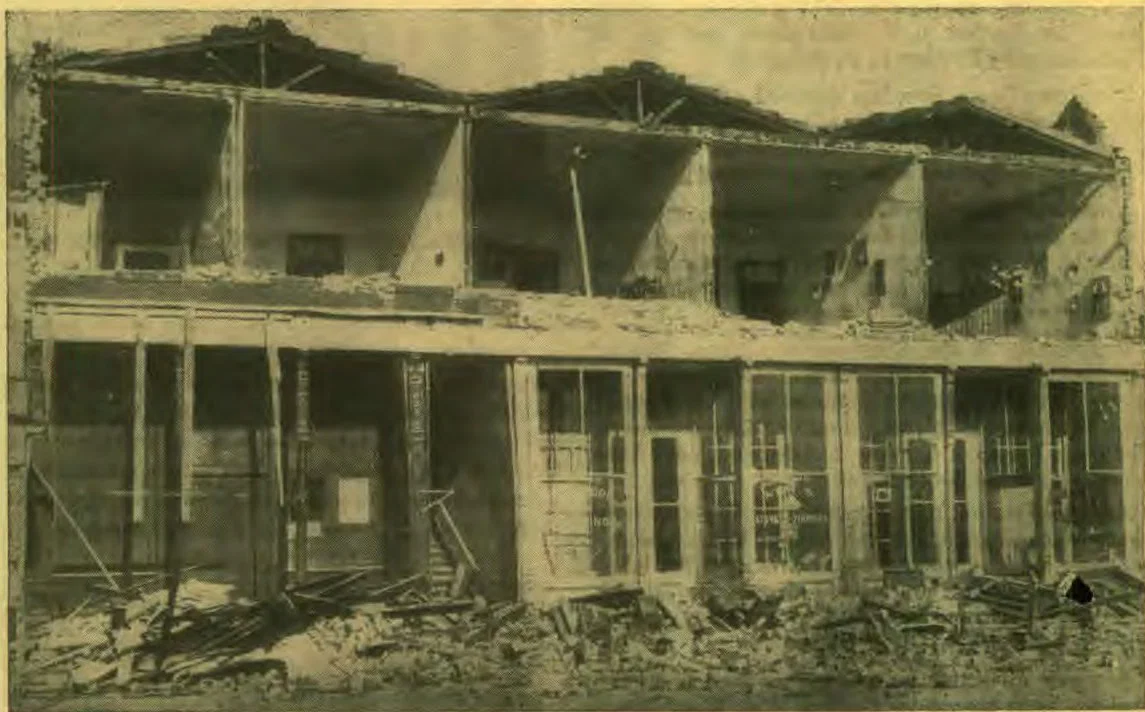
Gobbi Building, Healdsburg. This is a typical scene which might be met in every town where the earthquake did any considerable damage, the front wall fallen away, leaving open bedrooms which appear like little doll houses seen on exhibition.