THE limits of a brief article are quite inadequate for the discussion of an ancient civilization. And the attempt to describe the conditions in Japan to-day is further complicated by the commingling of the old and the new; for Japan has not yet passed the transition stage between the mediæval and the modern. To point out some of the most striking differences between eastern and western ways and ideas, and to note the effects of these differences, is the most that can be attempted here.
One of the first things to attract the attention of the newcomer in Japan, is the amount of hand labor performed. This is noticed first in the traffic of the streets. In all the large towns there are wagons drawn by horses; but these are the exception, the great majority of the vehicles being carts drawn by hand. Everybody has heard of the jinrikisha, the carriage of the Orient. And just as this somewhat exaggerated baby-cab takes the place of our 'busses and hacks, so do small two-wheeled carts do the work of our drays and delivery wagons. This may seem a hard way of doing things, but it has its compensations. Horse and driver are united in one, and the horse never becomes frightened nor runs away.
If we extend our observations by a visit to the country, we observe that this way of doing almost all kinds of work by hand applies also to the cultivation of the soil, and the harvesting of the crops. Occasionally one sees a horse or a bull wallowing through the mud of a rice field, drawing a plow or some other implement for preparing the soil for the seed; but very much oftener this sort of labor is being done by long-bladed hoes in the hands of men and women.
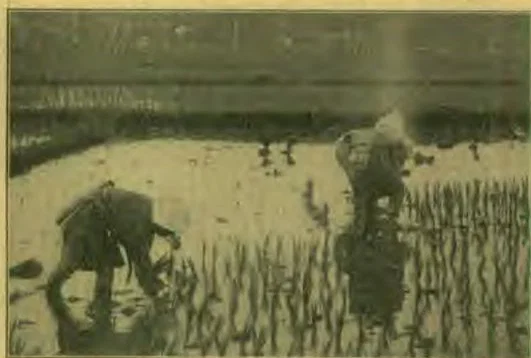
Rice is the principal crop, and its cultivation will serve to illustrate the farmer's work. The seed is thickly sown in a small tract of land, and grows there till some time in June, when the young plants are transplanted, all by hand. The plants are set in rows a few inches apart, and are fertilized and kept free from weeds by painstaking hand labor. The ripe grain is cut with a small sickle such as the reapers of Boaz might have used, the grain is separated from the straw by pulling a handful of heads between a number of close-set teeth or prongs; and all the implements for hulling, winnowing, and scouring the grain, are also commonly worked by hand.
Transplanting Rice.
In manufacturing lines the same rule holds, tho with exceptions; for foreign methods and appliances are being introduced, especially in the production of articles of foreign origin. But from ancient times the exquisite lacquer china, and porcelain wares, have largely been produced in the homes of the people. The same is true of the rich fabrics and needlework that are so highly prized.
The enterprising Westerner is inclined to look with pity, if not contempt, upon these slow, out-of-date methods; but here, too, there are compensations well worth considering. The invention and use of labor-saving machines seem to be not altogether an unmixed blessing. Every new invention throws many workmen out of employment, while the profits of the capitalist and manufacturer are proportionately increased. The net result is the massing of property into the hands of a few, while the common people grow poorer. The Japanese artisan may be poor; but he is more independent than many of like craft in Western lands.
The domestic life of the Japanese presents many features that are strange to Western people. The standard of living is on a cheaper scale, else the people would not be able to subsist. A foreigner would not take kindly to living "Japanese style," and might be inclined to recommend that they adopt Western ways. Let us notice what this would mean to them.
In the first place, such a change would quite revolutionize their dwellings. The use of chairs, tables, bedsteads, and other Western furniture would require that the rooms in the house be larger and more in number. The straw mats on the floors would have to go; for chairs and table legs ruin them, and with chairs and bedsteads they would not be needed. A Japanese house has no chimney except an opening in the roof over the kitchen. The handful of charcoal in the fire-box serves only to warm your fingers while you sit close by, and does not appreciably warm the air in the room. "Cold as a barn"
exactly describes a Japanese house in winter. The inmates keep comfortable, or as nearly so as possible, by donning extra garments, sitting on their feet, and warming their fingers over the charcoal fire. In the colder parts of the country, a box-like frame is set over the fire-box, and a heavy quilt is thrown over this. The family gather about this kotatsu, draw the edges of the quilt over their laps, and so keep quite comfortable. And at night the beds are made up on the floor around this queer stove, and the heat from the fire makes each bed very comfortable; but one is apt to wake in the morning with a headache, due to the charcoal fumes. The introduction of foreign stoves would call for chimneys and stovepipes, and would greatly increase the expense for fuel.
Contrasts in Cost of Living.
13All these considerations help to explain how the people can live so economically. Their houses contain very little furniture, and the same small room may serve as sitting-room and dining-room by day, and sleeping-room at night. But little fuel is consumed. The food is generally very plain and simply prepared, mostly by boiling in water; but preparations boiled in oil are not uncommon. There are no ovens, the broiling of fish and the baking of small cakes being done over a charcoal fire. It is said that six students can be educated in Japan for what it costs to educate one in an American college. A common price for board and lodging at an ordinary boarding-house is four dollars a month. And yet if a person wishes to live "foreign style," he must pay from thirty to thirty-five dollars a month at a private boarding-house; and hotel rates are in proportion.
Social and Family Relationships.
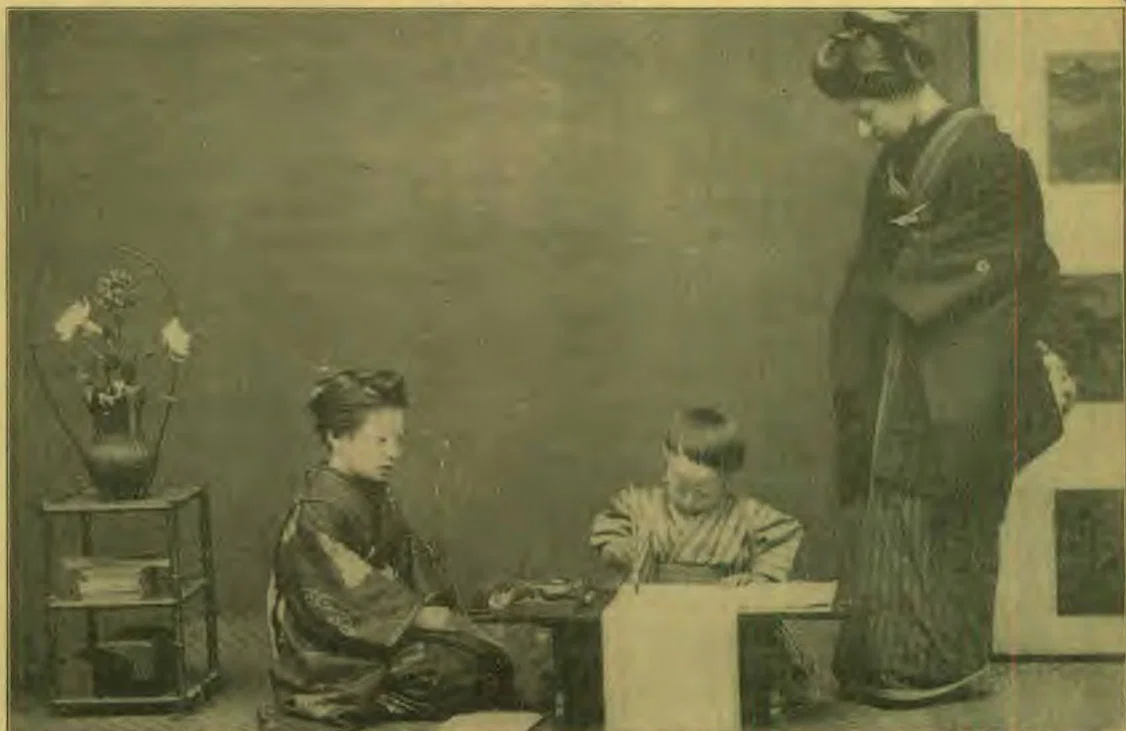
The social life of the Japanese also presents contrasts with the West. The social scale is perpendicular rather than horizontal, as with us. The parents, of course, stand at the head of the family; then the children rank according to age. The eldest son, as the family heir, is accorded a degree of respect and authority unknown in a Western family. The language contains no simple words for brother and sister; but there is one word for elder brother, and another for younger brother; likewise distinct words for elder and younger sister. Thus the distinction of rank according to age is daily recognized and impressed by the language used.
The position of wife and mother is one of meek submission to her husband. When a son of the family marries, he commonly brings his bride to the home of his parents, where she becomes subject to her mother-in-law. Under this plan the young people have the advantage of the long experience of the parents in matters of domestic economy; but such an arrangement is often the cause or occasion of much unhappiness.
The virtue of filial piety is highly prized by the Japanese. The duty of the child to the parent is one of the five relations recognized in the moral system of Confucius; namely, of subject to sovereign, of parent to child, of brother to brother, of child to parent, of friend to friend. Perhaps I can not better illustrate the Japanese ideal of obedience to parents than by relating the following story, said to be strictly true. A Japanese father one day ordered his son to go to the village on some errand; and as the roads were muddy, he told him to wear his straw sandals. As the boy was about to start, his mother saw him, and, not knowing what his father had ordered, told him to wear his high wooden clogs, as the mud was not deep. It required a few minutes to make the change from sandals to clogs, and, as he was about to start again, his father saw him, and, noticing that he was wearing clogs, repeated his order that he wear sandals. The boy without controversy made the change, and again essayed to start. But this time his mother saw him again, and repeated her command to wear the clogs. What should he do? How could he obey both parents? When next seen he had answered these questions to the best of his ability; for when met by a friend, he was hobbling along, with a sandal on one foot, and a clog on the other.
This may seem like a high standard of morality for a people regarded as heathen. But it will be noticed that the Confucian system of morality fails to recognize man's obligations to a Power higher than parent or earthly ruler. And so the Christian teacher often finds that these ideas of loyalty to the civil ruler and obedience to parents often stand in the way when the obligation to obey the law of God is presented. And it requires much care to impress these people with a proper sense of their obligations to God, without appearing to teach disloyalty and disobedience to rulers and parents, when laws and commands conflict with the Lord's requirements. The lessons learned in childhood exercise a strong influence upon the life, and it is very difficult to unlearn these lessons, or to weaken their influence. This illustrates the great importance of early education.
But the truth of God, like a hammer, is breaking hard hearts in Japan; like the sun, it is bringing light into darkened minds. The strongholds of error are being cast down, and souls are building for eternity upon the sure foundation. F. W. FIELD.