THE WEIGHT OF A SOUL

1%

THE WEIGHT OF A SOUL

By Mrs. S. M. I. Henry, Author of "Studies in Home Life," etc., etc.
SHE had come and gone like the door on its hinges. She had begun as a pretty little blue-eyed seamstress, and kept on in the same room, at the same table, with the same pair of shears, pin-ball, needle-book, emery strawberry, thimble, and tape-line, until now.
Now, no one would have recognized in her the pretty little seamstress. Her eyes were faded and red at the corners—sometimes red all over; but those times she kept them bent down so that no one could see them. Her hair was thin and dry, only when she slyly slipped over to the stationary bowl and spatted the top of her head with the cold, running water. She never did that when any one was in.
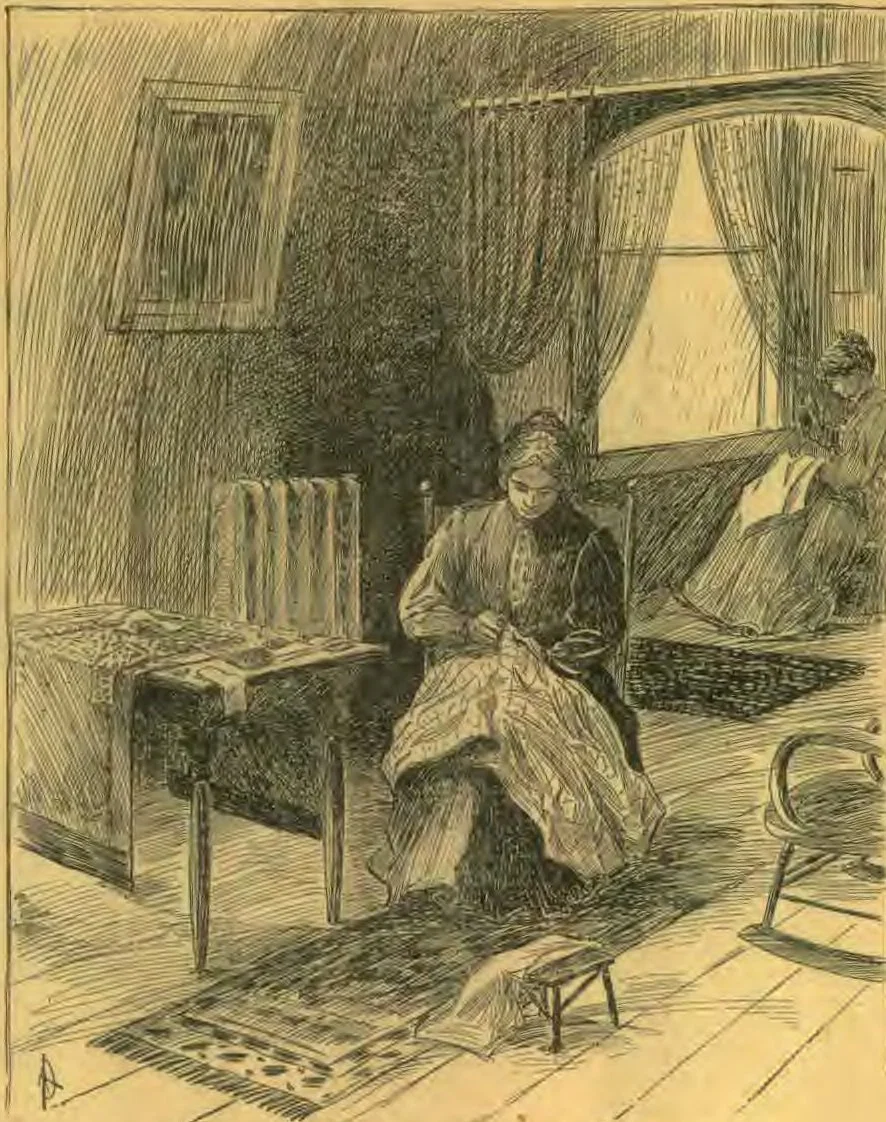
The sewing-room was in a great, beautiful house—a good home for those fortunate beings who had been born into it. It was a beautiful room, and everybody thought Mary Graham was highly favored indeed to have secured and held such a place, with its comfortable little chair, its good light, its steady, beautiful work, and, more than all, such a considerate mistress,—one who never forgot that her sewing-woman might be glad of her money when the week's work was done; who never allowed over-hours; and, if the weather was very bad, gave her her car fare.
There was also another advantage that Mary Graham had over many others of her class,—she had to become well informed about many things, for the large, pleasant sewing-room was practically the morning-room for the whole family. Mrs. Hungerford had her work-table in a little alcove which overhung the garden, and looked westward toward the beautiful river; and here she put many finishing touches to the dainty garments for her children, wrote, read, and received her intimate morning callers, and the several committees of which she was chairman. The affairs of the Woman's Club, with its culture projects; of the W. F. M., with its many plans for converting the heathen, and of the W. C. T. U., with its reforms, philanthropies, its educational and evangelistic methods, were all discussed in open council in the presence of the little seamstress, who seemed to have even a soft pedal to her sewing-machine, so quiet and unobtrusive was she in all that she was and did.
"Mrs. Hungerford, is your little seamstress deaf as well as dumb?" laughingly asked Mrs. Northropp one day. "Not that I have anything to say, you know, but she is so very quiet."
Both ladies looked over Mary's way, but she did not seem to hear, at least unless the slight coloring of the rim of her white ear, and a sudden little splash of red on her neck, was a sign.
"Mary is a very quiet, busy little woman," said Mrs. Hungerford, in a kind, appreciative tone. "She never disturbs any one, and she does beautiful work. See this"—and, lifting a pile of delicate little garments, the two fell to examining them, and talking them over as women will.
"Well," said Mrs. Northropp, "I wish I could steal your Mary Graham, or find her double—tho that sort doesn't grow in pairs; and then it would be of no use to steal her, unless I intended to lock her in; for you have given her the best berth that any seamstress that I ever knew of, ever had. She's a fortunate girl. Let's see—how many years is it that she has occupied that corner?"
"Don't ask me," laughed Mrs. Hungerford, "for if I should go to reckoning those figures I should make gray hairs grow in all our heads. My! O, how the years have flown! It was when George was a baby, and the year that I was elected president of the Missionary Circle. We made our first missionary plans, cut out the first missionary clothes, and tried the first sewing-machine I ever owned on them. You selected that machine, Mary; do you remember?"
"Yes'm."
"There, Mrs. Northropp, you see she is neither dumb nor deaf," laughed Mrs. Hungerford. "But your voice sounds tired, Mary; are you tired?"
"O, no'm!"
"Very well, you ought to know; and if you are, you ought to know enough to pick up your things and go and stay till you get rested. That's another nice thing, Mrs. Northropp; Mary knows that she can do just as she pleases with me. I never worry about her. She comes and goes, does her part, and I try to do mine, tho sometimes she does almost sew me out of house and home, so that I have to take a day off for shopping."
"Well," sighed Mrs. Northropp, "if one's part was all done with the shopping—but, dear me—I am almost killed over the awfulness of responsibility sometimes."
"That is a consideration," said Mrs. Hungerford, "and it is a great comfort to me that my folks all seem to know how to behave themselves, from Mary down to the children and Mr. Hungerford. They all keep straight, without any bother to me, and I thank the good Lord for it every time that I hear of the goings on all about us. I am left absolutely free, without a worry, to give myself to the heathen."
Both ladies laughed quietly, and Mary worked the treadle of her noiseless machine with her back toward them, while the heart within her seemed more stony than ever, and her lips curled in a scorn that was cruel for any face to be compelled to carry. The look of scorn, however, soon changed to anguish, and in suppressing its cry, she bit into a needle which she was holding between her teeth, and only by great effort prevented the pointed half from slipping down her throat.
"What's the matter, Mary?" asked Mrs. Hungerford. "Did you swallow a pin again? That is a nasty habit you have of making a pin-holder of your teeth. Did you get it out?"
"Yes'm."
"Well, I'm thankful. I expect to find you strangled with a needle some day; then what would we do for clothes?"
That night, after all the house was quiet, Mrs. Hungerford still sat at her table in the sewing-room alcove. The lights of the city reflected in the river lay in long shafts of silver from shore to shore. She was writing; but occasionally, glancing up and out, the beauty of the scene tempted her to turn the key at her hand by which the illuminating current was cut off from the room, that she might have the friendly aid of darkness within by which to gather up the tender beauty of the scene without. As she sat with her elbow on the table, her chin on her palm, thinking over the day's work for the W. F. M., which had especially engaged her attention, suddenly a strange, new, startling thought came to her, startling only, however, because it was new. She wondered where it came from, and why just now, but more why it had never come before. It would have been a very little commonplace thought under almost any other circumstances, but under these, in which it had dropped like a lightning flash out of a cloudless sky, it was so uncommonplace as to bring her instantly upright in her chair, her hands to the edge of the table, as if to lift herself by them. She did not arise, however, but sat looking fixedly towardthe long silvery bars of light that banded the two shores of the river together. But she had forgotten them; she thought only one thing, and that was, "I wonder if Mary is a Christian."
That was all there was to it, but since Mrs. Hungerford really had a sincere heart, small as that "wonder" looks, it was enough to fill it for the time being.
"Why don't I know?" was the next thought. "How is it that I have not known? I can not wait until morning to find out—and yet I shall be ashamed to ask her. How can I ask her, after all these years, and all that has gone on in this room in her hearing? But of course she is one, and she knows that I know it. I couldn't help but know it; of course not. She will appreciate the fact that I have taken it for granted, have understood without words—yes, indeed, I shall find some perfectly natural way of introducing it so that she will not suppose for a moment that I have only just now thought about it. That would be a dreadful thing for her to know. It is dreadful, and I will see that it never happens again."
She sat on and on, her eyes fixed on the river, until the home lights had all been called in, and only those remained that were for public safety—slender threads, few and far between, shot in through the darkness of the night, only serving to make its blackness more suggestive of dangerous depths. After a while she arose, dropped on her knees, and, with her face buried in her hands, and an intolerable burden on her heart, she groaned out the prayer for herself that she could not speak, while tears trickled through her fingers until the handkerchief which she had dropped in the seat was wet.
The next morning when Mary entered the sewing-room she was surprised to find Mrs. Hungerford before her. The expression in the face of her mistress was new. But Mary was alike indifferent to expressions new and old; so, with a civil reply to the, "Good morning, Mary," which greeted her, she turned to the closet to lay off her wraps.
Mrs. Hungerford was, at the end of a long, sleepless night, weighted with a burden so heavy that she could think of nothing but how to get rid of it. Every consideration of carefulness or tact had been lost hours ago; she only waited for a chance to speak.
"Mary," she began, and her tone was so strange, with the pressure of pent-up feeling, that Mary really was moved to look at her in almost alarm, "Mary—I—I have a question to ask you; you—you—are a Christian girl, aren't you, Mary?"
Just a moment Mary stood, her face hardening every second as she slowly took in these words, and began partly to comprehend what was back of them. Then she laughed a shrill, horrible laugh, which distorted her face, and left it paler than before; then she seemed to grow tall, and taller, her eyes became cold as steel, and in a low, sarcastic tone she answered:—
"I think it is time you asked me that question."
"O Mary!" and Mrs. Hungerford sprang toward her as if to throw her arms about her; but Mary had slipped beyond them, and stood like an avenger beside her sewing-machine.
"O Mary, you are right! It is time—long, long past time!" she cried. "You don't know what I have suffered all this night. Listen!"
"Listen? No, I must get to my work. Suffered, did you say? Well, suffering that can be measured by a night will not spoil your beauty."
"Mary!"
"Yes, ma'am. Did you get the cambric yet for Miss Dorothea's slips, and the lace to edge Master Guy's ruffles?"
"Mary, O Mary!"
No answer.
"Mary!"
"Yes, ma'am."
"O Mary, don't look so hard at me! Will you not listen to me?"
"Of course I'll have to listen to you, or"—
"Or what?"
"Why, lose my place, maybe!"
"You know better. O, how unjust! But no, I deserve it. Say what you please, my poor girl; you"—
"Mrs. Hungerford, please, whatever you do, don't call me girl again. I'm a woman. I—was a girl once, but that was ages ago."
"What do you mean? Are you married?"
"O, yes, I'm married!"
"And—and children?"
"Now you stop. O!"
And before Mrs. Hungerford could anticipate her purpose, she had seized her hat and shawl, was down the stairway, and off like a wounded roe, plunging through the open spaces toward the river.
The morning and the afternoon passed, but she did not return. Several committees came to meet Mrs. Hungerford, but she excused them. She spent the early part of the day looking among old papers for an address. She had once known where Mary Graham lived, but, never having occasion to look her up, she had lost the address. She humbled herself to inquire of the servants, but not one of them could enlighten her. The late afternoon found her under a pressure of anxiety that could not be longer endured; and, calling the carriage, she started out upon the almost impossible task of finding Mary Graham among the thousands of unregistered poor of a great city; for by this time she had, as she supposed, at least classified her. She was also by this time too determined to stop with half-way methods, but went directly to police headquarters, from which, after a half hour, she emerged with a list of "Mary Graham's," only one of which could be hers, and, giving the first order to her driver, she started on a search which, before it was ended, brought her face to face with things that gave point to all the work which she had been doing at long range; and the fire which began to burn in her breast no "reports" could ever have kindled.
It was long after midnight. She had gone through her list of "Mary Graham's," and sundry experiences which she would never forget. She had taken John, the old coachman, into confidence some hours before, and he stood with one hand holding the reins, and the other on the open door of the carriage, waiting. At last, suddenly a sharp cry rang out from a partly open upper window near by in the court, and then a tender woman's voice was heard—a voice which sent a thrill through the heart of the startled listener in the carriage.
"Let me out, quick, John; that is she."
"Are you sure, ma'am? Be careful; this is a bad part, ma'am."
But she was out, and hastening by the light of a dim street lamp toward the crooning voice which still fell from the partly open window. How she found the way she could not have told—up the shaky stairway, and along the dark halls—but at last, without even a premonitory tap, she softly opened the door, from which the voice still came, tender, sweet, heart-breaking, with its burden of unspeakable love and pain. She was unnoticed, so she stood and took in the scene.
The room was very small. A lamp, shaded on one side by a piece of newspaper, stood on the table. On the pillow of a little bed, over which this shadow fell gratefully, was a pinched face, distorted by pain, while cry after cry came from the drawn lips. The head was thrown back, the eyes were dilating with that expression of surprise which acute and sudden stabs of pain will produce, and which is so pitiful to behold. In another corner, on a lounge, slept a man, whose heavy breathing, laden with sickening fumes, told its part of the story. Mary was sitting on the edge of the narrow bed, from which she had evidently suddenly arisen, and was bending low over the poor little face, with a Madonna look which made her beautiful, while with her hands she was supporting the suffering body.
Mrs. Hungerford waited but a moment, then, slipping softly back into the hall and closing the door, she stood and thought; then carefully she felt her way back to the street, and with a reassuring word to John, stopped under the street lamp, and, taking a note-book and pencil out of the bag on her arm, she wrote two, three, four, of the small pages full, folded, pinned them together, and stole noiselessly back, slipped them under the door, knocked softly, and returned to the carriage.
"No, not yet," she whispered, as John opened the door, but stood with her eyes on the window.
On the thin curtain she saw first the silhouette of a woman reading, then of an erect statue, then of a bowed form, its face in its hands; then, after a long time, the curtain was parted, and the lamp was moved close to the window, so that the silhouette was blotted out.
"Thank God! O, I do thank Thee, Father!" and with a sob of gladness, Mrs. Hungerford started quickly toward the light. But, stopping a moment, she whispered, "John, where are we?—what part of the city?"
"Well, not so very far from home now, ma'am, just off the avenue, on Gray Street. That, where the light is, is Lost Court."
"Well, then, you drive quickly home, tell Mr. Hungerford where I am, then come back. I will see you, and come down to tell you what to do."
She went up, and in a moment had Mary sobbing in her arms.
"O, did you really mean it enough for this? Then I believe—I do believe; I will come back to the God of my childhood. I had made up my mind there was no God," she whispered, "for, you see—you see him—and, O, my baby, my baby! I began to sew for you for her sake, for he hurt her, and I had her in the hospital until they gave her up, years ago; and, O, I thought nobody cared only for—you know"—
"Yes, I know; you had reason to think we only considered you as a sewing-machine; but God laid your soul upon me last night; I have found out how much it weighs, and if you had not lifted it off by beginning to believe, I think it would have crushed the life out of me. O, I never want to feel that sort of a burden again! But now we will see, dear heart, what can be done for yours."
"Everybody thought Mary Graham was highly favored."