By Mrs. S. M. I. Henry, Author of "Studies in Home Life," etc., etc.
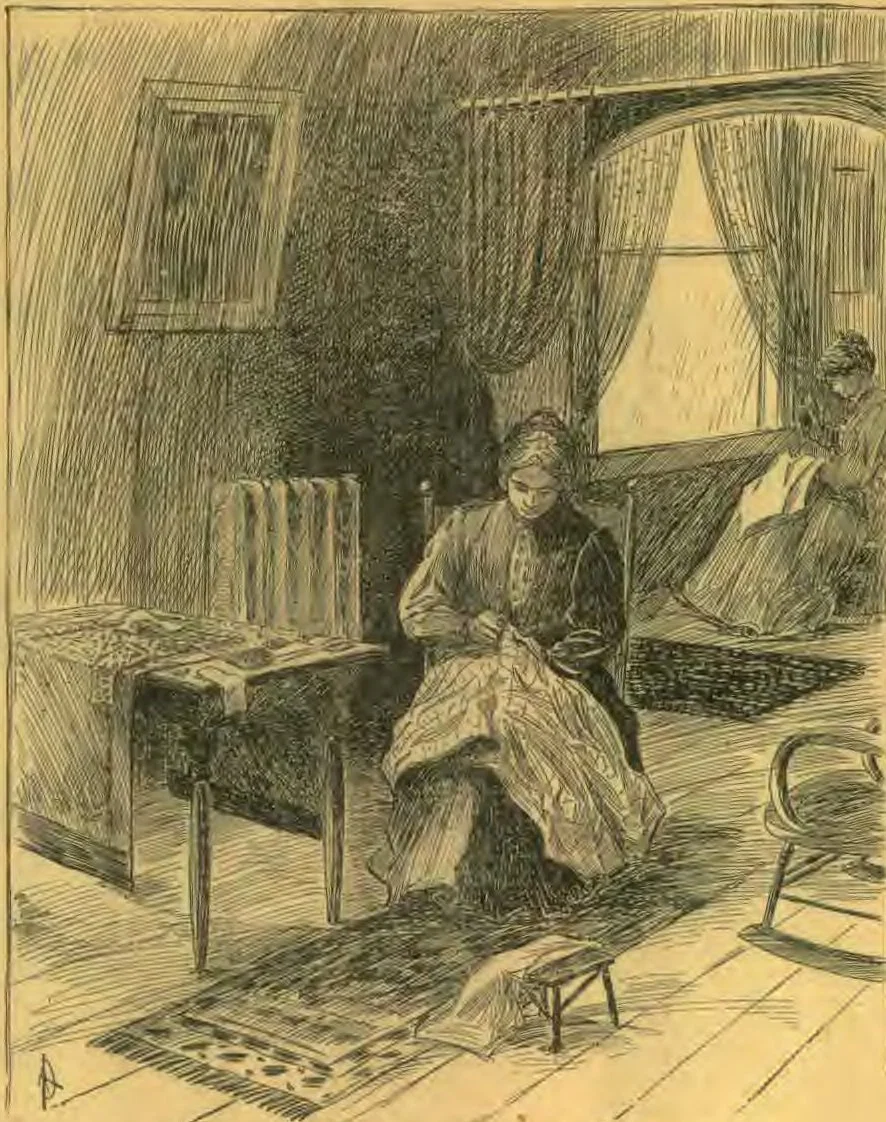
SHE had come and gone like the door on its hinges. She had begun as a pretty little blue-eyed seamstress, and kept on in the same room, at the same table, with the same pair of shears, pin-ball, needle-book, emery strawberry, thimble, and tape-line, until now.
Now, no one would have recognized in her the pretty little seamstress. Her eyes were faded and red at the corners—sometimes red all over; but those times she kept them bent down so that no one could see them. Her hair was thin and dry, only when she slyly slipped over to the stationary bowl and spatted the top of her head with the cold, running water. She never did that when any one was in.
The sewing-room was in a great, beautiful house—a good home for those fortunate beings who had been born into it. It was a beautiful room, and everybody thought Mary Graham was highly favored indeed to have secured and held such a place, with its comfortable little chair, its good light, its steady, beautiful work, and, more than all, such a considerate mistress,—one who never forgot that her sewing-woman might be glad of her money when the week's work was done; who never allowed over-hours; and, if the weather was very bad, gave her her car fare.
There was also another advantage that Mary Graham had over many others of her class,—she had to become well informed about many things, for the large, pleasant sewing-room was practically the morning-room for the whole family. Mrs. Hungerford had her work-table in a little alcove which overhung the garden, and looked westward toward the beautiful river; and here she put many finishing touches to the dainty garments for her children, wrote, read, and received her intimate morning callers, and the several committees of which she was chairman. The affairs of the Woman's Club, with its culture projects; of the W. F. M., with its many plans for converting the heathen, and of the W. C. T. U., with its reforms, philanthropies, its educational and evangelistic methods, were all discussed in open council in the presence of the little seamstress, who seemed to have even a soft pedal to her sewing-machine, so quiet and unobtrusive was she in all that she was and did.
"Mrs. Hungerford, is your little seamstress deaf as well as dumb?" laughingly asked Mrs. Northropp one day. "Not that I have anything to say, you know, but she is so very quiet."
Both ladies looked over Mary's way, but she did not seem to hear, at least unless the slight coloring of the rim of her white ear, and a sudden little splash of red on her neck, was a sign.
"Mary is a very quiet, busy little woman," said Mrs. Hungerford, in a kind, appreciative tone. "She never disturbs any one, and she does beautiful work. See this"—and, lifting a pile of delicate little garments, the two fell to examining them, and talking them over as women will.
"Well," said Mrs. Northropp, "I wish I could steal your Mary Graham, or find her double—tho that sort doesn't grow in pairs; and then it would be of no use to steal her, unless I intended to lock her in; for you have given her the best berth that any seamstress that I ever knew of, ever had. She's a fortunate girl. Let's see—how many years is it that she has occupied that corner?"
"Don't ask me," laughed Mrs. Hungerford, "for if I should go to reckoning those figures I should make gray hairs grow in all our heads. My! O, how the years have flown! It was when George was a baby, and the year that I was elected president of the Missionary Circle. We made our first missionary plans, cut out the first missionary clothes, and tried the first sewing-machine I ever owned on them. You selected that machine, Mary; do you remember?"
"Yes'm."
"There, Mrs. Northropp, you see she is neither dumb nor deaf," laughed Mrs. Hungerford. "But your voice sounds tired, Mary; are you tired?"
"O, no'm!"
"Very well, you ought to know; and if you are, you ought to know enough to pick up your things and go and stay till you get rested. That's another nice thing, Mrs. Northropp; Mary knows that she can do just as she pleases with me. I never worry about her. She comes and goes, does her part, and I try to do mine, tho sometimes she does almost sew me out of house and home, so that I have to take a day off for shopping."
"Well," sighed Mrs. Northropp, "if one's part was all done with the shopping—but, dear me—I am almost killed over the awfulness of responsibility sometimes."
"That is a consideration," said Mrs. Hungerford, "and it is a great comfort to me that my folks all seem to know how to behave themselves, from Mary down to the children and Mr. Hungerford. They all keep straight, without any bother to me, and I thank the good Lord for it every time that I hear of the goings on all about us. I am left absolutely free, without a worry, to give myself to the heathen."
Both ladies laughed quietly, and Mary worked the treadle of her noiseless machine with her back toward them, while the heart within her seemed more stony than ever, and her lips curled in a scorn that was cruel for any face to be compelled to carry. The look of scorn, however, soon changed to anguish, and in suppressing its cry, she bit into a needle which she was holding between her teeth, and only by great effort prevented the pointed half from slipping down her throat.
"What's the matter, Mary?" asked Mrs. Hungerford. "Did you swallow a pin again? That is a nasty habit you have of making a pin-holder of your teeth. Did you get it out?"
"Yes'm."
"Well, I'm thankful. I expect to find you strangled with a needle some day; then what would we do for clothes?"
That night, after all the house was quiet, Mrs. Hungerford still sat at her table in the sewing-room alcove. The lights of the city reflected in the river lay in long shafts of silver from shore to shore. She was writing; but occasionally, glancing up and out, the beauty of the scene tempted her to turn the key at her hand by which the illuminating current was cut off from the room, that she might have the friendly aid of darkness within by which to gather up the tender beauty of the scene without. As she sat with her elbow on the table, her chin on her palm, thinking over the day's work for the W. F. M., which had especially engaged her attention, suddenly a strange, new, startling thought came to her, startling only, however, because it was new. She wondered where it came from, and why just now, but more why it had never come before. It would have been a very little commonplace thought under almost any other circumstances, but under these, in which it had dropped like a lightning flash out of a cloudless sky, it was so uncommonplace as to bring her instantly upright in her chair, her hands to the edge of the table, as if to lift herself by them. She did not arise, however, but sat looking fixedly toward27the long silvery bars of light that banded the two shores of the river together. But she had forgotten them; she thought only one thing, and that was, "I wonder if Mary is a Christian."
That was all there was to it, but since Mrs. Hungerford really had a sincere heart, small as that "wonder" looks, it was enough to fill it for the time being.
"Why don't I know?" was the next thought. "How is it that I have not known? I can not wait until morning to find out—and yet I shall be ashamed to ask her. How can I ask her, after all these years, and all that has gone on in this room in her hearing? But of course she is one, and she knows that I know it. I couldn't help but know it; of course not. She will appreciate the fact that I have taken it for granted, have understood without words—yes, indeed, I shall find some perfectly natural way of introducing it so that she will not suppose for a moment that I have only just now thought about it. That would be a dreadful thing for her to know. It is dreadful, and I will see that it never happens again."
She sat on and on, her eyes fixed on the river, until the home lights had all been called in, and only those remained that were for public safety—slender threads, few and far between, shot in through the darkness of the night, only serving to make its blackness more suggestive of dangerous depths. After a while she arose, dropped on her knees, and, with her face buried in her hands, and an intolerable burden on her heart, she groaned out the prayer for herself that she could not speak, while tears trickled through her fingers until the handkerchief which she had dropped in the seat was wet.
The next morning when Mary entered the sewing-room she was surprised to find Mrs. Hungerford before her. The expression in the face of her mistress was new. But Mary was alike indifferent to expressions new and old; so, with a civil reply to the, "Good morning, Mary," which greeted her, she turned to the closet to lay off her wraps.
Mrs. Hungerford was, at the end of a long, sleepless night, weighted with a burden so heavy that she could think of nothing but how to get rid of it. Every consideration of carefulness or tact had been lost hours ago; she only waited for a chance to speak.
"Mary," she began, and her tone was so strange, with the pressure of pent-up feeling, that Mary really was moved to look at her in almost alarm, "Mary—I—I have a question to ask you; you—you—are a Christian girl, aren't you, Mary?"
Just a moment Mary stood, her face hardening every second as she slowly took in these words, and began partly to comprehend what was back of them. Then she laughed a shrill, horrible laugh, which distorted her face, and left it paler than before; then she seemed to grow tall, and taller, her eyes became cold as steel, and in a low, sarcastic tone she answered:—
"I think it is time you asked me that question."
"O Mary!" and Mrs. Hungerford sprang toward her as if to throw her arms about her; but Mary had slipped beyond them, and stood like an avenger beside her sewing-machine.
"O Mary, you are right! It is time—long, long past time!" she cried. "You don't know what I have suffered all this night. Listen!"
"Listen? No, I must get to my work. Suffered, did you say? Well, suffering that can be measured by a night will not spoil your beauty."
"Mary!"
"Yes, ma'am. Did you get the cambric yet for Miss Dorothea's slips, and the lace to edge Master Guy's ruffles?"
"Mary, O Mary!"
No answer.
"Mary!"
"Yes, ma'am."
"O Mary, don't look so hard at me! Will you not listen to me?"
"Of course I'll have to listen to you, or"—
"Or what?"
"Why, lose my place, maybe!"
"You know better. O, how unjust! But no, I deserve it. Say what you please, my poor girl; you"—
"Mrs. Hungerford, please, whatever you do, don't call me girl again. I'm a woman. I—was a girl once, but that was ages ago."
"What do you mean? Are you married?"
"O, yes, I'm married!"
"And—and children?"
"Now you stop. O!"
And before Mrs. Hungerford could anticipate her purpose, she had seized her hat and shawl, was down the stairway, and off like a wounded roe, plunging through the open spaces toward the river.
The morning and the afternoon passed, but she did not return. Several committees came to meet Mrs. Hungerford, but she excused them. She spent the early part of the day looking among old papers for an address. She had once known where Mary Graham lived, but, never having occasion to look her up, she had lost the address. She humbled herself to inquire of the servants, but not one of them could enlighten her. The late afternoon found her under a pressure of anxiety that could not be longer endured; and, calling the carriage, she started out upon the almost impossible task of finding Mary Graham among the thousands of unregistered poor of a great city; for by this time she had, as she supposed, at least classified her. She was also by this time too determined to stop with half-way methods, but went directly to police headquarters, from which, after a half hour, she emerged with a list of "Mary Graham's," only one of which could be hers, and, giving the first order to her driver, she started on a search which, before it was ended, brought her face to face with things that gave point to all the work which she had been doing at long range; and the fire which began to burn in her breast no "reports" could ever have kindled.
It was long after midnight. She had gone through her list of "Mary Graham's," and sundry experiences which she would never forget. She had taken John, the old coachman, into confidence some hours before, and he stood with one hand holding the reins, and the other on the open door of the carriage, waiting. At last, suddenly a sharp cry rang out from a partly open upper window near by in the court, and then a tender woman's voice was heard—a voice which sent a thrill through the heart of the startled listener in the carriage.
"Let me out, quick, John; that is she."
"Are you sure, ma'am? Be careful; this is a bad part, ma'am."
But she was out, and hastening by the light of a dim street lamp toward the crooning voice which still fell from the partly open window. How she found the way she could not have told—up the shaky stairway, and along the dark halls—but at last, without even a premonitory tap, she softly opened the door, from which the voice still came, tender, sweet, heart-breaking, with its burden of unspeakable love and pain. She was unnoticed, so she stood and took in the scene.
The room was very small. A lamp, shaded on one side by a piece of newspaper, stood on the table. On the pillow of a little bed, over which this shadow fell gratefully, was a pinched face, distorted by pain, while cry after cry came from the drawn lips. The head was thrown back, the eyes were dilating with that expression of surprise which acute and sudden stabs of pain will produce, and which is so pitiful to behold. In another corner, on a lounge, slept a man, whose heavy breathing, laden with sickening fumes, told its part of the story. Mary was sitting on the edge of the narrow bed, from which she had evidently suddenly arisen, and was bending low over the poor little face, with a Madonna look which made her beautiful, while with her hands she was supporting the suffering body.
Mrs. Hungerford waited but a moment, then, slipping softly back into the hall and closing the door, she stood and thought; then carefully she felt her way back to the street, and with a reassuring word to John, stopped under the street lamp, and, taking a note-book and pencil out of the bag on her arm, she wrote two, three, four, of the small pages full, folded, pinned them together, and stole noiselessly back, slipped them under the door, knocked softly, and returned to the carriage.
"No, not yet," she whispered, as John opened the door, but stood with her eyes on the window.
On the thin curtain she saw first the silhouette of a woman reading, then of an erect statue, then of a bowed form, its face in its hands; then, after a long time, the curtain was parted, and the lamp was moved close to the window, so that the silhouette was blotted out.
"Thank God! O, I do thank Thee, Father!" and with a sob of gladness, Mrs. Hungerford started quickly toward the light. But, stopping a moment, she whispered, "John, where are we?—what part of the city?"
"Well, not so very far from home now, ma'am, just off the avenue, on Gray Street. That, where the light is, is Lost Court."
"Well, then, you drive quickly home, tell Mr. Hungerford where I am, then come back. I will see you, and come down to tell you what to do."
She went up, and in a moment had Mary sobbing in her arms.
"O, did you really mean it enough for this? Then I believe—I do believe; I will come back to the God of my childhood. I had made up my mind there was no God," she whispered, "for, you see—you see him—and, O, my baby, my baby! I began to sew for you for her sake, for he hurt her, and I had her in the hospital until they gave her up, years ago; and, O, I thought nobody cared only for—you know"—
"Yes, I know; you had reason to think we only considered you as a sewing-machine; but God laid your soul upon me last night; I have found out how much it weighs, and if you had not lifted it off by beginning to believe, I think it would have crushed the life out of me. O, I never want to feel that sort of a burden again! But now we will see, dear heart, what can be done for yours."
"Everybody thought Mary Graham was highly favored."
THE RANSOMED OF THE LORD.
By Frances Eugenia Bolton
BY FRANCIS EUGENIA BOLTON.
O ANGELS who have looked upon our wo,
And read in earth sin's dire malignity,
And read in men how it can plunge us low,
And read God's love in Christ on Calvary,
To-day I think with thrilling heart that soon
Ye'll see love's consummation and reward,—
The church of Christ made fairer than the moon,
The ransomed, the redeemed ones of the Lord.
Ye've seen the lepers spotted in the gloom,
Ye've seen the paralytic, helpless, mute,
Ye've marked the madmen raving 'mid the tombs,
And seen the world-wide bearing of sin's fruit.
Ye've seen how innocence is burnt from brows,
Seen lovely eyes with hate grow wild and hard,
And sorrowed gentle ones; but now hope glows;
Ye soon shall see the ransomed of the Lord.
Ye've seen the mighty bear away his prey
To death's foul prisons of decay and gloom,—
Nations swept down as harvests of a day,
To feed the world-wide gaping of the tomb.
Ye've seen the broken heart, the mourner's tear,
The God-like glory lost, the image marred;
But, O, the great Deliverer's army's near,
Ye soon shall see the ransomed of the Lord!
Down the great skies that open from the throne,
The choirs of heaven will march with harps a-ring,
And fair Emmanuel come to claim His own
From a usurping and despotic king.
The hosts of ill will wither at his eyes;
His brow by crown within a crown be starred;
His voice will bid the captive hosts arise;
The tomb will yield the ransomed of the Lord.
Then principalities and powers will fall,
And prostrate fall before the King of kings.
The ransomed of the Lord, now sad and frail,
Will rise triumphant as on angels' wings,
From continent and isle and ocean cave,
Like doves that fly the golden sky toward,
The church of God that Christ has died to save—
Will rise to Him, the ransomed of the Lord.
O, how ye'll sing, ye angels, how ye'll sing!
And how our voices, too, will swell the strain!
And how the heavenly worlds above will ring,
That we, the captives, wear no more a chain!
Ye'll hail us conq'rors in the city fair,
Where never more shall sin or pain retard.
Will ye not whisper to each other there,
And say, "How fair the ransomed of the Lord"?
Through world on world, with Christ our King above,
We'll pass, reflecting His divine, sweet grace.
And how ye sunken powers will look and love,
And marvel at the glory of each face,
Once earthly, sensual, now sweet beauty given,—
The image fair of Christ, untouiched, unmarred!
O angels, 'twill be joy enough for heaven
To contemplate this mystery of the Lord!
CHRIST IS COMING.
By Charles Miles Snow
BY CHARLES MILES SNOW.
All the elements are telling it; the sky is full of signs;
There's an ominous awakening foreboding God's designs.
E'en the timorous are telling what the mighty fear to speak,
And the powerful are cringing with the wicked and the weak.
It is God's expostulation with the wretched and the rich,
With the princes in their palaces, the drunkards in the ditch.
Christ is coming, Christ is coming, all the prophecies proclaim,
With the mighty hosts of heaven, in His chariot of flame.
He is coming, He is coming, it is written in the sky;
Earth is rip'ning for the harvest, and the harvest-time is nigh.
He has heard the cry of millions in the slavery of sin;
He has listened to the pleading of the ones He died to win;
He is gathering His armies for our liberation day;
And that great emancipation human hands can not delay.
He is whispering in the whirlwind, He is speaking in the flood,
In the perfume-laden zephyr, in the bursting of the bud.
All the stars are singing praises to the glory of His name,
While the reeling earth is groaning 'mid a load of sin and shame.
Vice parades her gaudy trappings 'mid the pleasure-seeking throng,
Tinging with enticing glamor every separate way of wrong.
Homes once happy are in ruins through the gay deceiver's wiles;
While the throng are singing praises to the drama that beguiles.
There's a luring fascination for the slinking libertine
In the comedy of passion, for a glimpse behind the scene.
Soon his blandishments are followed by the wrecking of a life,
And the bonds are snapped asunder 'tween a husband and a wife.
There's a plaintive cry ascending in a long, unceasing moan
From the law-made orphan children to the great Judge on His throne.
You may listen but a moment to the mutterings of wo
That are gathering all around you as the seasons come and go;
But the words you hear are laden with a draught of bitter dregs—
There's a great, gaunt army growing, and the ragged waif who begs
At the doorstep of your dwelling is a thorough-drilled recruit
In that massive, marching legion moving down destruction's route.
Justice heeds the cry but seldom of the innocent oppressed;
Where the glittering bribe is lacking, many a wrong is unredressed.
Wealth is marshaling its forces; labor's legions are astir;
Anarchy, the wild, red-handed, has in this its dowager.
All the nations are a-quiver with the threatenings of strife,
Pouring out a golden river for new means of taking life;
They are furrowing the ocean with a myriad ships of mail,
Ballasted like clouds of fury with a load of iron hail.
On the hill the beacon's lighted, every torch is trimmed anew,
And the ranks of moving millions gather where the harvest grew.
There's a force unseen impelling all earth's factions to the fray;
'Tis the warrior host of Satan, hastening Armageddon's day.
You have seen the stars of heaven failing as the King foretold;
Seen the moon with bloody visage; seen the sun his light withhold.
You have marked the march of knowledge with its swift increasing stride,
And the progress of invention, like an irrepressible tide.
You have seen the preparation of the armies of the world,
Waiting now the order only like swift meteors to be hurled
To the seething sea of turmoil, 'gainst the city and the plain,
Belching death in iron hailstorm, strewing all the land with slain.
God is holding still the bridle of the prancing warrior steed,
While there yet is hope in heaven and a Priest to intercede.
When redemption's work is finished in this sin-polluted land,
And the seal of God is given to His humble, faithful band,
Angel hands will stay no longer earth's impatient armed horde,
And the trodden plains will redden 'neath the threshing of the sword.
Sad will be the billows' burden where the flaming fleets go down,
With the bright-eyed sailor laddie, and the captain of renown.
Then the form of the Redeemer in the heavens will be seen,
Seated on a cloud of glory, in His hand a sickle keen.
By the hand that bled for sinners will the harvesting be done;
For salvation's work is finished, and the race of sin is run.
RETROSPECT AND PROSPECT.
THE PAST.
THE first issue of THE SIGNS OF THE TIMES was published in the year 1874, by Elder James White. It was given to the world by those who knew that God had given them a message for the people of this generation.
Its beginning was small, and in its earlier career it passed through many changes. It was issued at first as a weekly, at $2.00 a year, but during the first year—from June to December inclusive—only twelve numbers were printed. Scarcity of funds and lack of subscribers were the chief hindrances. It was then an eight-page folio, size of reading page 10¼ x 15¾ inches. Its paid circulation was limited to a few hundred copies. From that time to the year 1895 its circulation ranged from 5,000 to 15,000, reaching at one time for a little while, on short-term subscriptions, an issue of 20,000 copies.
In 1895 more diligent efforts were put forth for the paper on the part of its publishers and friends. The circulation immediately began to increase, till for the last two years in the neighborhood of 40,000 copies were circulated each week; the regular circulation of the paper stands at present little above the last-named figure; but as the paper is sold in many of our largest cities, these editions are frequently exhausted, and a new edition is printed. Our Thanksgiving number reached 60,000 copies, with orders for 2,000 still unfilled.
We confidently hope that this issue, which marks the beginning of the twenty-fifth year of its publication, will exceed 1,000,000 copies, the largest number, we believe, ever issued by any wholly religious newspaper ever published. To God give we all the glory.
OUR FACILITIES.
OUR FACILITIES.
The first copies of THE SIGNS OF THE TIMES were printed in an outside office. The second year of its publication an office was built in the form of a Greek cross, three stories in height, including attic, with a floor space of about 4,000 square feet. That building is now devoted to two clerical offices, the most of it for packing and storage rooms. In 1887 a new building was erected, of four stories, including basement, with a floor space of 40,000 square feet. The Pacific Press Publishing Company, the publisher of THE SIGNS OF THE TIMES, now possesses the most complete printing plant west of the Rocky Mountains for all first-class periodical and book work. It includes typesetting, electrotyping and stereotyping departments, press-room, job-room, book-bindery, folding-room, art and editorial departments, a complete counter check-book plant, with all necessary business departments requisite to large publishing houses. It has branch offices in Kansas City, Mo., and New York City. Its present force consists of 150 employees, and its monthly pay-roll averages over $5,000.
The first press upon which THE SIGNS OF THE TIMES was printed in its own home was a four-roller drum cylinder, Cottrell & Babcock. It was disposed of the other day as a fairly good machine still, but insufficient for our needs. As new presses have been demanded, we have ever aimed to secure the press doing the best service, and our office is now equipped with eight first-class flat-bed presses, and all except one built by the Cottrell Company.
We found, however, that our ever-increasing subscription list demanded more than the fastest flat-bed presses could supply, and, after thorough investigation of the merits and demerits, the advantages and disadvantages, of perfecting presses for book work, we placed the order with the firm of C. B. Cottrell & Sons Co., of New York. This press was built on special order, to fulfil special and exacting conditions. A cut of this press appears on page 17, and well illustrates the advancement made in the printing art during the last two decades. As will be seen from the illustration, the paper printed is fed continuously from a roll at the rear. It is then printed on both sides, folded, pasted, and trimmed, and delivered all complete at the rate of 10,000 per hour, the grade of work and fineness of illustrations determining the rate of speed. Curved electrotype plates are used, and special machinery not shown in the engraving was built for making these plates. This is not a newspaper press, but was built for doing finer grades of book and periodical work. It is provided with Cottrell's patent "shifting tympan," a unique device for the purpose of preventing "offset." This "shifting tympan" is so arranged that a clean sheet can be made to cover the cylinder at the will of the operator, while the press is in motion. The machine is 18 feet 8¼ inches long, 11 feet 7½ inches wide, 7 feet 7½ inches high, and weighs 36,000 pounds, including the auxiliary machinery. It is the only press of the kind on the Pacific Coast. Presses similar to this are used on which to print some of the great illustrated journals and magazines of the East. This press has also an attachment for folding tracts and book signatures in 16-page forms. A sample of the work of the press is shown in this million-copy edition of THE SIGNS OF THE TIMES.
THE FUTURE.
The past, with its conflicts, its failures, and its successes, we leave with God. The question which most concerns us now is the future as unrolled in the ever-living present.
One writer has well said that "intensity is taking possession of every earthly element." Old controversies are being revived. New controversies are springing up. In this generation is being waged anew the conflicts of all past ages.
Uncertainty is a manifest factor everywhere,—in politics, in science, in the great social questions agitating the world; and nowhere else as in religion. An unbelieving and inconsistent hypothetical "science" boasts that it has overthrown and undermined the Bible. Ancient heathen cults rear their heads aloft, demanding attention. Men who have seemed to be pillars in Christianity have patronizingly bent the knee to the advocates of these ancient religions, and have drawn before their Christian hearers beautiful pictures of moral theories, which are as destitute of life as painted canvas or chiseled marble. To the blurred vision of many the foundations of Christianity seem to be shaking. Professed believers are reeling in their faith. The trumpets of many of the professed watchmen give an uncertain sound. The cry arises from many an anxious heart, "Watchman, what of the night?" The answer, if answer at all, is incoherent; and the questioner stumbles on in darkness or sinks in despair.
The church at large is partaking of the spirit of the world. More than this, she is appealing to the weak, vacillating, ineffective arm of civil power to assist her in religious matters, forgetting that the Egypt or Assyria of earth will, as a staff to Jerusalem, ever prove a broken reed which will pierce her heart with fatal wound.
Is it God's plan that His church, the children of Him who is light, shall remain in darkness and uncertainty?—It is not. "Surely the Lord God will do nothing, but He revealeth His secret unto His servants the prophets." "We have also a more sure word of prophecy; whereunto ye do well that ye take heed, as unto a light that shineth in a dark place, until the day dawn, and the day star arise in your hearts." "The wise shall understand." "Whoso is wise, and will observe these things, even they shall understand the loving-kindness of the Lord." "The secret of the Lord is with them that fear Him; and He will show them His covenant."
God has in the earth, and ever has had, His servants who know Him, who know His mercy, who know the power of Christ's resurrection, who know the knowledge of His will, and who know the message for the time. They are men who have "understanding of the times, to know what Israel ought to do;" they are watchmen who can tell when the night of sin is about to close, and when "the morning cometh;" they are householders who will give to those in need their "portion of meat in due season;" they are faithful men who will "cry aloud and spare not;" they are faithful ambassadors, lifting up the Lord Jesus Christ, the Crucified and Coming One, as the world's only hope.
"And this will we do, if God permit," in The Signs of the Times. We will, in the strength and wisdom given of Christ, be true to our motto: "As we were allowed of God to be put in trust with the Gospel, even so we speak; not as pleasing men, but God, which trieth our hearts;" because the only way by which the world of humanity can be truly benefited is the way which is pleasing to God. That way is the way of the Gospel, "the power of God unto salvation to every one that believeth," the sole remedy for all earth's ills.
As God in Jesus Christ is Creator and Saviour of all, The Signs of the Times will preach the Gospel to all, whether rich or poor, high or low, of whatever race, or nation, or religion, or creed. That Gospel is able to convert and save the sinner to the uttermost, and to comfort and build up the child of God. It is a complete Gospel, which takes cognizance of the body as well as the soul, the physical and mental needs as well as the moral and spiritual necessities; which sets men free in Christ Jesus from every form of bondage and slavery. It is able to restore in the lowest the lost image of God.
Amid the uncertainties in politics and society, in State and Church, in science and religion, The Signs of the Times will give, as God gives wisdom, the certain sound of the divine message to the world. It will show from that Word where we are in the great stream of time; what mean the wonderful developments in every phase of life, the deep intensity taking possession of every earthly element, the perplexing conditions among all the nations of earth, the increasing perils in the moral, ecclesiastical, spiritual, and physical worlds.
But the Signs will not be sensational. While it believes that we are rapidly nearing the end of the Gospel age, we are not "time-setters." In faithfulness to God's Word we can never be. But we do know and will demonstrate from a multitude of predicted omens and the living facts before the eyes of all, that the coming of our King draweth nigh. Certainly, if this be true, it is a matter, not of mere sensation, but of the profoundest thought, the maturest deliberation, and the wisest decision on the part of every soul. There is world-wide agitation over the Sabbath question in both Church and State, which "will not down." The true Christian will desire above all things to know God's mind with reference to the question; and this we shall endeavor to present in all its varied phases, as related to the State, the church, the29individual.
In brief, The Signs of the Times will stand for every true reform embodied in the Gospel of Jesus Christ. It will be a true religious home paper for all classes. It will endeavor to bridge the chasm between men by uniting them at the Cross.
In all these reforms, in spreading the Gospel of Jesus Christ, in lifting by the power of the Cross fallen men to the throne of God, in driving away moral darkness by the beautiful light of truth, in making souls everywhere stronger, better, happier, in the only way by which true happiness ever comes, we ask, kind reader, your coöperation. May we not count you our co-laborer in Christ Jesus?