By Elder Uriah Smith, Author of "Thoughts on Daniel and the Revelation."
THAT we are living in an age of wonders multiplying in number and growing in power, none will deny. So nothing that may here be said will be understood as offered to prove that fact. But the thought intended to be emphasized is the significance of these events as fulfilments of the prophecies of the Bible, and their efficiency as a means to carry out the work the Lord has to do in the last days, together with their potency to accomplish great revolutions, which will give existence to those conditions so clearly set forth in the Scriptures as signs and immediate precursors of the impending day of the Lord.
In view of the wonderful discoveries of the present age, and the great achievements accomplished by increased knowledge in the arts and sciences, the question is often asked if these things do not show that the world is yet in its infancy, and just waking up to its possibilities, and that the real life and efficiency of the human race is yet before us, and must occupy generations still to come. The answer to this question must be in the negative; for the wonderful things so suddenly and surprisingly accomplished at the present time by chemical and mechanical discoveries, are not the indications of infancy and childhood. They are not the work of puerile and uncultivated minds. They indicate rather the result of mature and cultivated powers. And this view of the situation is strengthened by the fact that the prophecies foretell just such an awakening of the human mind, and such manifestations of its powers, as one of the peculiarities of the last days. Let a few texts suffice in evidence: "But thou, O Daniel, shut up the words, and seal the book, even to the time of the end; many shall run to and fro, and knowledge shall be increased." Dan. 12:4.
There are but two directions in which the application of this prophecy can be attempted. One is, to take the running to and fro in its most literal sense, and let it refer to the tide of travel, which, as the result of modern inventions in the field of locomotion, is sweeping like a tidal wave over the world; and let the knowledge which was to "increase," refer to such knowledge as pertains to discoveries and progress in the arts and sciences in general. The other is to apply the running to and fro to the study of the prophecies, turning back and forth in the inspired books, and so causing the knowledge of the sacred Word to be increased.
But in whichever way we may apply it, we have before our eyes the most emphatic fulfilment of the prediction. The "time of the end," to which the book was to be closed up and sealed, and when, consequently, it was to be opened, commenced in 1798, an epoch marked by the ending of the two great prophetic periods, the 1,290 and 1,260 days, of Dan. 7:25; 12:4, 7, 11; Rev. 11:3; 12:6, 14; 13:5. A great prophetic era like this,—when the word of prophecy takes such prominent notice of earthly affairs, when from the book shut up by divine direction for over twenty-three hundred years the seal is lifted, and the time comes for knowledge to be increased,—can not but denote the loosing of all the shackles from the human mind which had so long restrained it from the exercise of its highest powers, and the opening of an era of progress and achievement, when the mental and spiritual endowments of men should assume a greater dominion over the lower and material forces of nature.
God said to Job, "Canst thou send lightnings, that they may go, and say unto thee, Here we are?" Job 38:35. Tho this may not be a direct prophecy of the electric telegraph, it is the seed thought of the scheme for transmitting thought to distant points, and receiving an intelligent reply, by means of electricity, or the lightning, and a suggestion that such a thing might sometime be. Nearly five million miles of wire now constitute the highway over which the nimble feet of the lightning speed to bear their messages from land to land. By steam propulsion on land and sea, defying time and distance, and the operation of the telegraph, the whole world has, as it were, been condensed from a vast expanse of terra incognita, into a little hamlet of contiguous neighbors; and national relations and conditions throughout the globe are thereby all changed.
Still other scriptures speak of the manifestation of great signs and wonders to appear in the last days; and, though these pertain mostly to the spiritual world, nevertheless they could not appear except under the very condition of civil and religious liberty which is the boast and characteristic of the present day. In the midst of the great tide of discovery and invention which has been rising so rapidly during the last fifty years, it is difficult to single out any portion of the time as preeminent over the remainder, as peculiarly a period of invention; and while the quarter century immediately past has been marked by some notable inventions of its own, it has been perhaps as much distinguished by improvements in preceding inventions, and by carrying them forward to perfection, as for new ones. Witness the multiplex system of telegraphy, by which different messages may be sent in opposite directions at the same time, on the same wire. Look also at the improvements in the steam-engine, sewing-machine, etc., etc.
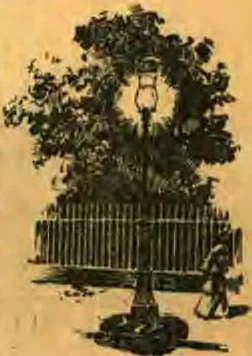
It might be appropriate at this point to call attention to the fact that the electric light was invented in London, in 1874, the opening year of the quarter century now under consideration. What that has been in behalf of light in the natural world, such has the SIGNS OF THE TIMES been in the spiritual world. The experiments by which electric lighting has been brought to its present state of perfection and utility, were successfully accomplished by Thomas A. Edison, in the years 1878–1880.
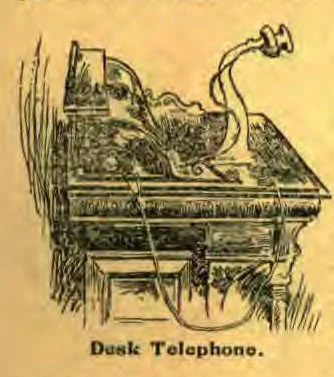
The telephone has so increased in use the past twenty-five years that, although experimented with as early as 1860, it may be considered as belonging to this period. The principle was exhibited in Frankfort, by Johann Philip Reis, doubtless the first and real inventor, in 1861. He died in 1874. But the idea was worked out into more practical shape by Professors Elisha Gray, A. G. Bell, and, later, by Mr. Edison. Professor Bell was the first to perfect his patent; and his articulating telephone was tested by experiments at Salem and Boston, Feb. 12, 1877. Edison's carbon loud-speaking telephone was brought out in 1878. Nineteen years elapsed, and the telephone statistics for 1897 show the following marvelous figures: "Total miles of wire in use, 536,845; number of instruments in the hands of licensees, 772,627; number of change connections for the year, 847,000,000; capital of the company, $23,650,000."—World Almanac for 1898.
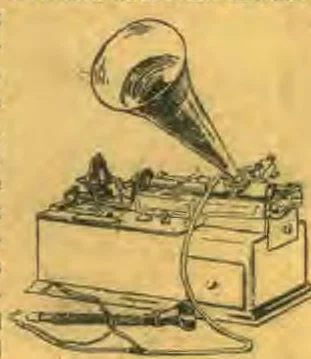
The phonograph is an invention of a similar nature. In this the vibrations of the diaphragm, under the impulse of the human voice, reproduce the voice, not by forming electric connections, sending the electric current to the other end of the wire, and causing a like diaphragm to make the same vibrations there, but by simply actuating a needle-point attached to the diaphragm, beneath which slowly revolves a cylinder coated with some soft substance, upon which it impresses its indentations corresponding to the vibrations of the diaphragm. Now when the pointer is caused to pass through the same groove again, it follows the same indentations, and causes the diaphragm to repeat its vibrations, and so the voice is heard again. It was invented by Edison in 1877.
The graphophone is simply a modification of the phonograph, involving better material and more skilful construction rather than any new principle. It was invented by Mr. Chas. S. Tainter, who, instead of tinfoil, which was less durable, used a mixture of wax and paraffine to coat the cylinder and attached one or more trumpet-shaped tubes over the diaphragm to augment and project the voice. This instrument is able to reproduce speeches, songs, music of all kinds, even to a whole orchestra, and every kind of sound, in the most natural and pleasing manner. Thus can be brought to the rooms of the helpless and infirm, profitable addresses and all first-class entertainments.
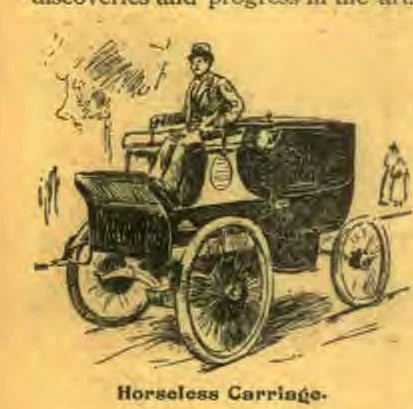
Another invention destined to modify largely existing social conditions is the "motor cycle," "automobile," or "horseless carriage."
Bicycles have proved such an immense success, the annual output having now reached the astonishing number of three-quarters of a million, that inventors are greatly stimulated to take the next logical step, which is to bring out a carriage capable of conveying two or more persons, self-propelling, and cheaply operated by electricity or gasoline.
This will change the whole, complexion of country and suburban travel over common roads, said roads being necessarily vastly improved for this purpose. In anticipation of the demand which will exist for such vehicles, many manufacturing firms are preparing to embark in the business of their production. When such conveyances come into general use, as they will when they can be furnished at moderate prices, they will crowd out from cities and the highways the horse, which in many respects is considered a very "unneat and dLnice animal." This will greatly promote the sanitary condition and pleasing appearance of our cities, as is already beginning to be done through the displacement of the horse by the bicycle, motor cabs, motor delivery wagons, cable and electric cars, etc. The time may soon come when horses will be demanded only for some necessary work on the farm, and for fancy turnouts, which the wealthy will doubtless persist in maintaining. In some places, already, the price of horses has gone down to almost a nominal figure.
In the line of discoveries to alleviate the sufferings of the sick and wounded, as well as for other purposes, we have two very important achievements. One is what is known as the Roentgen or "X" rays, and the other is the production of liquid air in commercially available quantities. By the "X" rays the bones of the human body can be seen through the flesh, and any foreign substance in the body, like needles bullets, etc., can be discovered and located. The surgical operation necessary to remove them can thus be greatly facilitated. The advantages of this discovery in alleviating human suffering and saving life can hardly be overestimated. Had this been known in the days of Garfield, the fatal bullet might doubtless have been extracted, and his life saved.
And now comes liquefied air, called "the newest wonder of science." Liquid air is air from which the heat has been so far extracted that the temperature is reduced to 312° below zero. In this condition it is a bluish semi-transparent fluid, and can be poured from vessel to vessel. One cubic foot of it represents 800 cubic feet of common air. When returning from its liquid to its natural condition, it evolves tremendous power, which can be utilized for any purpose for which power is wanted. Besides this, it will be of untold utility in cooling rooms, preserving food, and arresting yellow fever, which can not live within the frost line. It is thought that this discovery may even solve the problem of aerial navigation, as the only desideratum now to be supplied to carry out that conception, is the production of sufficient power without involving too much weight. The first ounce of liquid air produced is said to have cost an English laboratory $3,000. But Prof. Chas. E. Tripler, according to an illustrated article in the Cosmopolitan for June, 1898, has discovered a method by which in fifteen minutes he can have a stream of it running from his apparatus into any proper receptacle, and can keep that process up all day, at comparatively little expense. It is spoken of as "opening up immense possibilities," "the potential applications of which are simply revolutionary." It is further declared that "it is probable that even electricity is not destined to be of greater service to mankind."
Still standing, as we are, within the lurid glare of the late war with Spain, it is unnecessary to speak of the phenomenal armored ships of war, and the great guns. In the fierce iron duel, for years past, and even still in progress, between defensive armor-plates and piercing shot and shells, it is still undecided which will win, the efforts to produce a steel plate which it will be impossible for any shot to pierce, or a shot which it will be impossible for any plate to resist. So far the shot have come off victorious. A thirteen-inch shell, that is, a shell thirteen inches in diameter and several feet in length, weighing over 1,100 pounds, discharged with a force that will propel it thirteen miles in a clear flight, is a terrible weapon of destruction. Such weapons, and such discharging power, could not have been, or at least were not, produced twenty-five years ago. It would seem that no floating breastworks, nothing short of solid land fortifications, could withstand the impact of such a shot. But the field of invention is still open, and stranger things than have yet been seen may come to pass.
The rapid-fire guns, carrying shot of from one to six pounds, and the machine guns, automatically loading and discharging 1,000 shots per minute, till the movement can be compared to nothing but a stream of lead like a stream of water from a powerful hydrant hose, can not be passed by. Before such a gun, an army of quivering flesh and blood falls like grass before the scythe, or, to keep up the consistency of the figure, like grass before the sweeping mowing-machines of the present day. Witness the results in the late conflict in Africa between the forces of the Mahdi and the English under General Kitchener, the latter being provided with these terrible machine-guns. By means of these, with a loss of only a few hundred men on the part of the English, 18,000 of the enemy were slain, and 17,000 wounded, in the brief engagement.
But all the changes wrought are not in the line of death-dealing weapons. Improvements in surgical instruments and practise have been marvelous; also improvements in food and sanitation, care of the sick and wounded, and all the arts of industry and peace; and many of these have grown out of the demands made upon the profession by the exigencies of war. This seems appropriate on the ground that God often causes the wrath of man to praise Him. As an illustration, weather bureaus and signal-service, which have now come to occupy so prominent a place, and are doing such a beneficent service in behalf of property and life, arose out of an incident in the Crimean War. A terrible storm caused great damage to the English fleet. It was soon ascertained that a like storm had visited France but a few days before, and had traveled eastward. Tracing its progress, it was found that it was the identical storm; and, had it been reported, they in the Crimea would have been forewarned, and had time to prepare for it, and avoid the loss. The thought that just such things were probably happening all over the earth, and should be made a study and science for human protection, has led to official weather forecasts and weather bureaus, which are proving such a safeguard against danger to life and property.
But, alas! the tendency in human affairs is more to turn good into evil than evil into good; and so from the inventions and improved methods for producing the necessities of life in the direction of light, food, clothing, and transportation, arise the great combinations of capital, the monopolies, the trusts and syndicates, which, by crowding out individual workmen and small capitalists, are sowing such seeds of discord between labor and capital, and bringing distrust and alarm in all the industrial world. Who can not see that these causes are bringing us right into that condition of things which is to exist when "the Judge standeth before the door." James 5:1–8; Luke 21:25–27.
But, amid the coming "wreck of matter and the crush of worlds," there will be hope and safety in God and His promises. Joel 3:16; Acts 2:21; Heb. 12:26–29.
Uriah Smith.
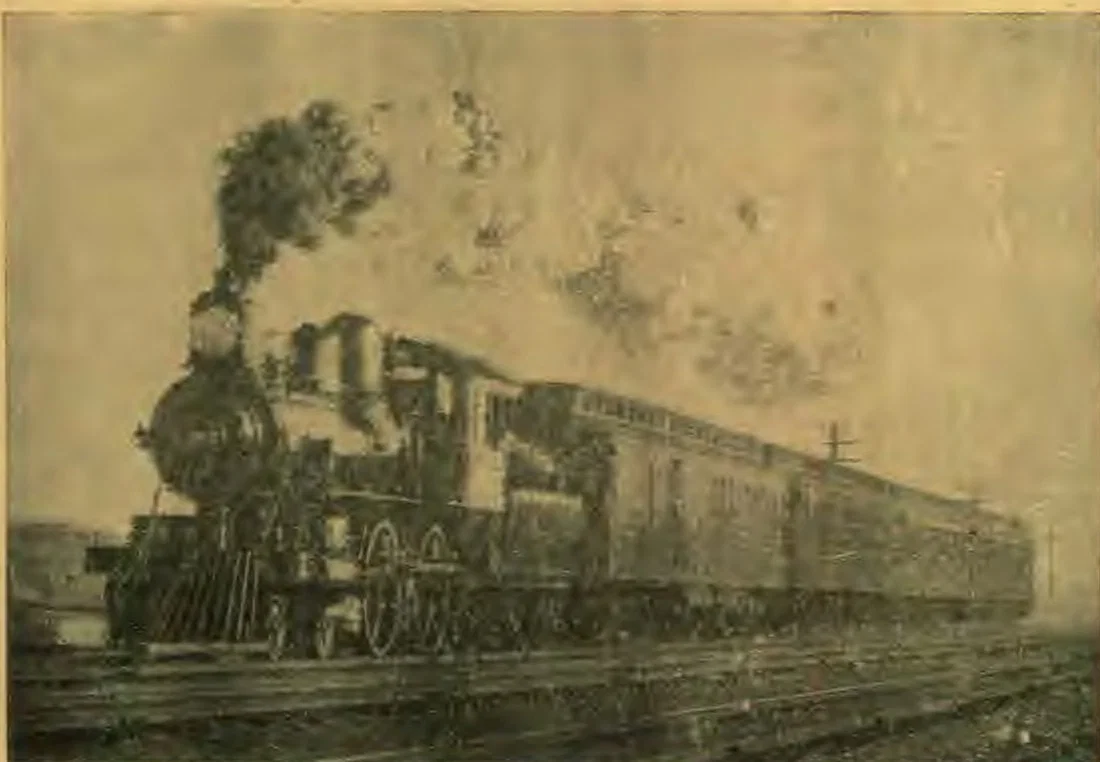
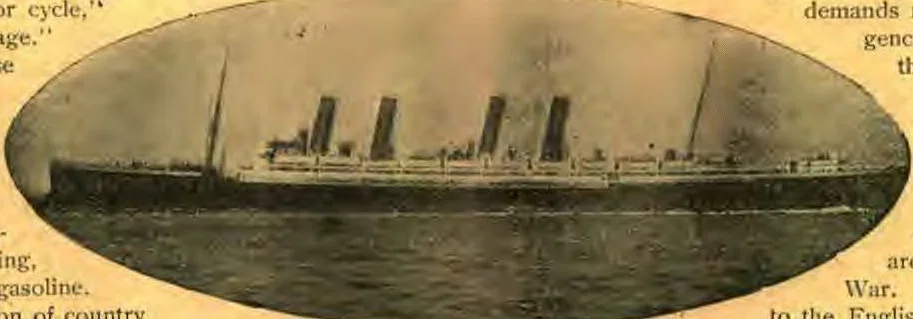
THE EMPIRE STATE EXPRESS.
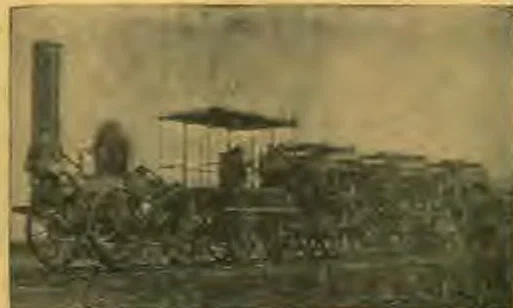
The De Witt Clinton, First Train on the New York Central Railway.
The Phonograph.
NOTED INVENTIONS.
Quadruplex telegraphy, invented by Thomas A. Edison, in 1874.
The dynamo was constructed by Siemens & Halske, of Berlin, in 1874.
The "Ordinary" bicycle was invented in 1874. The roller process in milling was introduced in 1876. The Bell telephone was invented in 1876, and Edison's carbon transmitter was introduced in 1878. In 1893 there were more than 600,000 telephones in use in the United States.
The cantilever principle in bridge building was first employed in 1876. The phonograph was invented by Edison in 1877. In 1879 the first electric railway was operated in Berlin by Siemens. In 1879 Edison produced the incandescent electric light.
Electric Light.
Electric Light.
In the decade from 1886 to 1896 we have the graphophone; Pull-man and Wagner cars, and vestibuled trains; Harveyized armor-plates; artificial silk from pyroxylin; horseless carriages; the Zalinski dynamite gun; the Mergenthaler linotype machine; the Welsbach gas burner; the Krag-Jorgensen rifle; Langley's aerodrome (a steam flying-machine); acetylene gas from calcium20carbide; discovery of argon (a hitherto unknown element in the atmosphere); the Roentgen rays, or "X" rays; Edison's fluoroscope for seeing with the cathode ray; Tesla's discoveries in electricity; liquid air produced in commercial quantities; the21kinetoscope; the web perfecting press; the modern bicycle; transmission of pictures by telegraph; the cash register; a fluorescent light bulb, produced by both Edison and Tesla, giving light without heat; welding of metals by electricity; development and improvement in typewriters; artificial diamonds produced from pure carbon compressed by the shrinking of heated metal; and the eophone, for detecting the direction of sounds during a fog or storm.
In 1898 Prof. Henry A. Rowland, of Johns Hopkins University, invented a device for sending eight messages over the same telegraph wire at the same time, four in each direction. In the same year Prof. S. W. Burnham, the astronomer, invented a calculating machine, by which multiplication and division and the extraction of square roots and roots up to the ninth power are accomplished by the mere movement of a hand upon a disk.