"They have healed also the hurt of the daughter of My people slightly, saying, Peace, peace; when there is no peace."
This method of treatment, merely to heal slightly, is quite popular in the world to-day. The effort to make people feel well when they are not well, is manifest in the treatment of physical as well as spiritual diseases. It produces an immediate effect, and that is what many want. The man who can preach something that will ease the consciences of men, and allow them to do things that are wrong, often becomes immensely popular. The doctor who can prescribe something that will instantly cure a headache, at the same time allowing the individual to continue indulging the appetite in things which produce it, is not the man that is likely to look in vain for business. In each case it is simply saying, "Peace, peace, when there is no peace." The hurt is healed but slightly.
The promptings of conscience are merely an indicator, showing that the man is sinning. Pain is the physical conscience, which tells a man that he is violating the physical law. Symptoms are merely indicators of the condition. To smother them arbitrarily, without removing their cause, is like removing the red signal-light that has been put out to stop a passenger train from plunging into a terrible chasm. Without doubt the sight of such a danger-signal would cause considerable anxiety to both engineer and conductor and to such of the passengers as might see it; they would feel much more comfortable if it were removed, but how woful would be the consequences! It would certainly be much easier to take down the lantern than it would be to rebuild the bridge; but rebuilding the bridge is the only safe thing to do. So when a man has wrecked his health, and nature begins to hang out warnings and danger-signals in the form of aches and pains and sleepless nights, simply to smother these is as absurd as to remove the lantern. The man must set to work to rebuild the wreck. This can not be done by swallowing sundry pills and drops. The remedy must be more potent.
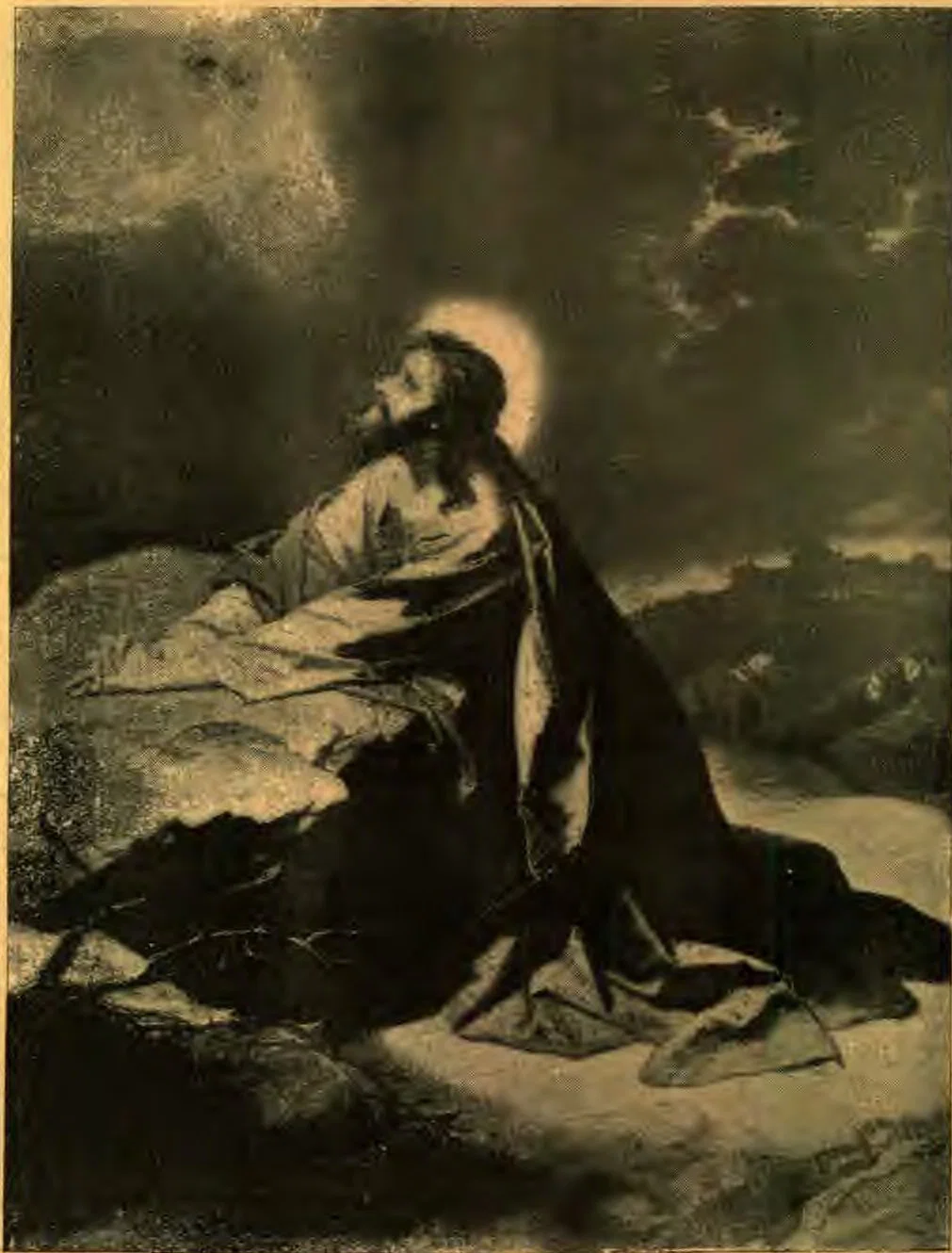
CHRIST IN THE GARDEN—From Hoffman.
It is true that there is a multiplicity of diseases and innumerable symptoms. If we were to deal with each one separately, it would indeed be a well-nigh hopeless task; but when we realize that there are only a few ways of becoming sick, and that, if we will live strictly in accordance with a few simple principles, health is an assured thing, the problem is much simplified. All that is necessary to cure any case that is curable at all is to bring ourselves into harmony with the law that is violated, the application of a few simple principles. In order to understand this fully, we must recognize that physical and spiritual laws are parallel; and a glance at the spiritual side of the question will help us to understand the physical.
Before Martin Luther's time every spiritual disease had a separate remedy. If a man had stolen, he would go to the priest to find out the remedy, and he was told to do this or that as a penance. If he had borne false witness against his neighbor, this required an altogether different treatment. Thus there grew up a colossal system of spiritual therapeutics, and none but the spiritual doctors, who were called priests, were supposed to know what to do for the various cases of sin. The subject was so complicated that the common people did not feel that they could ever understand it. But in the fulness of time Martin Luther and other reformers arose, and stated that while there were hundreds of ways of being spiritually sick, there were only a few principles that were violated, and the principles underlying the cure were simple. Luther prescribed justification by faith in Christ, and suggested the reading of God's Word, prayer, doing good to others, and meeting together to recount their experiences. The priests ridiculed the simplicity of this treatment, and tried to hold a vail of mystery before God's plan for the forgiveness of sin; but God's simplicity in treating spiritual diseases finally triumphed.
Exactly the same principle is applicable in physical disease. There are over sixteen hundred ways of being sick, but only a few ways of becoming sick; it is the violation of a few simple principles that brings on this host of diseases, as lack of fresh air and exercise, improper dress and diet, impure water, worry, and distrust of God. To effect a cure, we must bring the patient back into harmony with the laws he has violated, by coöperating with nature and by the use of her simple remedies. This brings the patient into harmony with God, who works mightily in him, and restores him physically, even as He does spiritually under similar conditions.
There has been a tendency to treat physical symptoms as the priests in the Dark Ages treated spiritual symptoms, and the same effort to keep from the people the simplicity of getting well as there was then to keep from them the simplicity of spiritual restoration. But we are now in a time when there is abroad in the land a physical reform, even as there was then a spiritual reform. Recognizing that God works in disease as well as health, all we have to do is to remove the obstacle that we have placed in the way, and unless the man has committed the physical unpardonable sin, so to speak, he will recover, as verily as he does spiritually when he comes into moral harmony with God.
CHRISTIANITY A LIFE.
WE commend the following from the great historian of the Reformation, D'Aubigne (Book 14.)
"The Reformation was accomplished in the name of a spiritual principle. It had proclaimed for its teacher the Word of God; for salvation, Faith; for king, Jesus Christ; for arms, the Holy Ghost; and had by these very means rejected all worldly elements. Rome had been established by the law of a carnal commandment; the Reformation, by the power of an endless life.
"If there is any doctrine that distinguishes Christianity from every other religion, it is its spirituality. A heavenly life brought down to man—such is its work; thus the opposition of the spirit of the Gospel to the spirit of the world was the great fact which signalized the entrance of Christianity among the nations. But what its Founder had separated, had soon come together again; the church had fallen into the arms of the world; and this criminal union had reduced it to the deplorable condition in which it was found at the era of the Reformation.
"Thus one of the greatest tasks of the sixteenth century was to restore the spiritual element to its rights. The Gospel of the Reformers had nothing to do with the world and with politics. While the Roman hierarchy had become a matter of diplomacy and a court intrigue, the Reformation was destined to exercise no other influence over princes and people than that which proceeds from the Gospel of peace.
"If the Reformation, having attained a certain point, became untrue to its nature, began to parley and temporize with the world, and ceased thus to follow up the spiritual principle that it had so loudly proclaimed, it was faithless to God and to itself. Henceforward its decline was at hand. It is impossible for a society to prosper if it be unfaithful to the principles it lays down. Having abandoned what constituted its life, it can find naught but death.
"It was God's will that . . . a striking contrast was to make this truth stand gloriously forth. One portion of the Reform was to seek the alliance of the world, and in this alliance find a destruction full of desolation. Another portion, looking up to God, was haughtily to reject the arm of flesh, and by this very act of faith secure a noble victory.
"If three centuries have gone astray, it is because they were unable to comprehend so holy and solemn a lesson."
THE DEMAND FOR A DEFINITE MESSAGE.
By J. O. Corliss
BY ELDER J. O. CORLISS.
At sundry stages in earth's history, God has given definite messages through His ministers, all of which were well calculated to arouse moral sensibility, and institute an era of moral reform. Each of these various messages has been a definite, unmistakable call to the people to separate themselves from some general overspreading evil, which threatened the existence of God's rule among men.
Beginning with the days of Noah, we learn that the world had then become so corrupt that every production of men's thoughts was toward evil. Gen. 6:3. The world was, in fact, so nearly sunken in evil that the days were numbered when it must go down, and its corruption be purged. One family alone was found that had not succumbed to the universal depravity. To the head of this house the Lord gave commission to build an ark for the saving of himself and house. Gen. 6:13; Heb. 11:7.
Through this man, during the 120 years in which the ark was preparing for the reception and salvation of those who believed the peculiar message of that time, the Spirit of God proclaimed to the antediluvians the one special, definite message of a coming flood. 1 Peter 3:18-20.
Coming down a little farther in the stream of time, we find the "cities of the plain" situated in the borders of the "pleasant land," which had already been assigned by the promise of God to a peculiar people, given over to fornication and other terrible sins. Gen. 18:20; Jude 7. The time of their extinction had come, and yet in the mercy of God, He would not destroy them without first sending a message of warning, by which they might escape impending doom. Lot, the nephew of Abraham, heeded the warning and used all the time of probation given the inhabitants of that and the cities of the plain, in warning others of their destruction. The message was definite and clear, one just suited to the needs of the people and the times, as God's special messages always are.
It was just the same in the days of Elijah. All Israel had departed from the true service of God, and were following in the ways of the sun-god Baal. 1 Kings 18:17-22. Baal's 450 prophets had so confused the people's minds that, although they seemed desirous to be right, they were quite wedded to that which was contrary to God's commandments. The burden was therefore laid upon one lone tho faithful man to proclaim a definite message of reform,—one which would, if heeded, radically change the customs and worship of the people. The time had come for this distinct message, in order that Israel might be saved from utter extinction as a part of God's inheritance.
Just before Christ appeared upon earth as the Messiah, the professed people of God had again become corrupt. So far had they descended, indeed, that simony stalked abroad in daylight. Even the highpriesthood was put upon the market like meat in the shambles, and sold to the highest bidder. The moral sensibilities of men had become so blunted that they even descended below the dumb animals in failing to acknowledge the gifts of a benefactor; for while an ox always knows his owner, and the dull ass distinguishes his master's crib from all others, Israel did not know or consider that the Lord had nourished and brought them up. Isa. 1:2-4.
At such a juncture it was necessary for the most potent remedy to be applied in order to rescue God's people from the terrible depths to which they had descended. At this time God came in the flesh, revealing Himself to the human race, that His people especially might reform, and be brought into conformity to His will. It matters not that His own rejected Him and gave Him over to be crucified; that but proves that the time was ripe for a moral reform to be wrought through just such a definite message as was given by the Son of God,—a message, indeed, which contravened all the religious teaching of that time.
True, that message did not turn all the professed people of God into the way of reform; but it did establish an apparently small beginning, which was designed, like leaven, to permeate all ranks, and call out from the masses those who would hold aloft the standard of righteousness to the glory of God.
But the enemy of all good has persistently opposed the growth of grace in the human heart, and has assiduously worked to stop its progress. This has not been altogether by standing off and using strong language against the requirements of God, but in bringing into the sacred assembly of the people—the church—such measures as would oppose the progress of true Christianity. This is really what is meant by the warning of the apostle when he said that the man of sin would so oppose and exalt himself above all that is called God as to sit in the temple of God (the human heart, or conscience, and the aggregate of such hearts, the church, 1 Cor. 3:16), and there reign as God. 2 Thess. 2:4.
Beginning with the so-called conversion of the emperor Constantine in the early part of the fourth century, the way was opened for the full development of just such a work. Acknowledging Christianity in words, but refusing to leave paganism behind, he laid the foundation for the Papacy, which in the sixth century was clothed with power to correct heretics, even to their extermination. For more than a thousand years it pursued the humble followers of Christ with relentless hatred. The Word of God shared the same fate as the innocent worshiper in the sentences of pope, council, prelate, and religious magistrate, and the auto da fé, the fagot, and the flame were called to the work of their destruction.
Thus things went on until it seemed impossible for them to be worse. In the sixteenth century the notoriously depraved Leo X. was occupying the papal chair. Indulgences for sin were freely hawked about the streets, while the Bible and its adherents were hunted to death. At this very juncture the stentorian notes of reform began to sound forth from the lips of an Augustine monk, Luther by name. Thousands rallied to the support of the message so clearly sounded at that time, and the great Reformation began.
Step by step it moved on, calling to its ranks, as necessity demanded, such men as Calvin, and the Wesleys, with their co-workers, each one adding measures of reform to the swelling tide. All these did noble work in their day, but Satan has stood strongly against the tide of reform, lest it should bring the professed church of Christ up to the high standard which He left for His disciples to follow. Divisions exist in the professed church of Christ. Her creeds are as numerous as her costly towers. Confusion—Babylon—exists, which can only be annihilated by the unity of the faith of Jesus Christ in that work which in the beginning brought order out of confusion, cosmos out of chaos. But faith in the Word is weakened by "higher criticism" and infidelity in the churches. The religious establishments have, therefore, as a result, become worldly, wealthy, and popular, with a growing tendency to dominate religious beliefs and practices. They have accordingly united the interests of the civil power in their behalf, exactly as did the Papacy in its development to a persecuting power, and so the tide of true reform to a higher life in the nominal church has been stayed, and a rapid decline has become noticeable.
The only remedy for this is another definite message, which shall, as God's messages have ever done, demand a separation of His people from every unclean thing. 2 Cor. 6:15-18. This message must be such as to separate men from every earthly support, in order that their faith may be wholly in the power of God. This will call forth such a reform in men as to present a positive contrast between the practice of their lives and the lives of those who reject the message.
Besides this, the time has come for the gathering together of a people who shall be translated at the soon coming of Christ. 1 Thess. 4:15-17. The signs of that coming are nearly all fulfilled. The sun and moon have been darkened (1780); the predicted meteoric shower occurred in 1833 (Rev. 6:13); wars are on every hand; the sea and the waves roar, to the destruction of their traffic, and men's hearts are everywhere troubled regarding what is to come on the earth (Luke 21:25-27). The time has surely come, therefore, for a ripening message which shall prepare men for translation, so that when the Lord comes, He may receive as His own those in whose mouth is no guile, and who are without fault before the throne of God. Rev. 14:5.
Battle Creek, Mich.
The Last Reformation as Predicted by Prophet, Apostle, and Reformer.
By Francis M. Wilcox
By Elder Francis M. Wilcox.
[Chaplain of Boulder, Colorado, Sanitarium.]
A CRISIS has been reached in the professed church of God. It is still in the Babylonian period of its history. Division in creed, dogma, and method is everywhere manifest, and confusion [Babylon] is the result. Coldness, lethargy, and indifference exist where should be found spiritual vigor and Christian enthusiasm. The several branches have fossilized their beliefs and creeds, and hedged about with bars of iron their theological tenets, saying, "Thus far will we go and no farther." Instead of knowing a living, actual experience to-day, the church is trusting in its experience of yesterday. Instead of looking forward with earnest, eager anticipation to the victory of to-morrow, the professed warriors of King Immanuel are looking back upon the gains of the past, and feel now that they can safely rest upon their laurels.
But most mercifully does God look upon the condition of His professed children. With yearning and pity is His great heart of love drawn out for them in their weakness and necessity.
The demand for a definite message to the church in its present Babylonian (confused) state is painfully evident. Will God meet this demand? Will He, in the ministry of His grace, rise to meet this emergency, this crisis in the history of His work in the earth? Has He new gems of truth to reveal to this generation? If He has not, if all that may be known of God is known to-day, if all that may be found in this Word has been searched out, then there can be no special truth for this time; and God has exhausted His resources, and we can look for no dispensation of divine grace in awakening His children to their divided and fallen condition and saving His truth in the earth from root and utter ruin. But in God there are still inexhaustible resources; there are still new rays of light, yea, glorious streams of light, to break forth from the sacred Word.
By prophet, by apostle, by reformer, by the great and good of every age, by the leaders of Christian faith in every church, this hope has been cherished; and if the great religious bodies of Christendom to-day had maintained the principles of their founders, instead of circumscribing their faith within stereotyped creeds, they would be reaching forth with expectancy for new revelations of the light of God.
Well worthy of consideration are the remarks of John Robinson, one of the fathers of the Congregational Church, in his farewell address to the Pilgrim Fathers, at Leyden, 1620, as they were about to depart from Holland for America:—
"Brethren, we are now quickly to part from one another, and whether I may live to see you face to face on earth any more, the God of heaven only knows; but whether the Lord hath appointed that or not, I charge you before God and His blessed angels, that you follow me no farther than you have seen me follow the Lord Jesus Christ. If God reveals anything to you by any other instrument, be as ready to receive it as you ever were to receive any truth by my ministry; for I am verily persuaded, I am very confident, that the Lord hath more truth yet to break forth out of His holy Word. For my part I can not sufficiently bewail the condition of the reformed churches, who are come to a period in religion, and will go at present no farther than the instruments of their reformation. The Lutherans can not be drawn to go beyond what Luther saw. Whatever part of His will our God revealed to Calvin, they will rather die than embrace; and the9Calvinists, you see, stick fast where they were left by that great man of God, who yet saw not all things. This is a misery much to be lamented; for, tho they were burning and shining lights in their time, yet they penetrated not into the whole counsel of God, but, were they now living, would be as willing to embrace further light as that which they first received. I beseech you, remember it is an article of your church covenant that you may be ready to receive whatever truth shall be made known to you from the written Word of God."
Commenting on the above words, Wendell Phillips, in a lecture delivered in Boston, January, 1881, makes the following quotations:—
"The Hon. Robert Boyle (1680) says: 'As the Bible was not written for any one particular time or people, . . . so there are many passages very useful which will not be found so these many ages, being possibly reserved by the prophetic Spirit that inclined them . . . to quell some foreseen heresy, . . . or resolve some yet unformed doubts, or confound some error that hath not yet a name.'
"The Interpreter (1862) says: 'A day is coming when Scripture, long darkened by traditional teaching, too frequently treated as an exhausted mine, will at length be recognized in its true character as a field rich in unexplored wealth, and consequently be searched afresh for its hidden treasures.'
"Vinet, in his lectures, says: 'Even now, after eighteen centuries of Christianity, we may be involved in some tremendous error, of which the Christianity of the future will make us ashamed.'"
In looking forward to the future, Luther himself declared: "I persuade myself verily, that the day of judgment will not be absent full three hundred years. God will not, can not, suffer this wicked world much longer. The great day is drawing near in which the kingdom of abominations shall be overthrown." To the same intent spoke other reformers.
"Has not our Lord Jesus carried up our flesh into heaven?" said Knox, the Scotch reformer, "and shall He not return?—We know that He shall return, and that with expedition." Ridley and Latimer, who laid down their lives for the truth, looked in faith for the Lord's coming. Ridley wrote: "The world without doubt—this I do believe, and therefore I say it—draws to an end. Let us, with John, the servant of God, cry in our hearts unto our Saviour, Christ, 'Come, Lord Jesus, come.'" "The thoughts of the coming of the Lord," said Baxter, "are most sweet and joyful to me. It is the work of faith and character of His saints to love His appearing, and to look for that blessed hope." Robert Hall, a Baptist preacher and author, says, "Everything in the condition of mankind announces the approach of some great crisis."
In harmony with the exhortation and expectation of these reformers are the words of divine revelation.
Says Joel, "Blow ye the trumpet in Zion, and sound an alarm in My holy mountain; let all the inhabitants of the land tremble; for the day of the Lord cometh, for it is nigh at hand." Joel 2:1.
Then there will be a message proclaimed just before the end of all things, and the burden of that message will be that the day of the Lord is at hand. The trumpet will be blown, and the alarm will be sounded; and as a result of this blowing of the trumpet and this sounding of the alarm, Zion will hear and the people of the land will tremble.
Says the Lord, through His apostle, "And I saw another angel fly in the midst of heaven, having the everlasting Gospel to preach unto them that dwell on the earth, and to every nation, and kindred, and tongue, and people, saying with a loud voice, Fear God, and give glory to Him; for the hour of His judgment is come; and worship Him that made heaven, and earth, and the sea, and the fountains of waters." Rev. 14:6, 7. Here also is brought to view the same proclamation, and its extent and power are plainly stated; it is proclaimed with power, and is preached to every nation, and kindred, and tongue, and people.
Says the prophet Isaiah: "Cry aloud, spare not, lift up thy voice like a trumpet, and show My people their transgression, and the house of Jacob their sins." Isa. 58:1. Here, again, is brought to view the message of God to backsliding Israel; and the time of the application of this message, as shown by the context, is in the age of the church just preceding the coming of our Lord to judgment.
The inquiry naturally arises, Of what does this last-day message consist? What are its component parts? Some of its features have already been specifically stated. It is to turn the people of God away from their transgressions, and bring them back to their allegiance to God and His eternal truths.
This work of reform naturally calls for a change of belief, a change of practice, a substitution of truth for error; in short, it must embrace a reform upon every point, bringing the people of God into such a condition before Him that they will be able to stand in the day of trial which shall come upon the earth, and pass the grand review of the Great Judge at the last day.
In the scriptures already quoted, specific sins are condemned, and principles of truth are enjoined upon God's children.
Isaiah 58 condemns the sin of oppressing the poor, and calls upon the church of God to engage in a true fast by ministering to the sick, by relieving the widowed and the fatherless. It condemns, further, in verse 13, the violation of the Sabbath of the Lord, and demands of the people of God that they take their feet from off this holy ordinance of Jehovah, exalting the Sabbath to the place God designed it to occupy, giving the gracious assurance that if they will do this, God will feed them with the heritage of Jacob their father.
The same idea of allegiance to the law of God is enunciated in the prophecy of John. Special attention is called to the impending judgment hour, in view of which the people of the earth are called upon to fear God and glorify Him in their lives. The standard of judgment (Eccl. 12:13, 14; James 2:12) is the law of God. As the cases of the judgment-bound world are to be tried by this great gauge of character, the Lord in gracious mercy points out, during probation's hour, the particular features wherein the world is not in harmony with its requirements. When we turn to other portions of the Revelation, we find this same thought suggested. In chapter 7 is brought to view a work of sealing, which just precedes the coming of the Lord. The company who receive the seal are those who, when Jesus comes, will be translated without seeing death (Rev. 14:1-4); consequently this sealing is likewise a last-day work, and must be connected with, and a part of, the last-day message.
The seal of God, spoken of in the first verse of the fourteenth chapter, is called the Father's name. The Father's name is an expression of His character. Ex. 34:6, 7. The Father's character is expressed in His law. Of necessity the law of every lawmaker is an expression of his character; hence the seal of God is connected with the law of God. This is further proved by Isa. 8:16: "Bind up the testimony, seal the law among My disciples." Further, the character of God is that of rest. This is shown in the words of our Saviour: "Come unto Me, all ye that labor and are heavy-laden, and I will give you rest. Take My yoke upon you, and learn of Me; for I am meek and lowly in heart; and ye shall find rest unto your souls. For My yoke is easy, and My burden is light." Matt. 11:28-30.
Therefore, as the seal of God is connected with His law, and as the law of God indicates the character of God, and that character is a character of rest, the seal of God, in a specific sense, must have to do with that part of the law which relates to rest, which is none other than the fourth commandment of the Decalogue. We must therefore conclude that the keeping of the Sabbath of the Lord in its true sense constitutes the outward seal of God, indicating that the one observing this ordinance has had named upon him the Father's name and possesses the Father's character.
The question naturally arises, What has brought about this departure from the Sabbath of the Lord in the practice of the Christian church? It must be that the glory which should have been rendered to another, and that the honor which should have been bestowed upon the true Sabbath, have been given to a rival. This, indeed, has been the case. A man-made ordinance, the first-day sabbath, for which there is no divine foundation, has been exalted to take the place of the one enjoined by the Scriptures of truth. This counterfeit has been foisted upon the church of God and has come into general observance. It therefore could not be otherwise than that the same proclamation which exalts the true rest-day of Jehovah should utter a warning note against the false and counterfeit, and this also the last great message of reform does.
In the following terse, denunciatory warning does the Spirit of God draw the covering of falsehood from the usurper, pointing out its character, and the destiny awaiting its emissaries: "And the third angel followed them, saying with a loud voice, If any man worship the beast and his image, and receive his mark in his forehead, or in his hand, the same shall drink of the wine of the wrath of God, which is poured out without mixture into the cup of His indignation." See Rev. 14:9-12.
The beast brought to view in the above scripture is none other than old world earthly governments enforcing the dogmas of apostate Christianity. The image of the beast is the union of Church and State, which will be formed in this country to enforce religious dogmas and doctrines upon mankind; and the mark of the beast is the special sign of apostasy, for which the Papacy stands, and which it holds out to the Protestant world as a mark of its power and authority to change law and rule the conscience. This claim professed Protestants, in practice if not in theory, admit, in the change of Sabbath observance from the seventh to the first day of the week.
To whom does the last great message of reform go, to the godless world alone, or to the professed church? The words of the Lord through Joel, already quoted, indicate its field. The trumpet is first to be blown in Zion. "Blow ye the trumpet in Zion, and sound an alarm in My holy mountain." Joel 2:1. From Zion and the holy mountain the alarm is, then, to go forth to all the inhabitants of the land.
That the message is to go to the professed church is further indicated by reference to Revelation 14, from which we have already so largely quoted. In connection with the judgment proclamation, and with the warning against the worship of the beast and his image, there sounds forth the cry: "And there followed another angel, saying, Babylon is fallen, is fallen, that great city, because she made all nations drink of the wine of the wrath of her fornication." Rev. 14:8.
Babylon means "confusion." Confusion comes from departing from the truth of God's Gospel, and erecting a false standard. Babylon falls when she turns from her lawful Spouse, Christ Jesus, rejects God's message of reproof, and, looking to earthly sources of help, unites with civil government, and thus commits fornication with the kings of earth. Preeminently and primarily, the mystical Babylon is the Roman Church, which all through the Dark Ages dominated the kings of earth, as set forth in Rev. 17:1-8. But Babylon is said to be a mother,—"the mother of harlots and abominations of earth." If she is a mother, she must have daughters, and her daughters can be none other than those who are following in her footsteps, who, like herself, have committed fornication. Hence the daughters must be the great churches of Christendom who have imbibed the doctrines of Romanism, and who, having left their lawful husband, Christ Jesus, are linking with the nations of the earth, seeking to gain by legal enactment what, through lack of the Spirit and power of God, they are otherwise unable to accomplish.
In conclusion, therefore, we have found that the last great message of reform, as it goes to this world just preceding the coming of the Lord, has for its purpose the calling out from every nation, kindred, and people, and from every church connection and fellowship, a people who will be signalized by the observance of the requirements of the Lord and by the purity of their faith in Christ Jesus. Rev. 14:12.
Such a message is already going to the world. It is going by tongue and pen, by the living preacher and by the printed page. Such is the message being borne in the fear of God by this journal and its co-laborers in every part of the great harvest-field. Based upon the Word of God, answering to the prophecy of the Word in the time and manner of its rise, it is now going forth, not by the power or agency of man, but in the strength and by the power of the living God, to accomplish in the earth the work appointed it,—the preparation of a people for the reception of the soon-coming Saviour.
Kind reader, this is the message of God for to-day, the present living truth for this day and generation. How solemn, indeed, is this thought! To you and to me the message is sounding. We who are alive to-day are to witness that transcendent event before which all the glories of the universe shall pale,—the coming of the Son of man in the clouds of heaven.
May God grant that the message of truth may so change our hearts and reform our lives, and its principles become so engrafted in our religious life and experience, that we shall welcome with joyful hearts and glad acclaim the coming of the Just One, to receive whom a people is being called from all the nations of the earth.
THE VISION.
By Clyde Scott Evans
BY CLYDE SCOTT EVANS.
By a grim, rugged mountain, in grandeur appeared,
A man lies asleep at the closing of day,
And before him in vision the nations of earth
Strive one with another for prestige and sway.
At their feet, all unheeded, eternity's shore
Yawns, silently waiting their on-coming flight;
But the dark, pathless ocean, with fierce, warning roar,
Throws high the white breakers far into the night.
And, lo! in the east a fair angel appears,
The light of his glory bright gilding the wave,
As swift on his mission our planet he nears,
With the last Gospel message the nations to save.
To all kindreds and peoples his trumpet of gold
Proclaims the great message in warning aloud,
While above him, dispelling the darkness untold,
The hand of the Master is seen in the cloud.
Columbia City, Wash.
LIST OF IMPORTANT ITEMS IN ASTRONOMICAL PROGRESS.
THE first eclipse recorded occurred at Babylon, March 19, 721 B.C. It was of the moon, and was recorded by Ptolemy. A tablet found at Nineveh is thought to contain a record of a solar eclipse which occurred June 15, 763 B.C.
The earliest-known works on astronomy were prepared by Aristotle about 350 B.C.
The mean motion of the sun and moon was determined by Hipparchus (who also discovered the precession of the equinoxes), 160–125 B.C.
The places and distances of the planets were discovered by Ptolemy, 139–161 A.D.
Astronomy was cultivated by the Arabs about 760 A.D., and introduced into Europe about 1200.
(Continued on page 31.)11
(Continued from page 8.)
The principle of the telescope was described by Roger Bacon in 1250, and in 1537 Leonard Digges arranged lenses so that he could see very distant objects. In 1608 telescopes were constructed by Lipperhey and Jensen. A description of these enabled Galileo, in the following year, to construct an improved instrument, with which, in 1610, he discovered Jupiter's satellites.
Kepler's laws of planetary motion were announced in 1609 and 1618.
In 1654 Huyghens discovered Saturn's rings.
In 1655 Huyghens discovered Titan, the largest of Saturn's satellites.
Four more of Saturn's satellites were discovered by Cassius from 1671 to 1684. Wm. Herschel discovered two in 1788; and Bond, the last, in 1848.
The reflecting telescope was invented by Gregory in 1663.
The first charts of the moon were constructed in 1670.
In 1675 Römer discovered the velocity of light by observation of Jupiter's satellites.
Newton's system was taught and demonstrated in 1687.
In 1705 Halley made the first successful prediction of the return of a certain comet. (This comet, known as Halley's, will return again in 1910.)
Uranus was discovered in 1781, and two of his satellites, in 1787, by Herschel; the other two, by Lassell and Struve in 1847.
Neptune was found by Dr. Galle, of Berlin, on September 23, 1846, who had been told by Leverrier where the planet would be found. In the following month its satellite was discovered by Mr. Lassell.
The art of producing pictures by the action of sunlight upon a sensitized plate (now so extensively used in connection with astronomical work) was discovered by Wedgewood and Davy, of London, in 1802. M. Daguerre improved upon their work, and in 1839 produced Daguerreotype plates. The first photograph of the moon was made by Draper, of New York City, in 1840; but it was not till 1850 and 1851 that good work in this line began to appear. The first picture of the sun was taken in 1845; but successful views of the corona were not secured until 1870. The first photograph of a star was taken in 1850; of a nebula, in 1880; and of a comet, in 1881.
Spectrum analysis was applied to astronomy in 1861.
In 1877 the two satellites of Mars were discovered by Hall, of Washington.
The great Lick Observatory was completed in 1888, and the Yerkes Observatory in 1897.
In 1892 the fifth moon of Jupiter was discovered by Prof. E. E. Barnard, at the Lick Observatory.
In 1895 Prof. James E. Keeler demonstrated that the rings of Saturn consist of countless satellites revolving about the planet in the same or parallel planes; those at the inner edge moving faster than those at the outer edge. During the same year Professor Barnard discovered a vast nebula in the constellation Scorpio.