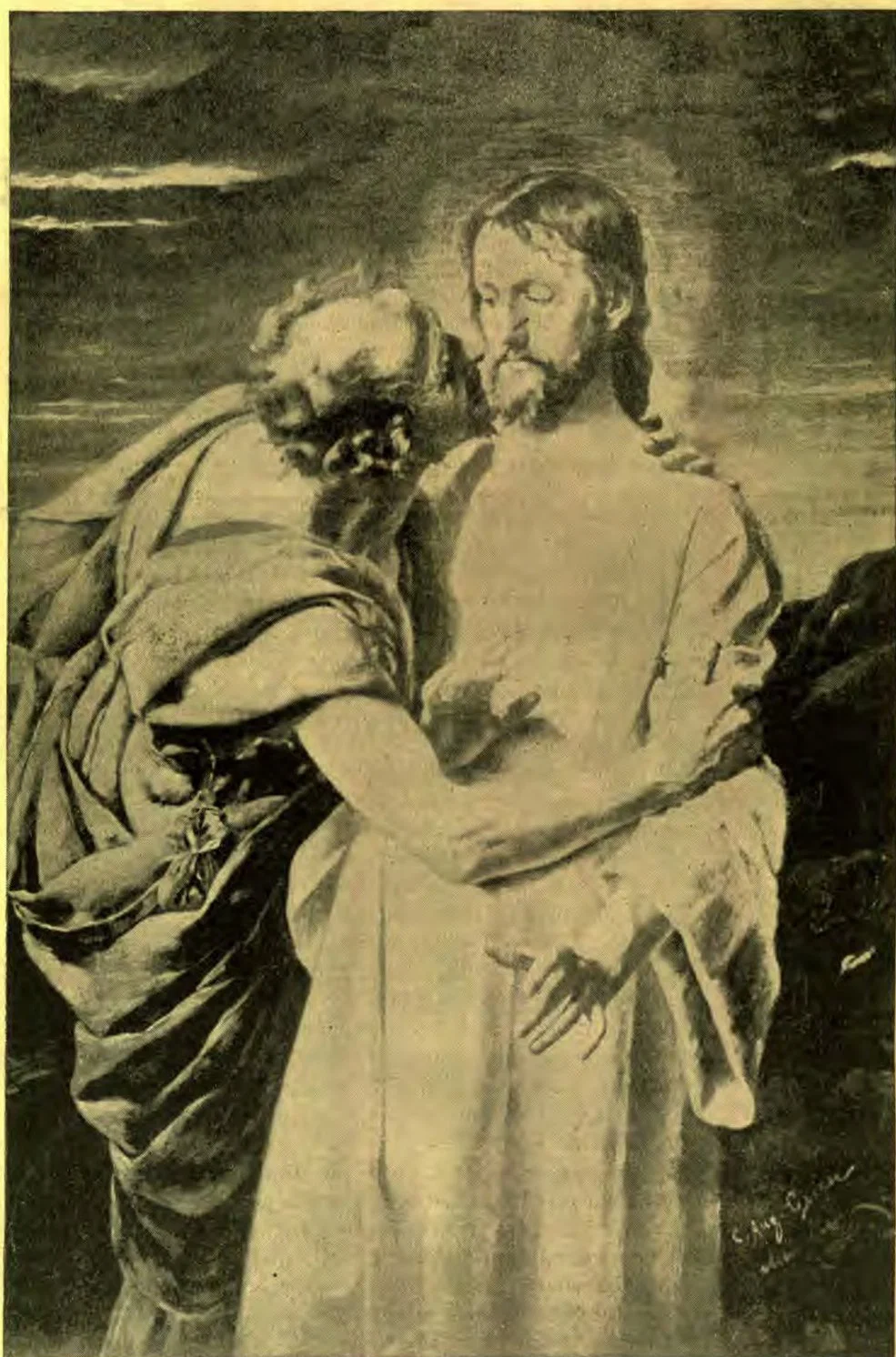
The Story.—The account of the betrayal of Jesus by Judas is found in all four of the Gospels, the fullest in John and Matthew. Together they tell us that the Garden of Gethsemane was one of the favorite resorts of the Master; that Judas knew the place; that he conducted thither a band of soldiers, furnished by the priests, to whom he had sold his Lord; that, when they came to apprehend Jesus, Judas designated Him by saluting Him as "Rabbi," and kissing Him much; that Peter, to defend his Master, drew his sword, and cut off the ear of Malchus, the high priest's servant; that Jesus healed the ear, and rebuked His impetuous disciple with words which were vibrant with lessons for the ages; and that He permits Himself to be taken, and drinks the bitter cup for the sake of humanity. All this, and more, is told in this story of base betrayal and everlasting faithfulness.
The Central Figure.—The central figure in the drama to both friend and foe is Jesus Christ. The one calm person in all that midnight assembly was the One purchased and sought that He might die. Seemingly the One with the greatest interest at stake, who is knowingly about to suffer untold agony, yet is He the least disturbed. The secret of His calmness, His placidity, His strength of character, was the Gethsemane, the pleading with God, the submission to the Father's will. There—alone with God—the great struggle took place, the mighty Agonizer won by yielding, and He was prepared for whatever might await Him. This is a lesson for us all. We never prepare ourselves for the great conflicts of life by waiting till the conflict comes. We always prepare for all conflicts by meeting every duty as it comes. Dark as Gethsemane may be, the right use of it, the yielding to God, gives a noble foundation for victory in coming trials. For all true, permanent victory lies in the operation of God's will, and we win by yielding to that will. Note, also, the absolute unselfishness of our Lord: "If therefore ye seek Me, let these [the disciples] go their way." He gave His life for others.
The Betrayer.—Judas is a fitting type of cherished sin. His nature was selfish. His sin was overweening covetousness. Christ in mercy associated him with Himself, placed before him constantly the teaching of His own wondrous life and ministry of unselfish love, that Judas might receive it, overcome his covetousness, and live. He was one of those who followed Christ for worldly gain. As treasurer he had stolen the scanty contributions given to the disciples, instead of using the money for the purposes for which it was given. He had found fault because costly balm had been used upon our Lord—and all because of the covetousness his heart had cherished. Winding its tendrils about every affection, enthralling every noble and unselfish impulse, his cherished sin at last leads him, for a few paltry pieces of silver, falsely to betray his Lord, whom he had said he would follow to prison and death. He doubtless reasoned that Jesus would, by His mighty power, release Himself from His enemies, and he, Judas, would be a few sheckles the gainer. Poor, mistaken man—duplicated so often in the lives of others since—he was selling, not his Lord, but his own soul. He had rejected the last warning, had refused the last reproof; he had chosen sordid gain, and with it death, dishonor, and eternal infamy. It is not safe to cherish one known sin for one moment. It will prove a traitor within the heart's walls, which opens its gates to a legion of other and worse sins. Its presence darkens the mind, stupefies the conscience, hardens the heart, and ruthlessly destroys every high and holy and unselfish thought and aspiration. Let Christ cleanse the heart by His word of reproof and forgiveness. Let Him abide there in all His purity, and by His presence "keep thy heart with all diligence; for out of it are the issues of life."
"Not by Might, nor by Power."—The betrayal has for us another important lesson in the course of another disciple. He was not one who betrayed his Master; he would have2died for Him then and there. Bold, impetuous Peter wanted Christ delivered, but he wanted it in his way, by the force of human might and power. Before this, Jesus had said repeatedly that the way of victory was the way of betrayal, suffering, the cross, the grave. Peter could not have it so. He desired earthly triumph. He wanted his Master to triumph as do earthly conquerors. His proud heart could not brook the humiliation; and he carried out what the others asked, "Lord, shall we smite with a sword?" Peter smote, and from his graciously loving Master received a rebuke, which is an eternal truth,—"All they that take the sword shall perish with the sword." A man is no stronger than his means of defense. If the church trusts to the sword, with the sword shall she perish. If she trusts to the arm of flesh, she will reap the inevitable curse of the trust; the arm of flesh will fail in the most trying hour. Israel trusted in Assyria and Egypt, and both Assyria and Egypt failed her, and spoiled her. They were as a staff upon which one leans, which breaks and pierces him who depends upon it for support. It has been so with the Christian church in the past. To-day the Christian church is living over the life of apostate Israel. In the demand for law, civil law, and civil penalties for Sunday "desecration" and the like, the church is appealing to the sword instead of to God, and showing by her appeal that she has no sure faith in God, that she has not learned the lesson of Christ. It looked dark at Christ's betrayal, and Peter thought something should be done, and done then. He tried in his way, and failed. Many look at the ever-increasing wickedness, and it seems as tho the kingdom of Christ—their ideas of His kingdom—would never materialize, and something must be done; and therefore Sunday laws, and the help of the civil power. God does not need such help. Pitifully He heals the wound which the unholy zeal causes, but He rebukes the zeal. He has all heaven's power at His command; He could wipe out all wickedness; but love, divine, eternal love must first be permitted to plead with men, even tho love's Keeper, for the time, dies. But love does not die. Righteousness can not perish. "Truth crushed to earth will rise again." In His own intrinsic worth, Christ, and all of Christ, will triumph. Let the rash hand of force sheathe its blade; let God's will be done. Not by army or power will He conquer, but by His Spirit in the hearts of men. Not by human power will His kingdom enter; "the zeal of the Lord of hosts shall perform this." Whenever force has been used in connection with Christ's cause or to advance its interests, it has always been at the expense of suffering to the innocent and irresponsible, and the ultimate defeat, and sometimes the eternal loss, of those who have chosen the force of flesh for the love of God. Reader, where do you stand? Will you learn these lessons of the betrayal? or, will you, sooner or later, betray or deny your Lord?