[The first part of this article presented the contrast between the Babylonian and the Biblical systems of education, and the results of each. It notes the likeness of present-day systems to the Babylonian, and points out four great defects in modern education. This article continues that subject further and points out the remedy.]
Defects in Education.
THE remedy for these deplorable results is a properly balanced education—a religious education which shall take into account the self-evident fact that a religion, to be of worth, must possess the whole man and be a motive power in every act of his life.
All this, in a dim sort of way, is recognized by many. In an editorial on the "Sources of Corruption," the Independent of Jan. 17, 1901, declares that—
"The wickedness and bribery and wholesale stealing from taxpayers for the benefit of the few lies almost wholly at the doors of men who move in what are called the 'well-to-do' or 'exclusive' circles. It lies at their doors to-day, and it has lain there from the beginning of human government."
These men are those who have received education in the schools of their country—an education lacking in what the Independent calls "the training of the satisfactions." It further says:
"Who will show us how to make children learn from actual experience that duty, truth, and honor yield the only satisfactions that may with us? His will be an educational philosophy worth talking about. When its clear, dry light arises in the moral firmament, the paths of wisdom will be easier to follow than they are at present, under the dancing will-o'-the-wisps of 'free election,' and the moon-shine of 'pedagogy,' both of which too often make worldly success look like the only thing worth living for."
In its issue of May 30, 1901, the same journal, under the heading of "Gospel of Wealth," refers to the address of Mr. Charles M. Schwab, president of the United States Steel Corporation, before 200 boys in a trade school in New York City, and who sets forth himself as "an example of the rewards of right living;" to the address of John D. Rockefeller, the Standard Oil magnate, to a Bible class of young men, in which he lauded his pleasure of doing good in employing 70,000 men; to Mr. Andrew Carnegie's book, "The Gospel of Wealth," and asks:
"What is the effect on the public of this 'Gospel of Wealth'? What is the influence of these men of vast fortunes, who, on several occasions, have stood forth as examples of right living?"
Apart from the means of getting this wealth, assuming them to be entirely legitimate, the Independent answers:
"This influence tends strongly to degrade the common morals. Let them amass their wealth; let them enjoy all the material good this earth permits; let them exert their power for weal or for wo in the markets of the world; but in the name of all that is good and precious to the human heart and imagination, let them not be set up before our young men as the great models of conduct to be imitated.
. . . There has been wealth in the land before now; but the riches of these men is so colossal as to obtain an entirely new force. It acts with hypnotic influence on the imagination; it benumbs the senses; and in its vast glitter the eyes are blinded to all the simpler and purer attainments of life. . . . We are stricken down by these men with a delirium of material drunkenness, and they allow us no escape from its fascination."
It is all true, and its spirit dominates popular education everywhere. The education of the world has not protected us from wealth's engulfing tide; and now that it has assumed the throne, it will not save us from slavery to its imperial demands.
A Sense of Need.
The remedy, the only remedy, is right education and training in religious lines from infancy. As one has expressed it, "The whole man must be educated; the whole man must be trained." This training must be from the Bible. And men feel this.
Professor Huxley, skeptic tho he was, felt it. This is what he says:
"I have always been strongly in favor of secular education, in the sense of education without theology, but I must confess I have been no less seriously perplexed to know by what practical measures the religious feeling, which is the essential basis of conduct, was to be kept up, in the present utterly chaotic state of opinion on these matters, without the use of the Bible. The pagan moralists lack life and color, and even the noble stoic Marcus Antonius is too high and refined for an ordinary child. . . . By the study of what other book could the children be so much humanized and made to feel that each figure in that vast historical procession fills, like themselves, but a momentary space in the interval between two eternities, and earns the blessings or the curses of all time, according to its effort to do good and hate evil, even as they also are earning their payment for their work?"
Dr. Lyman Abbott has voiced the same thing in the Outlook recently, and declares that the state should teach the Bible as the history of a people and a religion. But this will not do. It must be taught as it was taught to Daniel and his fellows—as the eternal living truth. Taught in this way, souls will see its glorious beauty. They will see God's hand in history, molding and shaping the nations of earth, despite of sin. They will see God working in nature despite the curse. They will long for His creative and regenerative power in them. They will learn how to obtain it. They will see true worth to be more than wealth, faithfulness more than fame, ingenuousness more than ingenuity, purity more than mere power, character more than coin, the service of God and to mankind more than to be served of Him and to rule His creatures. And O, how minds wide open on the Godward side will expand. In every branch of true science, in every useful occupation, they will excel; and this world will see again, in modern Babylon as in Babylon of old, that those taught of God in "every matter of wisdom and understanding," are "ten times better" than mere secular teaching can produce. Men are needed. This is the education which will make men. It made one man then that served grandly as prime minister under Babylon's greatest monarch, and was called to the same post and as effectually served under the succeeding Medo-Persia dynasty, because he served his God; and if parents will return to God's method of education, trusting in that alone, unwarped, unpermeated by heathen or medieval tradition, or by an infidel science, it will again make men more precious than the golden wedge of Ophir, or the combined wealth of the world.
The first chapter of Daniel is God's object-lesson in education, with the world's education at its best and His education at the worst, with the comparative results. Who will heed the instruction and be taught of God?
[The next article will be entitled, "God the Revealer," an exposition of Daniel 2.]
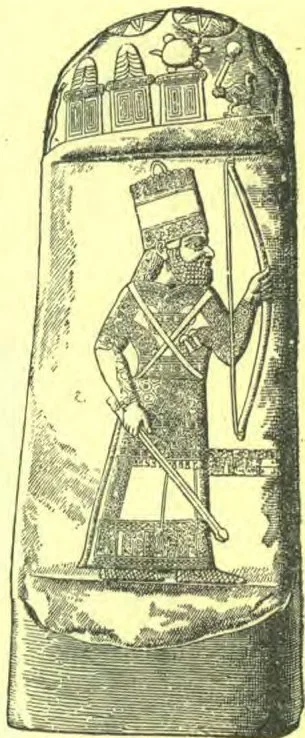
Babylonian Landmark; inscribed with the purchase-dead of a plot of ground, about B.C. 1100. (British Museum.)