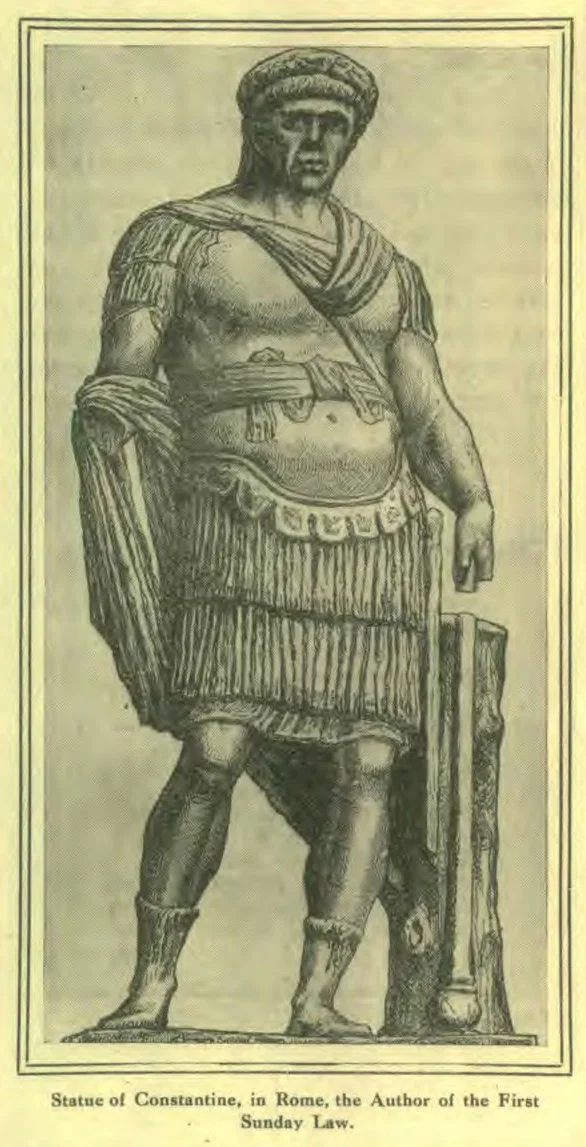
WHO changed the Sabbath? The day originally observed was the seventh day of the week. The day observed by the majority of the Christian church is the first day of the week. Was it not Christ, therefore, who changed the Sabbath at His crucifixion or resurrection? And if He did not do it, was it not changed by apostolic authority? If neither Christ nor His apostles made such a change, who did? The Bible-reading and the statement of facts which follow propose to answer this question. Has the change been legitimate, or has a great crime been committed? What is the testimony of prophecy and history?
I. Prophecies of Christ and His Work.
1. What prophecy of Christ was given thru Moses?
“I will raise them up a Prophet from among their brethren, like unto thee, and will put My words in His mouth; and He shall speak unto them ALL THAT I SHALL COMMAND HIM. And it shall come to pass, that whosoever will not harken unto My words which He shall speak in My name, I will require it of Him.” Deut. 18:18, 19.
2. What did Isaiah prophesy of Christ?
“The LORD [Jehovah] is well pleased for His [Christ’s] righteousness’ sake; He [Christ] will MAGNIFY THE LAW, AND MAKE IT HONORABLE.” Isa. 42:21.
3. As the Spirit of Christ spoke thru the prophets (1 Peter 1:10, 11), what did the great Teacher say thru David as to His attitude toward God’s law?
“Lo, I come; in the volume of the Book it is written of Me, I DELIGHT TO DO THY WILL, O MY GOD; yea, THY LAW IS WITHIN MY HEART.” Ps. 40:7, 8. Compare with Heb. 10:5-10, where this scripture is applied to Christ.
II. Fulfilled in Christ’s Teaching and Example.
4. Was it Christ’s purpose to present a law of His own or a new law?
“I DO NOTHING OF MYSELF; but AS MY FATHER HATH TAUGHT ME, I SPEAK these things.” John 8:28.
“I have not spoken of MYSELF; but the FATHER which sent Me, He GAVE ME A COMMANDMENT, WHAT I should say, and WHAT I should SPEAK.” John 12:49.
5. What honor and regard did He show toward God’s law?
“Think NOT that I am come to destroy the law, or the prophets: I am NOT come to DESTROY, but to FULFIL. For verily I say unto you, Till heaven and earth pass, one jot or one tittle SHALL IN NOWISE PASS FROM THE LAW, till all be fulfilled.” Matt. 5:17, 18.
NOTE.—‘Shall in nowise pass from the law.’ The double negative here strengthens the sense so as to admit of no contradiction. And the word ‘shall,’ it may be observed, is not barely future, declaring what WILL be, but has likewise the force of an IMPERATIVE, ordering what SHALL be. It is a word of authority, expressing the sovereign will and power of Him that spake,—of Him whose word is the law of heaven and earth, and stands fast forever.
“‘One jot or one tittle shall in nowise pass,’ ‘till heaven and earth pass,’ or as it is expressed immediately after, TILL ALL (or rather ALL THINGS) BE FULFILLED, till the consummation of all things. There is therefore no room for that poor evasion (with which some have delighted themselves greatly) that ‘no part of the law was to pass away till all the law was fulfilled; but it has been fulfilled in Christ; and therefore now must pass away for the Gospel to be established.’ Not so; the word ALL does not mean all the law, but all the things in the universe; as neither has the term FULFILLED any reference to the law, but to all things in heaven and earth.”—John Wesley, on Matt. 5:17-19.
6. How did He regard the law?
“I HAVE KEPT MY FATHER’S COMMANDMENTS, and abide in His love.” John 15:10.
“And He came to Nazareth, where He had been brought up; and, AS HIS CUSTOM WAS, HE WENT INTO THE SYNAGOG ON THE SABBATH DAY.” Luke 4:16.
7. How did the holy women who followed Jesus regard the Sabbath, even after His death?
“They returned, and prepared spices and ointments, and RESTED THE SABBATH DAY ACCORDING TO THE COMMANDMENT.” Luke 23:56.
8. What does the commandment enjoin?
“REMEMBER THE SABBATH DAY, TO KEEP IT HOLY. Six days shalt thou labor, and do all thy work; but the SEVENTH DAY is the SABBATH OF JEHOVAH THY GOD.” Ex. 20:8-10.
9. What is the teaching of the apostles?
“Do we then make void the law thru faith? God forbid; yea, we ESTABLISH THE LAW.” Rom. 3:31.
“If ye fulfil THE ROYAL LAW according to the SCRIPTURE, Thou shalt love thy neighbor as thyself, ye do well: but if ye have respect to persons, ye commit sin, and are convinced of the law as transgressors. For whosoever shall keep the whole law, and YET OFFEND IN ONE POINT, HE IS GUILTY OF ALL. For He that said [margin, ‘that law which said’], Do not commit adultery, said also, Do not kill. Now if thou commit no adultery, yet if thou kill, thou art become a transgressor of the law. So SPEAK YE, AND SO DO, AS THEY THAT SHALL BE JUDGED BY THE LAW OF LIBERTY.” James 2:8-12.
NOTE.—There can be no question as to the law here meant. (1) It is the royal law of the great King whose “kingdom ruleth over all.” (2) It is not a new law, but the law according to the Scripture,—a law found in the Old Testament. (3) It is the law which contains the precepts: “Do not kill;” “Do not commit adultery.” This is the Ten-Commandment law. (4) It is the same law to which the wise man refers (Eccl. 12:13, 14), by which we must be judged.
From the above witnesses, and many more might be called, it is clearly evident that neither our Lord nor His apostles even presumed7or thought to change God’s law. They knew in the very nature of the case that it could not be changed; that it was founded in the very character of God and in the normal nature and needs of man. Therefore “an enemy hath done this.” A usurper, a criminal, a traitor to God’s government has sought to do what Christ would not, could not, do. We shall find this power predicted in the prophecy of God’s word; and we shall also find the open, clear acknowledgment by this power itself that it has sought to do, and seemingly accomplished, what the more sure word of prophecy declares. We shall test the criminal by the same means as we did the great Teacher.
III. Prophecies of the Crime.
10. What does Daniel predict of the work of a certain apostate power?
“And he shall speak great words against the Most High, and shall wear out the saints of the Most High, and THINK TO CHANGE TIMES AND LAWS; and they shall be GIVEN INTO HIS HAND UNTIL a time and times and the dividing of time.” Dan. 7:25.
NOTE.—The Septuagint and the Revised Version, in fact most of the versions, read “THE LAW,” the law which he could not change, but could only THINK to change. Wintle and Spurrell read, “Shall presume to change the appointed times and the law.” The Douay, or Catholic, translation is “He shall think himself able,” to do this.
11. What does the apostle Paul say of the coming apostasy?
“For I know this, that after my departing shall grievous wolves ENTER IN AMONG YOU, NOT SPARING THE FLOCK. ALSO OF YOUR OWN SELVES shall men arise, SPEAKING PERVERSE THINGS, to DRAW AWAY DISCIPLES AFTER THEM.” Acts 20:29, 30.
“Let no man deceive you by any means; for THAT DAY SHALL NOT COME, except there come a FALLING AWAY FIRST, and that MAN OF SIN be revealed, the son of perdition; who OPPOSETH and EXALTETH HIMSELF ABOVE ALL THAT IS CALLED GOD, or that is worshiped; so that he as God sitteth in the temple [or church, see 1 Cor. 3:16; Eph. 2:20-22] of God, showing himself that he is God.” 2 Thess. 2:3, 4.
NOTE.—The great Head of the church is the Lord Jesus Christ (Eph. 1:22, 23), and the law of the church is the word of God, which came thru Christ. Now, the only way for a power to OPPOSE God is to enact laws contrary to God’s law, and to demand obedience thereto. The only way in which it could exalt itself ABOVE God is to demand that ITS LAW shall be OBEYED in PREFERENCE to GOD’S LAW. The same law promulgated by two rival powers in the same territory would be an impossibility, and would show no distinction between the adherents of the two powers. There must be a difference in the laws, and therefore this power must seek to change God’s law, and this difference made by the change between the law of God and the law of this usurping power must be the very mark of opposition to God and exaltation above Him. There is no evading this conclusion.
IV. Confession to the Prediction.
12. What did Eusebius, the apologist of the corrupt Constantine, say that Constantine, Pope Sylvester, and such bishops as himself had done?
“All things whatsoever that it was duty to do on the Sabbath, THESE WE HAVE TRANSFERRED to the Lord’s day [Sunday].”
13. What do Roman Catholic authorities say as to this?
“Ques.—Have you any other way of proving that the church has power to institute festivals of precept?
“Ans.—Had she not such power, she could not have done that in which all modern religionists agree with her,—she could not have substituted the observance of Sunday, the first day of the week, for the observance of Saturday, the seventh day, a change for which THERE IS NO SCRIPTURAL AUTHORITY.
“Ques.—When Protestants do profane work upon Saturday, or the seventh day of the week, do they follow the Scripture as their only rule of faith?—do they find this permission clearly laid down in the Sacred Volume?
“Ans.—On the contrary, they have only the authority of tradition for this practise. In profaning Saturday, they violate one of God’s commandments, which He has never clearly abrogated,—Remember that thou keep holy the Sabbath day.”—See “Doctrinal Catechism,” pages 101, 174, 351-355.
“Ques.—How prove you that the church hath power to command feasts and holy days?
“Ans.—By the very act of changing the Sabbath into Sunday, which Protestants allow of; and therefore they fondly contradict themselves by keeping Sunday strictly, and breaking most other feasts commanded by the same church.”—“Abridgment of Christian Doctrine.”
NOTE.—Read also the following letter from Cardinal Gibbons to Mr. John R. Ashley of Rock Hall, Md.:
“JOHN R. ASHLEY, Esq.—Dear Sir: In answer to your first question, directed by the cardinal to reply to your letter, I will say:
“1. Who changed the Sabbath?
“Answer—THE HOLY CATHOLIC CHURCH.
“2. Are Protestants following the Bible or the holy Catholic Church in keeping Sunday?
“Ans.—The PROTESTANTS are following the CUSTOM INTRODUCED BY THE HOLY CATHOLIC CHURCH.
“3. The Protestants do contradict themselves by keeping Sunday, and at the same time profess to be guided by the Bible only. I am faithfully yours, “C. F. THOMAS, Chancellor.”
NOTE.—Surely the above is sufficient to show (1) that neither Jesus nor His apostles had any part in the change of the Sabbath; and (2) that the apostasy, centering in the Papacy, did make the change. Yet there is much more testimony from other sources, Protestant writers, for instance, which shows the change to be gradual, as apostasy always is:
“Centuries of the Christian era passed away before the Sunday was observed as a Sabbath. History does not furnish us with a single proof or indication that it was at any time so observed previous to the Sabbatical edict of Constantine, in A.D. 321.”—Sir Wm. Domville, “Examination of the Six Texts,” page 291.
“By none of the Fathers before the fourth century is it [the first day of the week] identified with the Sabbath; nor is the duty of observing it grounded by them either on the fourth commandment or on the precept or example of Jesus or His apostles.
“Unquestionably the first law, either ecclesiastical or civil, by which the Sabbatical observance of that day is known to have been ordained, is the edict of Constantine, 321 A.D. . . .
“It was not till the year 538 that abstinence from agricultural labor on Sunday was recommended, rather than enjoined, by an ecclesiastical authority (the third council of Orleans).”—Chambers’ Cyclopedia, art. “Sabbath.”
“Opposition to Judaism introduced the particular festival of Sunday very early indeed, into the place of the Sabbath. . . . The festival Sunday, like all other festivals, was always only a human ordinance; and it was far from the intention of the apostles to establish a divine command in this respect,—far from them, and from the early apostolic church, to transfer the laws of the Sabbath to Sunday.”—Church History, Rose’s Neander, page 168.
The Augsburg Confession, drawn up by Melanchthon says:
“The observance of the Lord’s day [Sunday] is founded not on any command of God, but on the authority of the church.”—Cox’s “Sabbath Manual,” part 2, section 10; also “History of the Sabbath,” page 434.
Lyman Abbott, editor of the Christian Union, says in that paper of Jan. 19, 1882:
“The current notion that Christ and His apostles, authoritatively substituted the first day for the seventh is absolutely without any authority in the New Testament.”
The Protestant Episcopal Church says:
“The day is now changed from the seventh to the first day, . . . but as we meet with no scriptural direction for the change, we may conclude it was done by the authority of the church.”—“Explanation of Catechism.”
The Christian at Work, in its issue of Jan. 8, 1885, says:
“The selection of Sunday, thus changing the particular day designated in the fourth commandment, was brought about by the gradual concurrence of the early Christian church, and on this basis, and none other, does the Christian Sabbath, the first day of the week, rightly rest.”
The “Methodist Episcopal Theological Compendium” (page 103) says:
“It is true there is no positive command for infant baptism, . . . nor is there any for keeping holy the first day of the week.”
This is the evidence in part, reader, which day will you choose?