Our London Letter

4%

Our London Letter

(From Our Own Correspondent)
It is useless to deny that the government received a severe check at the by-election in Mid-Devon last Friday, when a constituency which has been consistently Liberal from time out of mind, returned the Conservative candidate by a majority of 559. The chief issue was a tariff reform, the opposition making use of the present high prices on coal and breadstuffs to strengthen their case with the electors, altho as a matter of fact Liberalism is in no way responsible for the condition of the markets. But tariff reformers are persistent and have an abundant supply of energy and enthusiasm. The Liberals, on the other hand, have been too much inclined to settle back at their ease. This striking defeat will awaken them to a sense of their danger.

English Politics.

The last two months have been rather a tame period in English politics; in fact, the year 1907 has not been an exciting one. The Colonial Conference amounted to very little. It was disappointing to both parties. The Hague Peace Conference, whose proceedings were at the outset followed with the deepest interest, turned out to be something of a fiasco. It said little and did less in the direction of securing peace among the nations. Some few conclusions were arrived at in reference to the rules of civilized warfare, the value of which time will have to determine. Europe will continue to be an armed camp, and if the military budgets increase during the next few years at the rate which has obtained since the first Peace Conference, it will be hard for even the most sanguine advocates of internationalism to maintain a belief in the efficacy of such conferences as agencies of reform.

Military Matters.

On the whole the military spirit is easily holding its own in England. The Liberal Party, by passing an Army Reform Bill, has distinctly improved the status of the war department, and while it has succeeded in saving a few millions, there has not been the slightest loss in efficiency. Under a Liberal regime there is no immediate danger of an act calling for conscription or for compulsory military training passing the House of Commons, but the present government will not always be in power and agencies are at work already under private auspices which are doing much spade work in the direction of fostering the military spirit among the young men, and it would not be at all surprising if an incoming Conservative government should pass a measure calling for universal military training as a necessary safeguard against possible invasion.

The Religious Atmosphere.

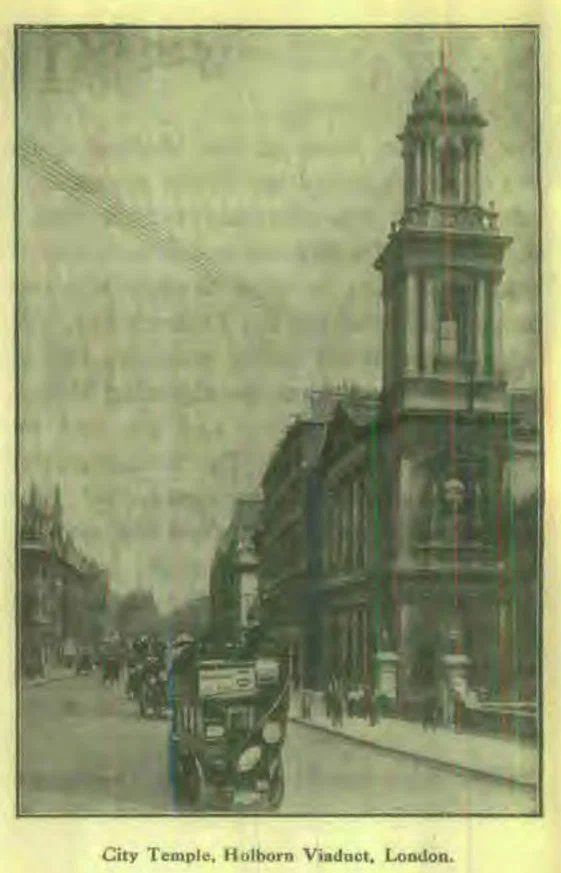
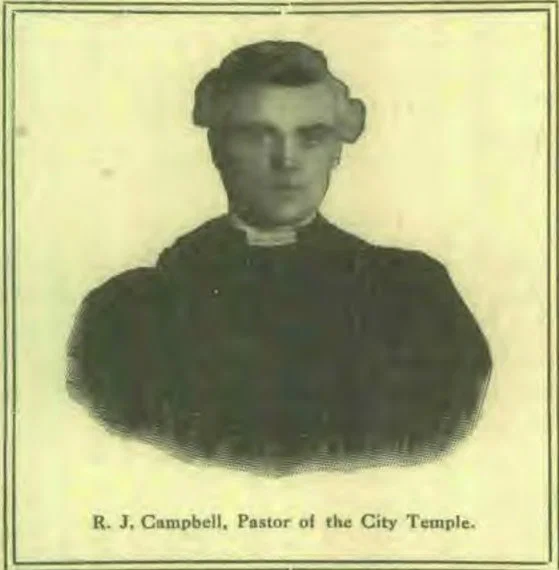
The religious situation is an interesting one. We are evidently still in a time of transition. Cautious men among the Non-conformists, men who are three-fourths politician and one-fourth preacher, are waiting developments before taking a definite stand. Mr. R. J. Campbell continues his New Theology campaign and has a reasonable number of supporters, both among the clergy and the laity. His strong advocacy of Socialism is making him friends among the Labor Party. No doubt his influence among evangelical Christians is not what it was before he entered upon his new evangel. He will never regain what he has lost, but with the rapidly growing multitude which is committed to social revolution, he bids fair to become something of a popular idol.
Theologically considered, Mr. Campbell's position is becoming fairly clear. He is simply taking into the pulpit the opinions which the higher critics have been advocating in the scholarly world for the past fifteen or twenty years. Hitherto such teaching has been chiefly confined to universities and a very few theological seminaries, as well as to books and periodicals of a more or less technical character. Some of the comparatively unknown preachers have endeavored to expound it from the pulpit; but R. J. Campbell is the first clergyman of influence and prestige to launch out boldly on a course of action which commits him apparently irrevocably to the higher critic's platform. In doing this he naturally voices the real feelings, not only of a large class which has grown increasingly indifferent to the claims of evangelical Christianity, but also of many of his colleagues in the ministry who have not the courage to take their stand by his side.
In time some of these will doubtless do this. The leaven is at work. Every day makes it increasingly manifest that popular Christianity has traveled far from the teaching and spirit of the New Testament. Mr. Campbell hardly exaggerated the facts when he said in a recent sermon on the resurrection:
"Our whole outlook has changed, and we may as well recognize it at once. We do not take the view that those New Testament Christians did about death. Seeing that it is impossible for us to think the same thing nowadays, where is the good of taking a text from these words and asking our hearers to put the same meaning on it that Paul did? If we can not believe in resurrection as Paul did, where is the good of trying to treat his words as infallible?"
As a matter of fact, the so-called change in views really involves outright apostasy. There were plenty of men in Paul's day who could not believe in resurrection, but they did not call themselves Christians, let alone ministers of the Gospel. A prominent exponent of agnosticism in this country has only one fault to find with the New Theology, and that lies in its name. He practically accuses the City Temple preacher of stealing his thunder, and professes wonder that Christians should uphold in Campbell what they condemn in him.

The Churches and Socialism.

Mr. Campbell and his sympathizers are as a matter of course sailing under false colors. They could not do this if the present were not a time of general apostasy. It is only too true that the verities of the Gospel are to-day openly flouted by many professed Christians besides the incumbent of the City Temple, so that his position is really not singular, only so far as he has expressed his views with a warmth bordering on recklessness and from his influential position has attracted widespread attention.
Of course Mr. Campbell is by no means singular in his advocacy of Socialism. That movement is gaining support amongst clergymen of all denominations. In yesterday's papers appears a manifesto signed by over a hundred ministers, some of them men of prominence and influence, stating that the Socialism they believe in (sometimes known as "Christian Socialism"), "involves the public ownership and management of the means of production, distribution, and exchange, and is therefore essentially the same Socialism as that which is held by Socialists thruout the world."
In to-day's papers we have Mr. Perks, a prominent Wesleyan preacher, saying in an interview that he is opposed to Socialism and that he believes the Wesleyan church will use its influence against Socialism of to-day even as it fought radicalism at the time of the French Revolution. The time will probably come when all clergymen will take sides on this question. At the present, Socialists are exceedingly active, and their organization has become very full and efficient. They make no odds, for the most part, of rejecting the teaching of Christianity. Their gatherings are marked by numbers and enthusiasm. The churches, on the other hand, are losing both adult members and Sunday-school pupils. Faithful, loyal souls are asking what it means. Wesleyans report a decrease of 12,000 in their Sunday-school membership, and Baptists admit a falling off of 3,000. The working classes which naturally form the bulk of the population, have stood aloof from the church of England for years past, and now the Non-conformist churches are losing the support of this large section. It has been suggested that the Christian churches are losing influence and prestige amongst the lower classes to the extent that Socialism is advancing. If this is true, the reason may be that the churches are also losing much of their original fire and earnestness. Socialism can never take the place of Gospel Christianity, but a pushful, aggressive Socialism may prove more attractiveto the poor and down-trodden masses than a Christianity which is such in name only.

Buddhism in Britain.

The year 1907 has witnessed not only the advent of the New Theology, but also the definite formation of "The Buddhist Society of Great Britain," with headquarters in a fashionable quarter of London. The secretary stated in a recent interview that there are quite a number of Europeans, both in Great Britain and on the continent, who are convinced Buddhists, having become so thru study and travel in Buddhist countries. He added that this was quite explicable, since there was nothing in primitive Buddhism which conflicted with the teachings of modern science. The society aims to carry on an active propaganda and will not unlikely gain followers. The time is favorable for such movements.
In the closing days of 1907 England lost one of her greatest scientists in the death of Lord Kelvin, better known as Sir William Thomson, who filled for fifty-three years the chair of natural philosophy in Glasgow University, and whose discoveries and inventions in the realm of physics are legion. We owe to him the submarine cable, to mention only one thing. Mariners will probably continue to use the Thomson compass, and likewise the sounding machine invented by the same fertile brain, from which have come more than three hundred original papers having to do with every branch of physical science. Lord Kelvin is the last of the giant-brained men who made the Victorian reign illustrious in the annals of science.
Speaking of science, one is reminded that toward the close of 1907 a regular system of wireless telegraphy was opened up between the British and Canadian coasts. For five pence (ten cents) a word for ordinary messages, or half that price for press messages, any one can have his Marconigram flashed across the Atlantic. This is indeed nothing less than marvelous.
King Edward again exhibited his usual tact when he conferred on Florence Nightingale, living in honored retirement and gradually failing in health, the new Order of Merit, which she is the first woman to receive. It is fitting that this much-loved heroine of the Crimean War and pioneer in scientific nursing should be thus recognized.
M. ELLSWORTH OLSEN.