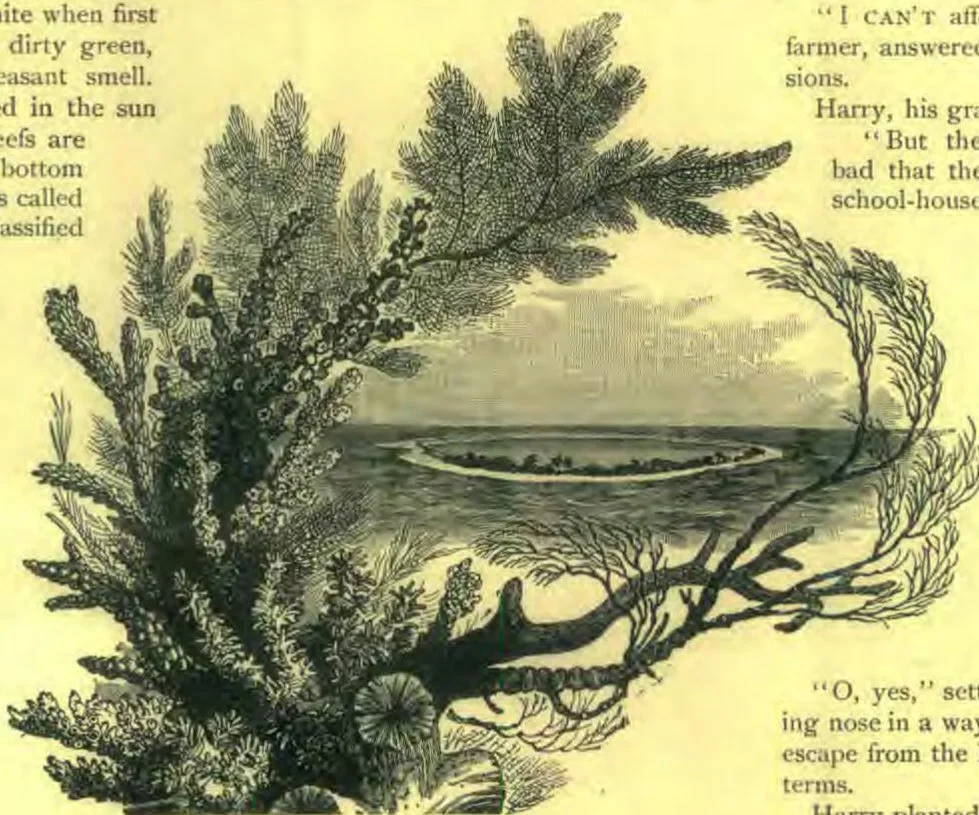
AMONG the many interesting features of the South Sea islands, among which we have visited in the missionary ship Pitcairn, are the coral reefs which are found around most of these islands. Pitcairn Island, in longitude 130 degrees west, and latitude 25 degrees south, has no reefs surrounding it, though there may be found here and there little detached masses of coral clinging to the rocks. Probably many of the people in the United States have never seen coral, though some may have been privileged to see little pieces in curio stores, for which exorbitant prices are charged. These pieces are not clean and white when first taken from the reefs, but have a dirty green, slimy appearance, with an unpleasant smell. They must be cleaned, then placed in the sun to be bleached. These coral reefs are built up by slow degrees from the bottom of the sea by little living creatures called coral polyps. They are usually classified as follows: Fringing reefs, barrier reefs, and atolls or ring reefs. The first named are found close to shore, in comparatively shallow water, with no lagoon, or deep channel, between them and the land. At high tide a few inches or feet of water covers them, but at low tide they may be nearly or quite uncovered. It was on such reefs as these that several United States and German men-of-war were driven, in the terrible hurricane in the harbor of Apia, Samoa, ten years ago. One of them, a splendid German ship, was lifted bodily by the force of the seas, and thrown upon the reef, where its great iron skeleton remains high and dry at low tide. Barrier reefs differ from the former in that they are usually found at a greater distance from the land, and have a lagoon, or deep water channel, between them and the shore.
Those which I have seen vary in their distance from the shore, from 40 rods to many miles. At Aitutaki, in the Hervey Island Group, the reef on the south side of the island is 7 miles from shore.
The great barrier reef off the northeast coast of Australia, is 20 or 30 miles from land.
The depth of water on the seaward side of the barrier reef is usually very great. Where there is a stream of fresh water running into the sea, there is generally found an opening in the reef, as the polyps do not work in fresh water.
These openings are wide enough in some reefs to admit ships into the safe harbor formed by this natural breakwater. In some cases, the reef extends entirely around two islands. Such a reef encircles Raiatea and Tahaa in the Society Group, forming a large and safe harbor between the two islands. The reef that surrounds the island of Mangaia, in the Hervey Group, has no opening whatever, and the shore can be reached with canoes only by “jumping the reef.” This is accomplished by getting onto one of the great swelling waves as it dashes on the reef with a terrific roar, and
being carried clear over the reef into the quiet waters within. None but natives who have spent their lives in such employment can make the hazardous trip without the almost absolute certainty of being wrecked.
The atoll is built up from the bottom of the sea in a circular or oval form, with a lagoon of deep water within, but no land. In process of time the reef becomes covered with soil and vegetation, the coconut being the tree usually grown. On some of the atolls, little islands are formed at varying distances from one another, around the whole circle of the reef. This is the case at Palmerston Island, between Rarotonga and Samoa, which we passed May 10. Being to the leeward of the island, we could not make a landing, but could see 4 islands in the large circle of the atoll, all of them covered with coconut trees. A few families live on the one inhabited island of this reef, to take care of the nuts.
While the pieces of coral usually seen in the curio stores are very pretty, it must not be supposed that the mass of coral of which these coral islands are formed, is equally fine. It is only on that part of the island where the coral polyps are at work that the beautiful live coral is found. The greater part of the reef is composed of the dead coral, which becomes cemented together in great ledges, and in some islands is quarried out by the natives and sawed into blocks for house building, or is burned into lime. At Mangareva, in the Gambier Group, 300 miles northwest of Pitcairn Island, I saw a Catholic church building, about 80x200 feet in size, built entirely of blocks of coral, with great pillars of the same material upholding its vaulted roof. A most beautiful sight is the forest of coral that may be seen in the lagoon when the water is quiet, by looking over the side of the canoe, down, down, many feet where fishes of all shapes, sizes, and colors are seen darting in and out of these submarine groves. Not all corals, however, take the form of branches. At Samoa I saw what was in my opinion the most beautiful of all these forma-
tions, the leaf coral. This is formed in the shape of a bunch of white leaves. Being very thin and fragile, it is almost impossible to transport it without breakage.
Then there is the brain coral, as it is commonly called, having the shape and appearance of a human brain. Sometimes the coral workers build a little white tree, five or six inches high, on the outside of a large pearl shell. These are quite rare. Red coral is found in a few of the islands, the branches being much smaller than that of the white. As we see all these wonderful creations, we can appreciate the words of David: “They that go down to the sea in ships, that do business in great waters; these see the works of the Lord, and His wonders in the deep.” Ps. 107: 23, 24.