THE life of Moses stands conspicuously in the foreground of the biographic pictures of notable men. Confronted at his birth by a law that demanded his immediate death, he became at once the special object of providential care. Loving, God-fearing parents were the instruments through whom was devised a way of preserving the child from the tyranny of the king. The story of the ark of bulrushes, the adoption by the king's daughter, and early instruction by a faithful mother before being taken into the king's family, are familiar to all Bible readers. Beyond this the record gives us no detail until Moses was forty years old. We are told in a general way that he "was learned in all the wisdom of the Egyptians, and was mighty in words and in deeds." Acts 7:22.
But at the age of forty years another bit of detail is given. This is told three times, namely, in Ex. 2:11-22, in Acts 7:23 and onward, and in Heb. 11:24-26. In the latter place it is said that "by faith Moses, when he was come to years, refused to be called the son of Pharaoh's daughter; choosing rather to suffer affliction with the people of God, than to enjoy the pleasures of sin for a season; esteeming the reproach of Christ greater riches than the treasures in Egypt; for he had respect unto the recompense of the reward." Stephen tells us, in Acts 7:23, that "when he was full forty years old, it came into his heart to visit his brethren the children of Israel." The record in Exodus 2 says that when he was grown, "he went out unto his brethren, and looked on their burdens." The details recorded show that this refers to the same time mentioned by Stephen and in the letter to the Hebrews.
While visiting his brethren, "he spied an Egyptian smiting an Hebrew, one of his brethren. And he looked this way and that way, and when he saw that there was no man, he slew the Egyptian, and hid him in the sand. And when he went out the second day, behold, two men of the Hebrews strove together; and he said to him that did the wrong, Wherefore smitest thou thy fellow? And he said, Who made thee a prince and a judge over us? intendest thou to kill me, as thou killest the Egyptian? And Moses feared, and said, Surely this thing is known. Now when Pharaoh heard this thing, he sought to slay Moses. But Moses fled from the face of Pharaoh, and dwelt in the land of Midian."
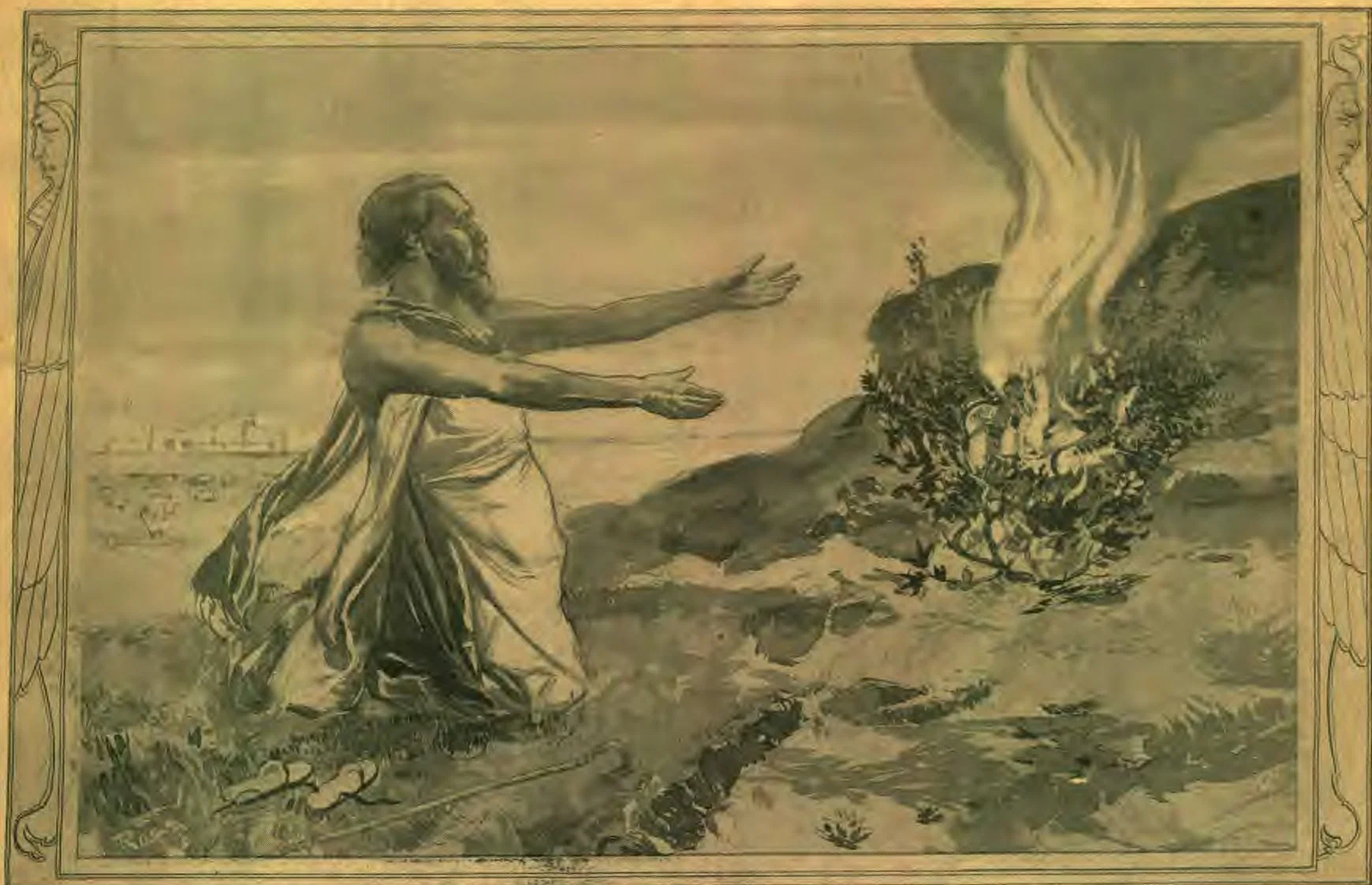
"And the angel of the Lord appeared unto him in a flame of fire out of the midst of a bush."
This brief detail calls for reflection, as, like all that was "written aforetime," it was "written for our learning." Rom. 15:4. Stephen says that Moses "supposed his brethren would have understood how that God by his hand would deliver them; but they understood not." From this it is evident that Moses understood it, and had given up his heirship to the throne for that very purpose. He had learned this while being instructed by his mother in his boyhood, while she was employed as his governess by the queen's daughter. He had remembered this, and had faith in it, deeming the further education he received in "the wisdom of the Egyptians" as peculiarly fitting him for the great work. From this point of