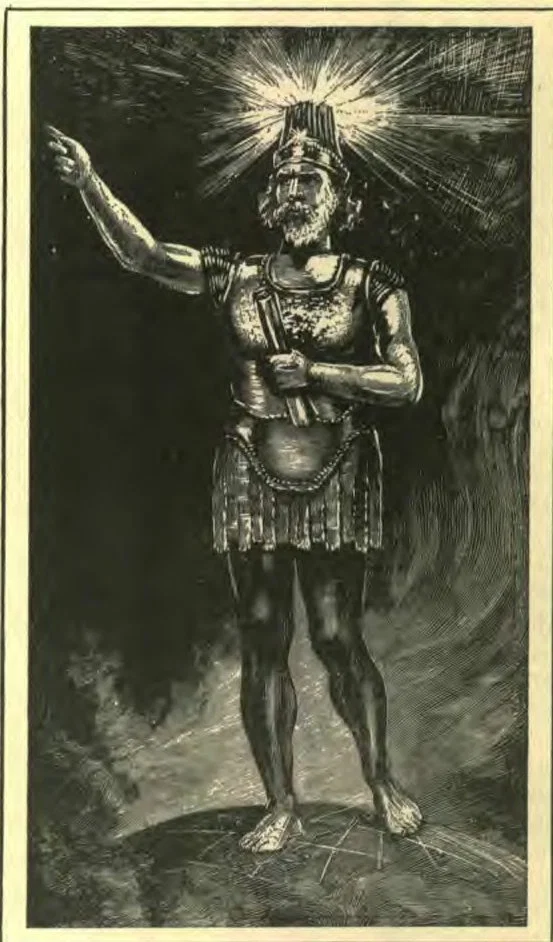
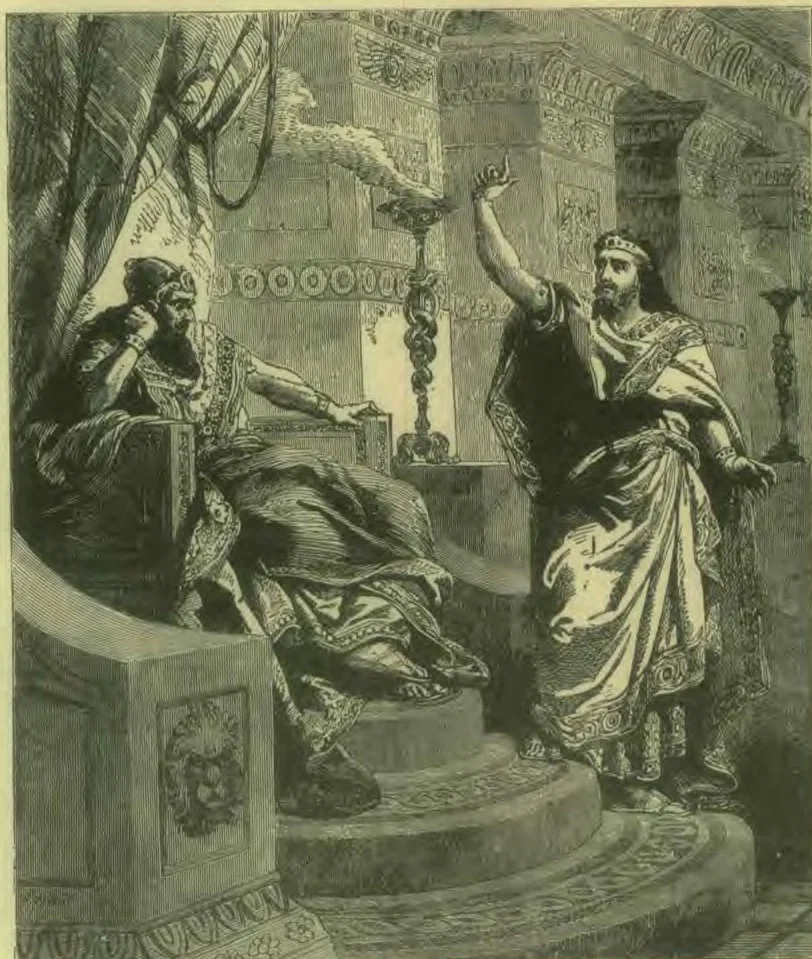
THE dream and the events which led to its relating by Daniel were given in our last issue. It should be read in connection with this article which explains the king's dream.
The Interpretation of the Dream.
“This is the dream; and we will tell the interpretation thereof before the king. Thou, O king, art king of kings, unto whom the God of heaven hath given the kingdom, the power, and the strength, and the glory; and wheresoever the children of men dwell, the beasts of the field and the birds of the heavens hath He given into thy hand, and hath made thee to rule over them all; thou art the head of gold.
“And after thee shall arise another kingdom inferior to thee; and another third kingdom of brass, which shall bear rule over all the earth.
“And the fourth kingdom shall be strong as iron; forasmuch as iron breaketh in pieces and subdueth all things; and as iron that crusheth all these, shall it break in pieces and crush. And whereas thou sawest the feet and toes, part of potter's clay, and part of iron, it shall be a divided kingdom; but there shall be in it of the strength of the iron, forasmuch as thou sawest the iron mixed with miry clay. And as the toes of the feet were part of iron, and part of clay, so the kingdom shall be partly strong, and partly broken. And whereas thou sawest the iron mixed with miry clay, they shall mingle themselves with the seed of men; but they shall not cleave one to another, even as iron doth not mingle with clay.
“And in the days of those kings shall the God of heaven set up a kingdom which shall never be destroyed, nor shall the sovereignty thereof be left to another people; but it shall break in pieces and consume all these kingdoms, and it shall stand forever. Forasmuch as thou sawest that a stone was cut out of the mountain without hands, and that it brake in pieces the iron, the brass, the clay, the silver, and the gold, the great God hath made known to the king what shall come to pass hereafter; and the dream is certain, and the interpretation thereof sure.” Dan. 2: 36-45, A.R.V.
“Thou art the head of gold” clearly shows the application of the beginning of this prediction. Nebuchadnezzar, Chaldea's greatest ruler, represented the Babylonian empire, the “golden kingdom of a golden age,” standing in barbaric splendor at the head of four successive world-wide empires, which it would infuse and fashion with its principles for all time. Roger tells us: “No capital in the world has ever been the center of so much power, wealth, and culture for a period so vast. It is indeed a brilliant cycle of centuries.” God's prophet has told us, “Babylon hath been a golden cup in the Lord's hand, that made all the earth drunken; the nations have drunken of her wine; therefore the nations are mad.” Yet God would “heal Babylon,” and He began, as He doubtless had before, with her mightiest king. Jer. 51: 7, 8.
But Babylon, despite her mighty protecting walls; despite her abundant supply of water; despite her proud kings, her rich and splendid palaces, her glorious temples to her gods, her army, the plans of her military men, must pass away. Only the righteous by choice shall exist forever. Only Love Incarnate is fitted to reign eternally. The golden kingdom was alloyed by the rust of depraving idolatry, cankered by selfishness, and eaten by the leprosy of sin, and it must pass away. “In the way of righteousness is life; and in the pathway thereof there is no death.” Prov. 12: 28. It is the work of the Gospel to restore man to righteousness; “for therein [in the Gospel] is the righteousness of God revealed from faith to faith.” Rom. 1: 16, 17. God was most emphatically preaching the Gospel to Nebuchadnezzar, and thru him to all generations. Babylon's continued reign depended on Babylon's acceptance, as individuals, of God's righteousness; Babylon's rejection of the Gospel, as individuals, of course, meant that that kingdom should be superseded by another. The golden kingdom must pass away. The riches, the splendor, the glory, the growing weakness and effeminacy and licentiousness of the tropical Euphratean valley were succeeded by the hardy frugality of the mountaineer peoples of Persia, combined with Media, in B.C. 538, symbolized by the breast and arms of silver.
Following Medo-Persia came Grecia, B.C. 331, symbolized by the belly and thighs of brass reaching to the knees. The successor of Grecia, of which the symbols were the legs of iron and the feet and toes of iron and clay, was Rome, in united and divided state to the end.
Note particularly that the different empires are symbolized, not by any special features of the anatomical parts of the body mentioned, but by the different metals. The image was materially that of a man; it represented the KINGDOM OF MAN; it naturally had a head, a breast, arms, sides, thighs, legs, feet, and toes; but it was the head of gold which symbolized Babylon; the breast and arms of silver which symbolized Medo-Persia. The two arms did not indicate the union of the two powers; this is indicated elsewhere. The arms are incidental, not objective, the same as the two thighs in Grecia, and the two legs in Rome. If the two legs represent Eastern and Western Rome, as some suppose, Rome should have been divided from the beginning, even as the legs, which begin at the knees. But for the greater part of its more glorious career, Rome was a unit.
Rome's union and strength are fitly represented by the iron. Iron can be fused together even as gold and silver; it can be welded. It fitly represents a strong, imperial empire, even as was Rome when she came in fullest connection with the work and people of God.
Rome became a divided kingdom. As a matter of prophecy and history, she became divided into ten kingdoms; but take particular notice that this division is no more symbolized by the toes than Eastern and Western Rome are by the two legs. The division of the fourth kingdom is symbolized by the coming in of the clay. “And whereas thou sawest the feet and toes, part of potter's clay, and part of iron, it shall be a divided kingdom. . . . And as the toes of the feet were part of iron, and part of clay, so the kingdom shall be partly strong, and partly broken.” Men would try to unite the divided parts. Marriage and intermarriage should take place; they would intermix themselves with men of any nation (Boothroyd) to endeavor to unite the discordant elements; “but they shall not cleave one to another, even as iron doth not mingle with clay.”
The clay is of the earth. It represents republicanism, democracy, socialism; plenteous, but weak and brittle. It can not unite with imperialism and retain its nature. Iron will not mix with clay. From the first division of Rome, beginning in the fourth century, the clay entered as a constituent element. From that time to the present, the European states,—the old Roman Empire,—have been partly strong and partly broken. Men have tried to unite them in one great empire, as Charlemagne and Napoleon; princes and diplomats have endeavored to unite them by intermarriages of royal families; “but they shall not cleave one to another, even as iron doth not mingle with clay.”10The word of God is mightier than all the ingenuity and diplomacy and wisdom and power of man. Imperialism and socialism will not mix, and this divided state will continue even unto the end. If the toes symbolized the kingdom and were all of iron, they would unite. If all of clay, they would unite, but the diverse elements continue to the very end.
Studies in the Book of Daniel
(Continued from Page 9.)
The Last Kingdom of Earth.
All these powers, diverse in nation and form and manner, each in turn demonstrates by its unrighteousness that it possesses no right to exist forever. The seeds of decay and death in each and every one have been sown and tended with care, and have borne the sure crop—ruin. But this earth shall not continue to be cursed. When the last divisions of the Roman kingdom demonstrate their unfitness to reign, when lawlessness, anarchy, and ruin shall sweep over the earth in spite of all human wisdom and power, God will interpose and erect His kingdom. “In the days of those kings shall the God of heaven set up a kingdom.” Note particularly,—
1. That this kingdom was not set up at the first advent, nor at Pentecost; for Rome was not then divided. It does not mean that it will grow thru the influence of the church till it converts the world; for it breaks in pieces and consumes all these kingdoms. It succeeds the utter ruin of all earthly rule, demonstrated to be unfit to reign forever.
2. The Stone of that kingdom is Jesus Christ, the “Tried Stone,” the “Sure Foundation.” He is now, as Priest upon His Father's throne, gathering the subjects of His everlasting kingdom. Those are His subjects who submit to His reign here,—in whose hearts is the throne of Christ Jesus, upon whose hearts is inscribed God's holy law. Thus choosing God from among all nations, tongues, and kings, in the midst of temptations to the contrary, they are fitted to reign with Him. Isa. 28: 16; Zech. 6: 12, 13.
3. It is to be a literal, earthly kingdom, tho not the less spiritual. It covers the territory of the four great empires. The earth, with its children who receive Christ as Saviour and King, is regenerated, recreated, made a spiritual home for a spiritual people. See Psalm 37.
4. It will be an everlasting kingdom. “Nor shall the sovereignty thereof be left to another people; . . . it shall stand forever.” Its inhabitant shall not say, “I am sick.” No fearful dream of future change shall trouble its King. No monarch shall oppress its people. No sorrow or sighing will be there; for sin and death are banished. Jesus Christ, the Saviour of men, the King of Peace, shall reign forever over the now children of tribulation, then and forever shining immortals. “The dream is certain, and the interpretation thereof sure.”
Nebuchadnezzar has taken another lesson in the Gospel school. He acknowledges that Daniel's “God is the God of gods, and the Lord of kings and a Revealer of secrets, seeing thou hast been able to reveal this secret.” Dan. 2: 47. But the haughty king does not yield himself to God. He honors Daniel, he admits the superiority of the prophet's God, but no more. He is like many others, who, in a political way, are Christians. The heart and the ambition of the king are not yielded to God.
Nevertheless God's Gospel is preached before the courts of Babylon and the world. Daniel, His servant, is honored, and given wider opportunity to preach the word. His three companions arise from obscurity to assist the prophet in the work. The people of God may prove false and deny Him, His law, His Gospel, yet will His glorious truth be preached, and will, by winning souls, vindicate His word.
The same God is a Revealer to-day. To-day He is telling rulers and statesmen that earthly kingdoms are soon to pass away, with all their ephemeral and evanescent glory; that righteous rule only is worthy to persist; that the kingdom of God is at hand. And He beseeches all of them to learn the lessons He taught the proud king of Babylon, and share in the glorious, eternal kingdom to come.