Gifts and Talents

3%

Gifts and Talents

By George W. Rine

The Promised Power.

IN his Pentecostal sermon, Peter says respecting Christ: “Being by the right hand of God exalted, and having received of the Father the promise of the Holy Ghost, He hath shed forth this, which ye now see and hear.” These memorable words were spoken by the inspired apostle upon that day of all days in the history of the primitive Christian church, when the disciples, assembled together with one accord, were baptized with the Holy Spirit and thus endued and endowed with Pentecostal power.
This baptism of the believers by the divine Spirit with the power of God, was, as Peter testifies, the fulfilment of the Master’s promise: “But ye shall receive power, after that the Holy Ghost is come upon you; and ye shall be witnesses unto Me both in Jerusalem, and in all Judea, and in Samaria, and unto the uttermost part of the earth.” Acts 1: 8. See also John 14: 16, 17, 26; 15: 26; 16: 7, 8.
In Acts 1: 2, we read of Christ that He was “taken up, after that He thru the Holy Ghost had given commandments unto the apostles whom He had chosen.” Here all the hallowed intercourse between the risen Redeemer and His disciples, during the forty days between His resurrection and ascension, all the eternally significant communications that He made to them in respect to the things pertaining to the kingdom of God, are declared to have come to Him and to have been given by Him thru the Holy Spirit. This fact prepares us to appreciate the necessity of the commandment immediately following—that the disciples “should not depart from Jerusalem, but wait for the promise of the Father, which, saith He, ye have heard of Me. . . . Ye shall be baptized with the Holy Ghost not many days hence.”
Even He (in His humiliation) was indebted to the Spirit of God for the power essential to the success of His ministry. Then surely we can not presume to attempt the tremendous task of finishing His work, which He has committed to us, until we shall be anointed with the same divine power.
This commandment, expressing our need of the power of the Holy Spirit, is immediately followed by the emphatic assurance, “Ye shall receive power, after that the Holy Ghost is come upon you.” He added that they should be witnesses unto Him in Jerusalem and unto the uttermost parts of the earth, but not until after they should be anointed with the Spirit and power of God. Here the “promise of the Father” becomes also the promise of the Son. The same Holy Spirit who abode in Jesus, and thru whom He gave the disciples both instruction and commandments, would descend upon them, abide in them, and be to them the all-power and all-wisdom of God, and so qualify them for working and witnessing. So important was this spiritual anointing, this new baptism, that for it they were to wait, to “tarry,” before beginning publicly their appointed work.
This reception, by all disciples, of divine power and illumination thru the medium of the divine Spirit, is, in verse 38 of chapter 2, designated as the gift of the Holy Ghost. Now, it is of vital importance that we should grasp the fact that the gift of the Holy Spirit is the supreme and all-inclusive gift of God to His believing children—all-inclusive because it implies and includes all those marvelous spiritual gifts bestowed by our ascending Lord upon the individual members of His body, the church. The gift of the Holy Spirit is essentially a composite gift, for it carries with it all the specific spiritual gifts brought to view in the inspired word.
These diversified gifts are apportioned among the anointed believers by the divine Spirit according to His own infallible will. The twelfth chapter of 1 Corinthians contains an inspired enumeration of these gifts of the Spirit. In the very first words of this record, the Holy Spirit declares it to be the mind of God that His people should be enlightened in regard to the nature and purpose of such gifts. The all-comprehensive gift of the Holy Spirit was bestowed by our Lord upon His church practically at the time of His ascension to the right hand of the Father. We are told in Eph. 4: 8 that when Christ “ascended up on high, He led captivity captive, and gave gifts unto men.” Compare with John 16: 7.
The opening chapters of the book of Acts teach and illustrate this double truth, as expressed in the words of another: “The Spirit of God . . . is to be to the disciple and to the church all that Christ would have been had He tarried among us and been the personal companion and counselor of each and all. And by the Spirit of God working in and thru the believer and the church, believers are, in their measure, to be to the world what the Spirit is to them.”

The Gifts Enumerated.

In verses four to six of 1 Corinthians 12, we are taught that, tho there are diversities of gifts, of administrations, and of operations, these are all imparted by one and the same God to one and the same Lord (Christ), and thru one and the same Holy Spirit.The impartation of these gifts constitutes the truest and highest manifestation of the Holy Spirit to the church of Christ. And this sacredly unique manifestation is “given to every man [believer] to profit withal.” Verse 7.
The gifts here specified are those of divine wisdom, of knowledge, of faith, of healing, of the working of miracles, of prophecy, of discerning of spirits, of tongues, and of interpretation of tongues. Not all these gifts are imparted to any one member of the body of Christ, but it is in the divine plan that each member shall be the recipient of at least one, and not infrequently, of several of these divine gifts.
It is evident that the blessed Spirit bestows this or that gift upon the individual member in accordance with the recipient’s original aptitudes. And the individual, in keeping with the particular gift or gifts received, is qualified and commissioned to serve the church in the capacity of an apostle, a prophet, an evangelist, a pastor, or a teacher. Eph. 4: 11. Or he may be especially fitted by spiritual endowment for the work of exhortation, for governing or guiding, for the gracious privilege of giving to an extraordinary degree, for uncommon effectiveness in praying for the healing of the sick and afflicted, for the doing of useful or necessary miracles, or for speaking in divers tongues when such speaking can glorify God by compassing the salvation of souls otherwise inaccessible to the Spirit of grace. The fact should be recognized, however, that persons of more than ordinary capacity are often qualified and deputed by the Spirit to serve in more than one of the offices named above.

The “Talents” Comprehend All Spiritual Gifts.
In our Lord’s thrilling, solemn discourse given on the Mount of Olives, He places before our inner vision, by the incomparable illustrative parable of the talents, a vivid picture of a most important aspect of the kingdom of God. The kingdom “is as a man traveling into a far country, who called his own servants, and delivered unto them his goods. And unto one he gave five talents, to another two, and to another one; to every man according to his several ability; and straightway took his journey.” The reader will recall the Lord’s statement to the effect that the servant who had received five talents and the one who received two, used their entrusted talents, or “goods,” to the utmost of their ability sanctified by the grace of God. The happy outcome of their absolute fidelity was the return revenue upon the original capital of one hundred per cent. At the time of settlement (the judgment), they surrender to their Lord the talents together with their phenomenal earnings. They are rewarded for their faithfulness with the high encomium, “Well done, good and faithful servant.” They are tangibly remunerated by being entrusted with vastly higher and more honorable responsibilities, and by being called to share the supernat and endless joys of their Master. Rewarded! —Yet they earned no reward. The capital was their Lord’s; the marvelous increase was the fruit of His blessing. The reward was not a debt, but the spontaneous expression of the heart of God, who “is love,” and so delights in mercy.
But the servant who was capacitated to use but one talent proved recreant to his sacred trust. He is said to have hid in the earth the gift committed to him. He tried to justify his faithlessness by trumping up all sorts of contradictory and stultifying excuses. He reasoned thus: “Because I can do so little, I might as well do nothing.” And that is precisely what he did. His logic was as presumptuous as it would be for a person of exceptional talents to reason, “Because I can do so much, I can do everything.” “He that is faithful in that which is least,” says the Master, “is faithful also in much.” Aye, the only guaranty of my being faithful in the doing of great things is the fact that I have been faithful in the doing of small things.
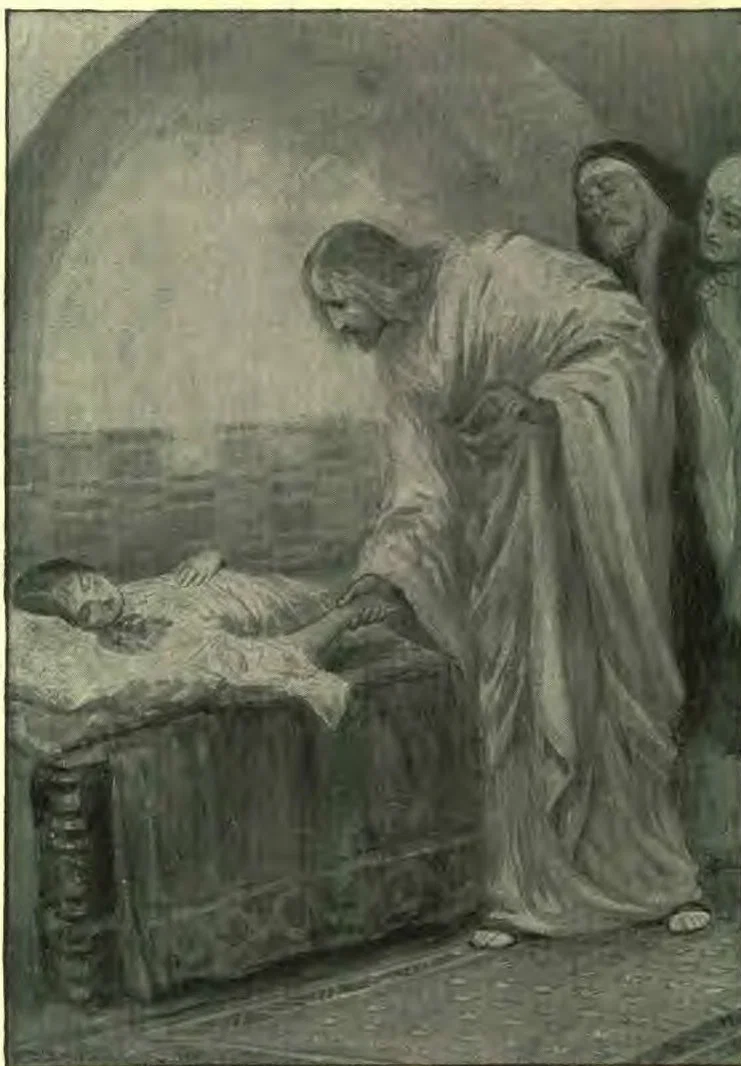
GIFTS OF HEALING.
GIFTS OF HEALING.
The parable is its own evidence that the term “talents” embraces absolutely all the blessings with which God has entrusted man. The term includes not only all the distinctive spiritual gifts described above, but also our powers of intellect, our emotions and affections, our powers of influence, our health and strength, our accomplishments, and our property.
All these are included in the “manifold gifts of God” to His children. They are all the absolute property of God. For “ye are not your own. For ye are bought with a price,” even “with the precious blood of Christ.”
Does not this parable prove incontestably that all the gifts and powers comprehended by the “talents” were put in trust to His church anew when our Lord returned to the Father, to be scrupulously employed until He shall “come again” to “judge the world in righteousness”? It was the purpose of Christ that the primitive purity and power of His church should be continued intact from the time the “man” took his journey (or from the time Christ ascended to heaven) till the time in which he “cometh and reckoneth with them” (or “when the Son of Man shall come in His glory,” etc).
It is true that many of the gifts of the Spirit afterward became wholly unknown to the nominal Christian church. Yet the same Christ is still Lord over all, and is longing to pour out His gifts, if only faithful recipients can be found who would use them in love and fidelity for the good of the whole church, and so to the glory of the Giver. Were not His gifts originally bestowed “for the perfecting of the saints, for the work of the ministry, for the edifying of the body of Christ”? Are the saints of our day all perfect? Does not the ministry still need help? Is not the church to-day susceptible of further edification? Surely the church stands in dire need of all the “helps” that her gracious Lord so abundantly provides.

Development thru Use.

“Talents used are talents multiplied.” The parable of the talents unmistakably teaches that it is not enough to render back to our Lord what we have received unimpaired, and uninjured, but that we must in justice bring back more than we received; that is, we must by industry made effective by the blessing of God, add something to what God commits to us.
The parable teaches that we are God’s stewards; it enunciates the law of responsibility. It shows that the more we receive the more we are morally bound to do. Two talents must, by use, grow into four; five, into ten. God has placed us here to grow, to develop, to “go on to perfection.” There can be no growth apart from exercise, no development without strenuous, systematic effort, no perfection apart from the travail of intelligently directed to it.

Use and Improve, or Neglect and Lose.

This is the sentence pronounced upon every one of us by all the courts of God, in the physical, the intellectual, and the moral world. Use and improve your muscle, your memory, your perceptions, your reason, yourconscience, or they will be swift to languish, atrophy, and die. There can be no standing still; either progress and gain, or recede and lose. It means forward and finally all, or backward and finally nothing. Hence there was nothing capricious or arbitrary in depriving the faithless servant of his unimproved talent. It was in keeping with the inexorable law of God’s universe—in accord with the everlasting verities.

Pertinent Reflections.

All gifts and aptitudes are conferred for the benefit of the entire church. He who perverts them to his own honor and use perpetrates a kind of church robbery. “No one liveth unto himself.”
As in the living body each member fills a special office for the good of the world, so has every believer a special gift of the Holy Spirit for the use and upbuilding of the whole spiritual body of Christ.
It does not depend upon whether one has effected much or little, but upon whether or not one has been faithful and diligent in the measure of his power and sphere. For the lowliest Christian is just as truly a member of the body of Christ as is the most prominent.
As to the gifts of God, nothing can be merited, nothing forced, nothing affected. His Spirit gives and works as He wills. Hence no one must be envious because he can not do so much or act so conspicuous a part as some other. Everything depends upon the state of the heart and the quality of one’s faith. Each one is a distinct member, who has his own peculiar gifts and qualifications, and with these he should in love serve the others.
In the language of Doctor Pierson, “There are three grand departments of Christian experience: salvation, sanctification, and service; and unction and Pentecostal power appear to be especially connected with the last of the three, giving spiritual discernment of truth, and so, also, effectiveness in the utterance of truth.”
Shall we not all most earnestly covet the best gifts, in order that we may the more acceptably glorify the beneficent Giver, and the more efficiently labor to promote the well-being of every member of the church of Christ, which He purchased with His own blood?