Our London Letter

4%

Our London Letter

(From Our Own Correspondent)
PARLIAMENT was prorogued August 28, after a long and fruitful session. The Liberal government can point to an excellent legislative and administrative record. Expenditure in the army and navy has been reduced the last two years to the extent of some nine million of pounds, and taxation has been lowered accordingly, while the income tax has been adjusted so as to rest less heavily on those with small resources. The army has been overhauled and remodeled to the satisfaction of all parties concerned, and measures favoring small holdings and removing some of the present abuses in regard to the land have been passed for England and Ireland, the corresponding bill for Scotland being lost thru opposition in the House of Lords. The way has been opened financially for old-age pensions.

The House of Lords.

When Parliament meets for its third session, under the new Liberal regime, in the early part of 1908, the struggle will begin in earnest between the Commons and the Lords. The government is determined to bring in a new education bill and a licensing bill, both of which are likely to meet with strenuous opposition in the Upper House. If this second effort to provide a national education system is rejected by the Lords, Parliament will doubtless be dissolved, and an appeal made to the people based on the arbitrary action of the Upper House. The campaign cry of the Liberals would then be the necessity of curtailing the power of the Lords.

Russian Relations.

The new convention with Russia, which is not popular with Radicals, seems to give some guarantee of peace in central Asia. The respective relations of the two countries in Persia are so adjusted as to give England the southern part for its sphere of influence and Russia the northern. Afghanistan is declared to be a British sphere of influence, and Tibet is given to neither of the two countries. The land of the Lamas is to be left alone for the present. There are to be no concessions for railways, mines, etc., and no "scientific expeditions" for three years to come.
King Edward's visit with the Kaiser at Wilhelms-Hohe was an extremely cordial one, and England is looking forward with pleasure to the return visit which the Kaiser will pay to his uncle. The king's popularity seems to increase every year. He certainly shows admirable tact in winning and holding the affections of all classes. Queen Alexandra is also exceedingly popular, and, in fact, the whole royal family.

Religion and Politics.

The religious situation is fraught with interesting possibilities. Mr. R. J. Campbell has just published a new volume of sermons, in which he further elucidates the principles of the "new theology." The book is more dignified and hardly as aggressive as the one which came out some months ago; but it teaches the same insidious errors. The writer admits that there are divergencies in the ranks of the adherents of the new doctrines. He shows his strong socialistic tendencies in a number of passages. There is a rumor abroad that he will run for Parliament as a Socialist candidate.
Other prominent preachers are giving increased emphasis to social and political matters. Mr. Griffith-Jones, the principal of a well-known theological seminary, in his inaugural address given a few days ago, said that the crying need of college training is "a study of applied theology—that is, a mastery of religious truth in its social and economic aspects. Abstract exegesis must give way to practical programs. The preacher must know something of politics as well as ethics, of economics as well as exegesis; . . . he must be in constant touch with the pulse of the age."
Mr. F. B. Meyer, the president of the P. S. A. (Pleasant Sunday Afternoon) Federation, struck a similar note at the annual conference of that large body. His subject was "Betterment; and How to Secure It." He said that the goal of the race was betterment, and betterment was to be reached thru the conjoint action of God and man. They must cultivate the idea of brotherhood. Socialism was the human quest for brotherhood.
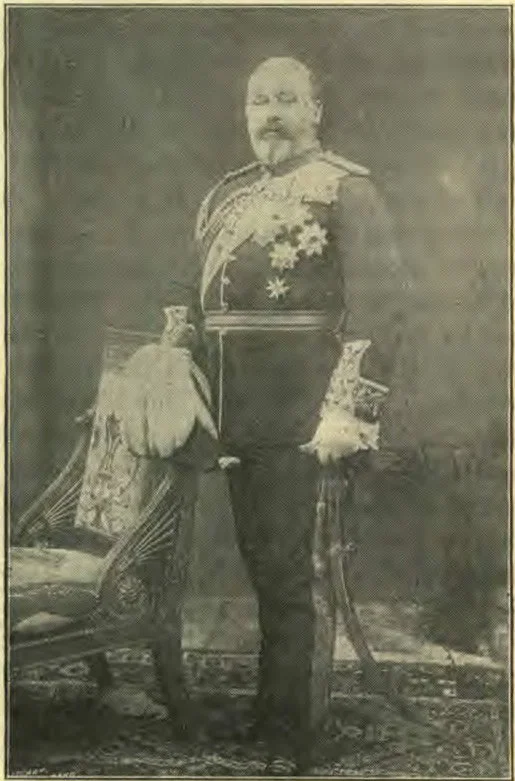
King Edward VII.
King Edward VII.
Mr. Sylvester Horne, a leading Congregational minister in London, has just published a book on "The Ministry of the Modern Church," in which he takes strong ground in favor of this broader conception of the work of the church. The earlier nonconformity, he tells us, was a kind of monasticism, that is, a retreat from the world in the interests of one's personal salvation. "But even Rome, with all its iniquities, had risen above that idea. . . . It never faltered in the belief that all life was the province of the church." Anglicanism by becoming sacerdotal had largely lost its hold upon the people. There was now "no possible exponent of the religious instincts and convictions of the age, and no possible influence in the commonwealth to give a religious direction to social, industrial, and political movements but the Free Church minister."

Church Federation.

The idea of church federation is rapidly growing. For years negotiations have been under way for the reunion of three branches of the Methodist Church; namely, the Methodist New Connection, the Bible Christians, and the United Methodist Free Church. The work was finally completed in the historic Wesley's Chapel, on City Road, London, the 17th instant. The resulting denomination will be known as the United Methodist Church, and will have 2,421 churches, 180,000 members, and 322,758 Sunday-school pupils. Different ideas of church government and organization were the cause of the split which separated these bodies originally, and it is on church polity that they are still separated from the Wesleyan Methodists and the Primitive Methodists; but a further union is not at all unlikely. In fact, there is talk of a union of all the nonconformist churches into one corporate body, and some would even include the Anglican and Catholic churches, should they be willing to join.

Union and Brotherhood

are watchwords with those who stand in the front rank of popularity. Denominational lines are vanishing; differences of creed weigh very lightly with the majority; what will win universal assent is evidently the only thing worth teaching. The minister must be a compound of the politician, the business manager, and the orator; he must open bazaars and attend committee meetings; he must keep up-to-date in politics at all hazards, and if he has some time left in which to study his Bible, well and good, but that is an after consideration.
The old idea of the preacher as a man with a message from God is dying away. The sense of sin is almost nowhere to be found. Few are calling out, "What must I do to be saved?" The religious indifference of the masses is appalling. And yet churches and ministers generally seem well satisfied. Some even talk of the wonderful spiritual progress the world is making.
Certainly the spirit of brotherhood is in itself good and to be welcomed; but a recognition of human brotherhood is not all there is to Christianity. Socialism can not save from sin, which is the real cause of the misery of this world. The preaching of the Gospel is to the mere Socialist foolishness, but it alone can reconcile a man with God, and fit him for heaven. The Christian, if he is true to his profession, will have a tender care for the poor, and will live a simple, self-denying life; but he will do more than this; he will recognize the fact of sin, and the need of an atonement, and will rest his hope for salvation on the word of God. He will take the Bible as his standard, and weave its saving principles into every detail of his daily life.
Funds are being called for to carry on a National Purity Crusade in the interests of the morals of London and other large cities. The new movement, which is being started under the auspices of a number of prominent men and women, is not intended to replace the work of any existing society, but rather "to supply a great moral impulse to the whole community which will greatly accelerate their work." It is represented that there are laws on the statute book which are a dead letter for want of a strong public opinion to back them up.

"Modernism" in the Church.

English Catholics view with mixed feelings the recent papal encyclical against "modernism" in the church. Of late years a liberal party has been growing up in the Romish church, and there are not wanting priests who advocate the so-called higher criticism. It has been thought by some that Rome has changed, and is ready now to welcome investigation, but such people have reckoned without their host. Roman Catholicism is at heart the same to-day as she was five hundred years ago when her power was unquestioned. She still imposes an arbitrary rule over every one of her professed disciples. Altho the modernism that she fights in this instance is for the most part contrary to true Christianity, this is not the real ground for the attitude she has taken, but rather the fact that free scholarship of any kind always leads away from Rome.
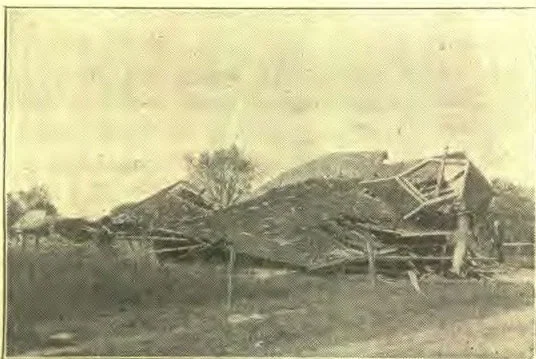
Christian Church, after Explosion.
We have been threatened with a serious railway strike. The Amalgamated Society of Railway Servants has asked for recognition, and threatened to strike if it is not granted. The railway companies at first haughtily declined to do anything; but the public press, for the most part, sympathizing with the men, the companies have recently shown some inclination to yield. Long hours are another source of complaint, but the one point the men will not compromise on is that of official recognition. The organization contains a very large number of the most efficient employees of the railways thruout the country, and if a strike were declared, the railway traffic of the country would be brought to a standstill. Strikes and lockouts seem to be an unpleasant concomitant of our present civilization.
Britain's third battle-ship of the Dreadnought class was launched the other day, and orders have gone forth to build two new ones. Had a reduction of armaments been agreed upon at The Hague, it was intended to lay the keel of only one of these tremendous fighting machines.
M. ELLSWORTH OLSEN. London, Sept. 27, 1907.
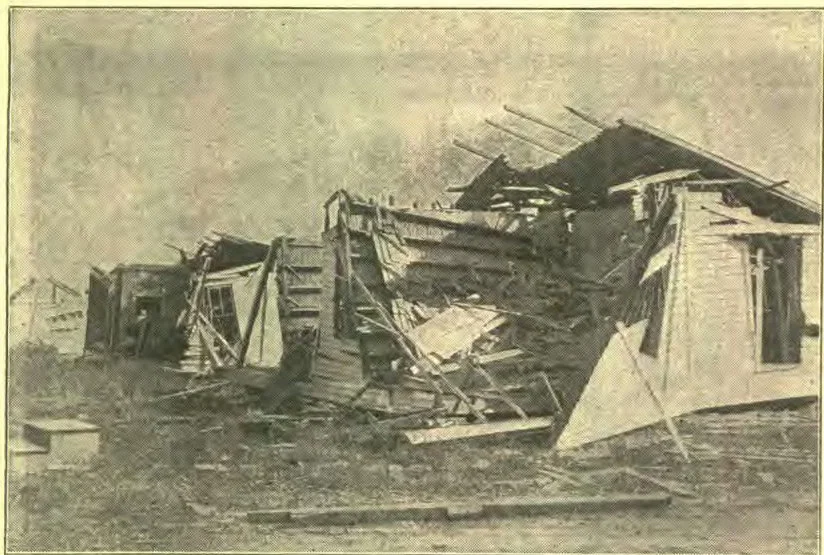
Cottages Half a Mile from Scene of the Explosion.