Daniel Two—The Alphabet of Symbolic Prophecy. The Dream.
THERE was a troubled king in the ancient and mighty empire of Chaldea—not a strange thing. This one, however, was troubled for cause. As he had looked backward over the kaleidoscopic history of the earth to his time, as he had viewed the rise and fall of empire, the exaltation and abasement of men, his mind had turned to his own mighty, growing, world-renowned, world-governing empire. Would it fall into decay and perish as had others? Would it in turn be subjected by some mighty conqueror, even as Babylon had brought other nations under her iron yoke? Or would Babylon, glorious above all her predecessors, stand forever?
The great God is interested in the affairs of men. He has a purpose in this world which He is working out despite sin and rebellion. In the working out of this purpose He seeks to use for His own eternal glory and the everlasting good of all His creatures, every human soul, to the fullest extent of that soul's capability. He will use every soul which will respond to Him. He will enter every avenue to heart or mind which may be left open to Him, in order to seek the salvation and cooperation of that soul. God has not revealed His working in behalf of all, but He works in behalf of all; and He leaves on record typical cases for the encouragement and instruction of those who come after.
Among the kings of earth, Pharaoh was one of such who rejected God's revelation, hardened himself against God's mercy, and defied God's power. Nebuchadnezzar was another ruler who at last yielded to the Divine Goodness. Thru both of these kings God showed His power and glory; thru the one despite his hardness and rebellion; thru the other by blessed final cooperation. The one hardened under reproof and instruction; the other yielded.
The Second Lesson.
God had showed the proud king of Babylon that the educational system of Babylon at its best was not to be compared with the divine system at the worst; but Nebuchadnezzar had not heeded the first lesson. Now the king's desire to know the future was the channel by which the second time God sought to teach Nebuchadnezzar the folly of all human wisdom, and the only true source of knowledge. He therefore came to the idolatrous king in the most impressive possible way—in a strange and startling dream which roused the king from his sleep, prevented further slumber, and troubled his spirit greatly.
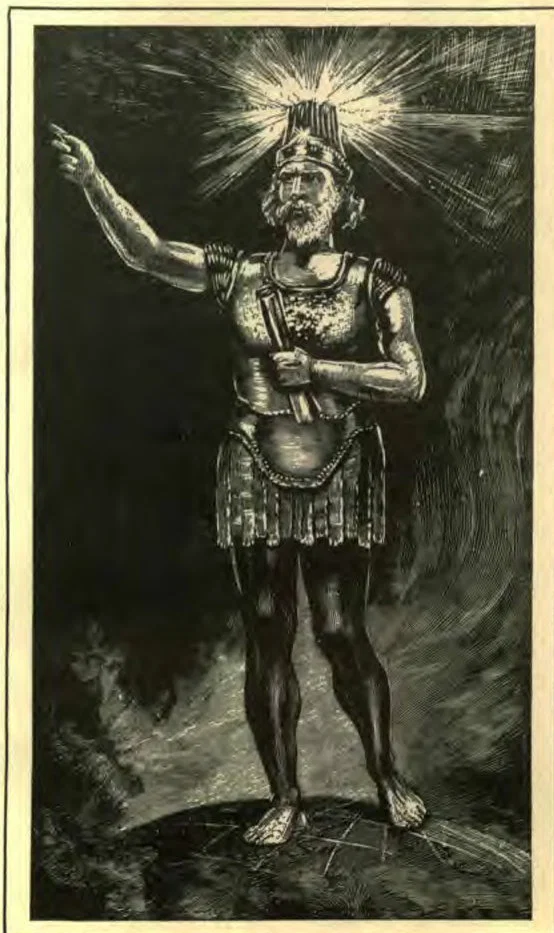
The Image of Nebuchadnezzar’s Dream.
A Vain Quest.
He sought for the meaning of the dream, so unlike any others of which he had ever heard, and naturally to the wise men of his council—the magicians, enchanters, sorcerers and Chaldeans. But that he might be assured of the true interpretation, he demanded that they should first tell his dream. The youthful Judean students had caused him to doubt the great teachers of his realm, and he thought it wise to demand more than the ambiguous replies of the scholars of mysticism, the school-men, or the priests. More than this, he demanded a satisfactory reply to his request under the penalty of destruction of property and loss of life. "If ye make not known unto me the dream and the interpretation thereof, ye shall be cut in pieces, and your houses shall be made a dunghill." Dan. 2: 5. On the other hand, if they would make known the dream and its interpretation, they should be loaded with gifts and honor. Dan. 2: 6. The king thus placed before these worldly wise men the strongest incentives to reveal their right to be regarded as counselors in his realm. They again ask that the dream be made known.
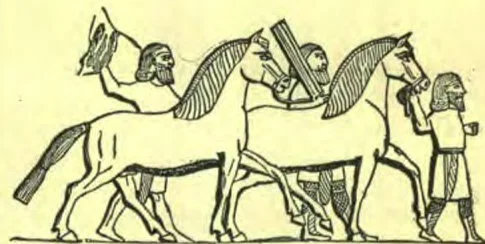
Babylonian Horses and Men, from the Monuments.
But the requirement is beyond their wisdom. No philosophy they possess, no science of which they are masters, no process of reasoning, no authority of masters or tradition, no incantation or spell, can reveal the dream or its meaning. They know this; and in the light of the king's sentence they confess the futility of their knowledge, and seek to excuse themselves and to persuade the king by precedent. The record tells us:
"The Chaldeans answered before the king, and said, There is not a man upon the earth that can show the king's matter; forasmuch as no king, lord, or ruler hath asked such a thing of any magician, or enchanter, or Chaldean. And it is a rare thing that the king requireth, and there is no other that can show it before the king, except the gods, whose dwelling is not with flesh. For this cause the king was angry and very furious, and commanded to destroy all the wise men of Babylon." Dan. 2:10-12, A.R.V.
Viewed from the ground of their great claims and pretensions, the king's decree was not unjust. Here were men who boasted10that they were keepers of the gate of heaven; that with them was the fulness of knowledge; and yet they were deceivers of men and destroyers of nations. Their lying interpretations and flattering counsel would lull a ruler to ease when he ought to be stirred to repentance and action. They were brought to a test, and were found wanting.
When the wise men were called before a king who had honors to bestow, the unpopular worshipers of Jehovah were not invited; but when the decree went forth that the wise men should be slain, "they sought Daniel and his companions." Dan. 2:13.
Prudently and wisely Daniel inquires of Arioch, the executioner, "Wherefore is the decree so urgent from the king?" Arioch tells him. Daniel goes to the king, and asks, not for the dream, not for time to escape, but for time to make known the interpretation. Then follows a prayer-meeting. Daniel tells his godly companions, and they seek God together, that He, the only Revealer of the veiled future, should make known the mystery. They make no demands on their merits, or because of their faithfulness; but desire "mercies of the God of heaven." Here is the result with Daniel's thanksgiving:
"Then was THE SECRET REVEALED unto Daniel in a vision of the night. Then Daniel . . . said, Blessed be the name of God forever and ever; for wisdom and might are His. And He changeth the times and the seasons; He removeth kings, and setteth up kings; He giveth wisdom unto the wise, and knowledge to them that have understanding; He REVEALETH THE DEEP AND SECRET THINGS; He knoweth what is in the darkness, and THE LIGHT DWELLETH WITH HIM. I thank Thee, and praise Thee, O Thou God of my fathers, who hast given me wisdom and might, and hast now made known unto me what we desired of Thee; for Thou hast made known unto us the king's matter." Dan. 2:19-23, A.R.V.
Daniel tells Arioch, Arioch tells the king, the king sends for Daniel; and here is Daniel's message to that king, and all other kings who desire to know the future:
"The secret which the king hath demanded can neither wise men, enchanters, magicians, nor soothsayers show unto the king; but THERE IS A GOD IN HEAVEN THAT REVEALETH SECRETS, and He hath made known to the king Nebuchadnezzar WHAT SHALL BE IN THE LATTER DAYS." Verses 27, 28, A.R.V.
God is the Revealer of the mysteries of the future. He "is Light, and in Him is no darkness at all." 1 John 1:5. He desires that men shall be His sons, "children of light," knowing of the evil to come, and the sure refuge—Christ Jesus. 1 Thess. 5:4-6. He would not have kings or rulers or presidents or statesmen blinded to these things; and His revelation to Nebuchadnezzar is left on record to all who live afterward. It is recorded in order that rulers now may know "what shall be in the latter days," "what shall come to pass hereafter; and He that revealeth secrets hath made known to thee [whomsoever you are] what shall come to pass." Dan. 2:29.
The Dream.
Daniel then tells the dream. It is neither guesswork nor conjecture nor mediumship nor mind-reading. It is the revelation of God, told with the conviction of truth:
"Thou, O king, sawest, and, behold, a great image. This image, which was mighty, and whose brightness was excellent, stood before thee; and the aspect thereof was terrible. As for this image, its head was of fine gold, its breast and its arms of silver, its belly and its thighs of brass, its legs of iron, its feet part of iron, and part of clay. Thou sawest till that a stone was cut out without hands, which smote the image upon its feet that were of iron and clay, and brake them in pieces. Then was the iron, the clay, the brass, the silver, and the gold broken in pieces together, and became like the chaff of the summer thrashing-floors; and the wind carried them away, so that no place was found for them; and the stone that smote the image became a great mountain [margin, "rock"], and filled the whole earth." Verses 31 to 35, A.R.V.
In these five verses of less than one hundred and fifty words is given in epitome the history of the world in time, and the outlook of eternity. It is the alphabet of all symbolic prophecy. From that kingdom of earth, most far-reaching in its influence, with its evanescent splendor, it sweeps forward to the eternally glorious kingdom of Jesus Christ.
[The second part of this article, "The Interpretation of the Dream," will be given in our next. It should be of great interest, as it is of vital importance to study these lessons which God has given us.]