France

5%

France

and the Papacy (From Our Own Correspondent)
The Bourne, the Wall Street of Paris.

The Law of Separation.

Its Main Provisions.
Part Second. THE following is an abridgement of the most salient features of the law of separation: Art. 1.—The Republic warrants liberty of conscience and guarantees the free exercise of worship. Art. 2.—The Republic does not recognize or stipend any form of worship. Art. 3 and 4.—The property belonging to public establishments of worship shall be transferred to associations of worship (Associations Culturelles), within one year from the issuing of the law. Art. 5.—The property originating with the State shall return to the State. Art. 8.—In case of property being claimed by several associations, the decision will be pronounced by the Council of State. Art. 11.—Ministers more than sixty years old shall receive a life pension equal to three-fourths of their salary; those more than forty-five years old shall receive a pension equal to half of their salary. These pensions shall not exceed 1,500 francs. In case of decease, half of these pensions shall go to the widow and children. The other ministers shall receive various sums covering a period of four years. Art. 12.—The edifices (cathedrals, churches, chapels, temples, synagogs, archiepiscopal and episcopal residences, parsonages, seminaries) dating back to the Revolution are and remain the property of the State. Art. 13.—The edifices used for public worship (churches and chapels) are left gratuitously at the disposal of public establishments of worship, and afterwards of such associations which shall take their place. Art. 14.—Archiepiscopal and episcopal residences, parsonages and their premises, large seminaries and Protestant theological school buildings are left gratuitously at the disposal of associations for a lapse of time varying between two and five years. Art. 19.—The associations shall be composed, according to the size of the parishes, of seven, fifteen, and twenty-five persons. Notwithstanding any clause to the contrary in the statutes, the financial and legal operations of the property by the trustees shall be presented each year for inspection to the general meeting of the members of the association, subject to its approval. Art. 21.—The financial inspection is exercised over the associations (or unions of associations) by the general administration of finance.
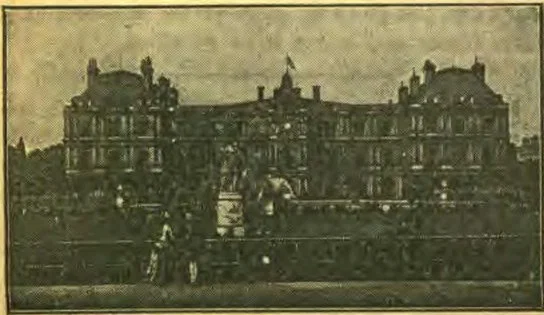
Palace of the Luxembourg, Paris.
Art. 22.—The associations and unions may create a reserve fund not exceeding three times the annual average of their expenses, and a second cash reserve to be used for purchasing necessary land or furniture.

How It Was Received by the Churches.
The Reformed and Lutheran presbyteries and the Hebrew presbyteries made no delay or difficulty in accepting the law; they immediately organized the associations provided by it, and on the 13th of December, 1906, received from the State the transfer of their churches and other property, the free use of
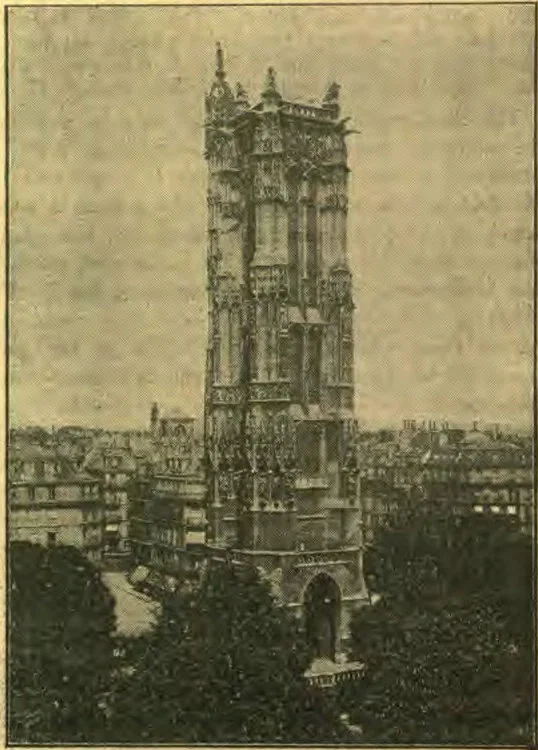
Tower of St. Jacques (James), in Which the Tower of the Church Is the Principal Thing.
the parsonages and the pensions due to their ministers. Not so with the Catholic Church. On the 11th of February, a first encyclical appeared, vehemently condemning the separation law. May 31, a general gathering of the French bishops, while condemning the separation, accepted the principle of the associations by forty-eight yeas of seventy-eight voters. August 10, a second encyclical forbade the forming of associations. In November, the government proposed to wait one year more for the decision of the church. The delay was rejected. Then the government offered the church the benefit of the law of 1881,—a law respecting public meetings which requires that each gathering be notified to the local authorities,—but requiring only one declaration a year for each parish. The pope gave orders not to make any declarations. This brings us to Dec. 11, 1906, the original date for the law to go into effect. At the uncompromising attitude of the church, the disappointment of the French Government was keen. Its anger was shown by an act which M. Clemenceau called "a first cannon-shot." Secretary Montagnini was arrested, led to the Italian border, and the papers of the papal embassy in Paris were seized. January 2, 1907, the government decided that the law would be operated at once. As a consequence, 300,000,000 francs worth of property, including the churches, was transferred to the townships and to charitable societies. The church properties were placed under sequestration until the State could transfer them legally to their owners. Bishops and priests were expelled from their dwellings. Five thousand theological students were drafted in the army, and the pensions to the Catholic clergy were suppressed. At the same time, the government announced that the churches would remain for the Catholics to use, but without legal title, and without excluding third parties from using them also. On January 16, a third council of the bishops convened in Paris. It proposed to the government a form of contract between the priests and mayors of each township, said contract granting the Catholic parishes the exclusive use of the churches for a period of eighteen years. The government laid down as a condition that the priests should not be foreigners nor members of the dissolved monastic congregations. This, of course, was not agreed to by the bishops, and here the negotiation ended. This brings us up to the date of this writing.
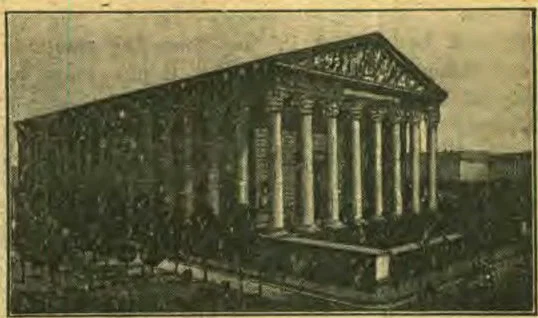
Church of the Madeleine, Paris.

Why the Catholic Church Rejects the Law.
It is but just to state, first, that the Catholic Church does not reject the law as a whole. She does not refuse the immense advantage, denied under French kings and under the Concordats, to appoint priests and bishops of her own free will and without any interference on the part of civil authorities. She does not refuse the freedom of conscience and worship guaranteed by the law, and of which the Protestants and dissenters in France have been deprived for centuries. She has immediately begun to make use of the valuable liberty granted its bishops to meet in council, and to go to Rome unmolested and without first asking permission of the State. This is recognized with pleasure by Archbishop Ireland in a discourse delivered Dec. 26, 1906, in the cathedral of St. Louis. Let us now examine candidly the objections formulated by the organs of the Catholic Church against the law of 1905: 1. "A Confiscation of the Blackest Dye." Of course, the first objection is the separation itself. The pope owed it to himself, to the Catholic tradition, and to the Encyclical of 1864 to condemn a law which severs a union blessed by the church and enjoyed by her for fifteen centuries. And yet, we mustremind the reader that Leo XIII wrote the American bishops in 1892 that the regime of separation as it exists in the United States is excellent from the fact that it insures equal liberty to all forms of worship. The organ of Archbishop Ireland, the "Western Watchman," of St. Louis, Mo., under date of February 7, says: "A State church is a State slave, and when the State is avowedly infidel, then the State church must either live as a monster or die as a State church." The main objection, however, one which has given rise to loud protests, is that of robbery. The above sub-title is from Archbishop Ireland. Let us see if this protest is not founded upon fact; but to this end we must go back to the Revolution. Nov. 2, 1789, the National Assembly voted the following: "1. All ecclesiastical property is at the disposal of the nation, the latter agreeing to support public worship and its ministers and to take care of the poor. 2. Each parish priest shall not receive less than 1,200 francs a year, exclusive of a lodging and the garden attached thereto." This was a confiscation with a compensation in the form of a yearly stipend and lodging free. This arrangement was disannulled by a decree passed in 1794, which said: "The French Republic shall henceforth cease to pay for the expenses or the salaries of any religion;" and by another one, in 1795, which said: "The Republic pays no salary to any religion; it furnishes no houses for the exercise of public worship nor for the accommodation of the ministers." This was confiscation without the compensation, in other words, confiscation pure and simple. In 1801, the Concordat brought the matter back where it was in 1789. It said: "All metropolitan churches, cathedrals, parish churches and others, necessary for public worship, shall be placed at the disposal of the bishops." "The government shall guarantee the bishops and priests proper support" (Articles 12 and 14). Article 13 stated: "His holiness declares . . . that neither he nor his successors will in any way trouble the persons having purchased such ecclesiastical property as has been confiscated" (by the Revolution). And now we come to 1905. The separation between the State and the church is pronounced. But this separation carries with it the cutting off of all State money for church support, that is to say, of the yearly pension paid the church as indemnity for the confiscation of 1879. The State should have offered the Church some other form of indemnity. Generously, and with true French gallantry, he should have tendered the Catholic Church, his consort for thirteen hundred years, first, all the churches, large and small; and next, the episcopal and priestly residences and the seminaries; in a word, all the bridal furnishings, all that the church was using for worship and for the education of her priests at the time of the separation in 1906. What did the French legislator do? He declared, Art. 12, that all church edifices built before the Revolution "are and remain the property of the State." And he also claimed the ownership of a class of buildings "posterior to the law of 1801." Which are these buildings, and which are those belonging to the church? The law does not tell. According to Art. 14, "archiepiscopal and episcopal residences, parsonages and their premises, large seminaries and Protestant theological school buildings," all these are excluded from the property of the Church, since the State claims them back at the end of a period of from two to five years. We are therefore forced to the conclusion that the French legislators of 1905 have rendered themselves guilty of an act of unjust confiscation toward the Catholic Church. Of course, Art. 13 says that "the edifices used for public worship are left gratuitously at the
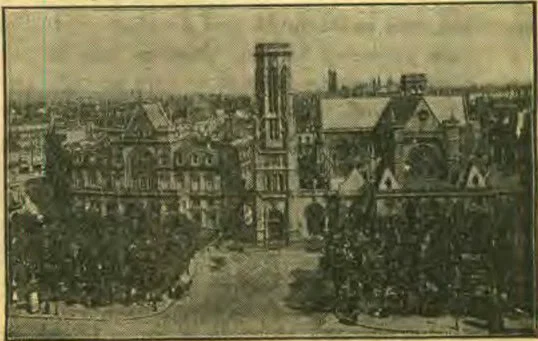
Church of the Saint Germain l'Auxerrois.
disposal of public establishments of worship and afterwards of such associations which shall take their place." But this refers only to churches and chapels, and not to parsonages and seminaries. Besides that, this right to the use of these churches and chapels may be withdrawn for five different causes enumerated in the same article. Under a free-thinking government, the outlook for the enjoyment of the churches may look rather slim. It seems as tho the State wanted to take back with one hand what it had given with the other. Why does the French Government—a purely laic institution—want to reclaim churches for which it has no earthly use? Is not this a "separation with a string to it," as the "Western Watchman" calls it? And must we conclude that the free-thinkers which are governing France are lacking faith in the power of their doctrine, and are afraid that the full and free liberty which they offer the Catholic Church may become fatal to liberty itself? The past has shown that they may well afford to be.
2. "The Law Enslaves the Church." Founded in fact, as we have concluded the complaint of confiscation to be, the editor of the "Western Watchman," Rev. D. S. Phelan, finds it unworthy of the church, and hastens to bring the whole question on the high platform of principles. He writes: "If the church of France was to lose her earthly possessions it were a pity, of course; but we can not be expected to explode in indignation over the loss of mere worldly possessions. What does the church care for homes and lands? Such grief were unworthy of her heroic past, and vulgar in the extreme. Then, has not the State the right of eminent domain? Can not the civil power take for its uses the temporal possessions of the church? In this country we have established the principle that private property shall not be taken for public uses without compensation; but even such provision in our fundamental law shows that such things had been done." Then he adds: "Rome saw the danger that lurked under the apparently innocent clauses of the law. . . . The Associations Cultuelles would not only hold the property of the church, but would dictate the mode and manner of the worship, and the specific uses for which that property would be employed. It was because the law enslaved the church that Rome interposed her veto; and that is the grievance the Catholics of France and the world had against the French Government. If they had stated the case in that way they would have won the sympathy of the whole civilized world; a sympathy which they forfeited entirely when they made their grievance one of property rights." We are unable to find ground for the above accusation. We ask every unbiased mind to reread the law and to say wherein the Cultuelles seek to "regulate public worship." The law says nothing, absolutely nothing, about the manner or form of public worship. Were this true, French Catholics, who are not lacking in intelligence, would have found it out. Hear what a group of eminent Catholics wrote to the bishops of France in a circular letter which has become public. After reminding them that the law states positively that the associations are to be in harmony "with the general rules of such worships as they shall propose to organize," they add: "This means . . . that a Catholic Association Cultuelle shall be legally such a one whose members are in communion with the priest, the priest with the bishop, and the bishop himself with the sovereign pontiff. It is for you, bishops of France, to say how they shall be composed, of how many members, and how selected or nominated. The State shall question them only with respect to their financial management. . . . But in everything relating to the organization of worship, allow us to repeat it, you, monseigneur, and you alone, shall be called to limit the authority of the Association Cultuelles, and it will be for you to say what rights shall be theirs. . . . Being forbidden by the law of separation neither to believe what we please nor to
practise what we believe, the hierarchy remains untouched."

3. The Real Difficulty.

The signers of the above letter also wrote to the pope. They besought him to tell them, in clear, French idiom, wherein the Cultuelles were contrary to Catholic doctrine, to which they pledged themselves as devoted believers. We do not know whether the pope answered their demand. But here is the point which seems to us to be the main ground for the rejection of the associations by the pope. It is the fact that said associations call for a number of laymen to participate in the financial administration of the parish. The editor of the "Western Watchman" says, with reference to the French situation: "I want to say that our Catholic laity should at all times keep in touch with Catholic interests which, in the domain of faith and morals, should be for them interests of paramount importance." This is pure Americanism, good democracy, and at that good Gospel. No wonder that this doctrine, dear to Archbishop Ireland, should be freely preached in the organ of his diocese. But this doctrine is not by any means welcome at the Vatican. And not without reason. Just imagine laymen, by virtue of being members of the Cultuelles, discussing with the priest, and talking over with him on equal footing the interests of the parish; and then imagine the whole parish discussing the same interests with the priest and the Cultuelle. Will not this very fact encourage the whole community to gradually take an interest in ecclesiastical and religious questions? And will not this result—which is the strength of Protestantism—undermine the Catholic Church founded on tradition and blind submission to Rome's decisions? The editor of the "Western Watchman" says that "according to canon law, the Catholic Church is in the bishop" and not in the whole community of believers. In the associations the pope discerned a germ of independence; this germ, in time, may become a tree which will break the fetters of hierarchy and tradition. Pius X preferred to sacrifice earthly riches and commodities rather than to sacrifice the principle of the church's power and possibly of the church's existence in France. Due to a profound and astute sagacity, the pope has very likely saved the hierarchy and the tradition. But has he not, at the same time, passed by and ignored two fundamental truths of the Gospel: the one which says that all men are brethren; and the other one which says that the Holy Spirit, sole and infallible interpreter of the word of God, is promised to the most humble and unlearned as well as to the most educated? J. VUILLEUMIER.