Religions of Korea

5%

Religions of Korea

Korean Articles—Number Four

KOREA has been described as a country without a religion. Confucianism and Buddhism were introduced from China, but at present have very little influence. The former is rather a system of ethics, quite lacking in the restraints and incentives essential to a religion. The latter at one time became quite prevalent and influential in Korea; but about three hundred years ago it fell into disrepute for political reasons, and was disestablished. So at the present time, Buddhism in Korea must be sought for to be found. The principal monasteries and temples are situated in remote places. Perhaps the most famous are those among the Diamond Mountains, in the east-central part of the country.

Airy Spirits.

With the people generally, the only substitute for a religion which they possess is a superstitious form of spirit worship. The popular imagination peoples every conceivable place with hosts of airy spirits, good, bad, and indifferent; but the great majority are malevolent. The people live in constant dread of being injured by these evil spirits; or of offending the good spirits, and so losing their favor and protection.
This gross superstition is without priests or temples, without any regular form of worship or of religious ceremony, without sacred writings to which even a form of reverence is paid. Two classes of exorcists or sorcerers, the Pan-su and the Mu-tang, tho not forming an order, nor being united into an organization, are practically recognized as the priesthood of the cult; for it is thru them that the spirits are approached and propitiated.

Seeking the Sorcerers.

The services of these sorcerers are sought under a variety of circumstances. In time of sickness or other trouble, the incantations of the sorcerers are believed to exorcise the evil spirits. On the occasion of some important transaction, as a marriage, the location of a grave, or of a dwelling, the purchase of land, a sorcerer is employed to make a favorable forecast for the event. It will be seen that the services of these sorcerers are frequently required; and as their fees are high, the aggregate of these makes a heavy burden for the people already impoverished by official rapacity. It has been estimated that at the lowest calculation Demonism costs Korea two million five hundred thousand dollars annually.
The Pan-su are a class of blind sorcerers; and fortunate are the parents who have a blind son, for he will be able to support them from the profits of his divinations. The Pan-su form a guild, or society; and the chief officers of this guild in Seoul hold certain official titles from the government, which serves to give prestige to the whole body. The Pan-su are employed in time of sickness to exorcise the evil spirit that is believed to cause the disease. Their services are also sought for the purpose of divination. The late queen is said to have frequently consulted these blind sorcerers in behalf of her son, the crown prince, whose health has always been somewhat precarious.

The Mu-tang Deserts Everything.

Of the other class of sorcerers, the Mu-tang, the great majority are women. The position of these women is peculiar. While their employment is lucrative and their services are freely sought, socially they are looked upon as outcasts from society. A Mu-tang is believed to be possessed by some spirit; and any woman is liable to receive this "supernatural call." The spirit is supposed to seize upon the woman, and impose his personality upon her. From this time she severs every home tie, deserts parents, husband, and children, and obeys only the "call" of her familiar spirit. Judging from the experiences of these women upon receiving the "call," it seems more than probable that these are real cases of possession by evil spirits, like those recorded in the Bible.
The functions of the Mu-tang are similar to those of the Pan-su, but more varied. While the Pan-su seeks by his incantations to expel, bottle up, or bury the troublesome evil spirit, the efforts of the Mu-tang are rather to propitiate the spirit, and so secure relief from his malevolent influence. The Mu-tang are also consulted for purposes of divination; and their influence in this direction extends even to the court of the king. It is related that on one occasion when the king was planning to give an entertainment to the corps diplomatique, sorcerers were consulted as to the most propitious building or room in which to hold the function. A number of sorcerers were consulted in turn; and as their advice did not agree one with another, the place of the entertainment was several times changed within an hour. No serious consequences might follow so simple a matter as this. But as these sorcerers are also consulted in matters of State, the resulting uncertainty and confusion can readily be imagined; and the removal of their influence from government circles is one of the political reforms that has been attempted within recent years.
Much more might be written on this topic of Demonism in Korea; but enough has already been presented to give some idea of the burden of superstitious fear which rests upon this people. And it is with a sense of relief that we turn to consider what the Gospel of peace and of love that casts out fear has done for them.

The First Protestant Missionary.

Korea was opened to foreign residents and foreign intercourse in the year 1884; and in the same year the first Protestant missionaries entered the country. But the Roman Catholics had preceded them by exactly a century. The first efforts of the Protestant missionaries met with very scant success.After five years of labor, the number of believers in both the Presbyterian and Methodist missions was only about one hundred. As late as 1897 a well-known traveler and writer described the people as being practically devoid of religious sentiment, and the outlook for the success of the Gospel among them as very unpromising.
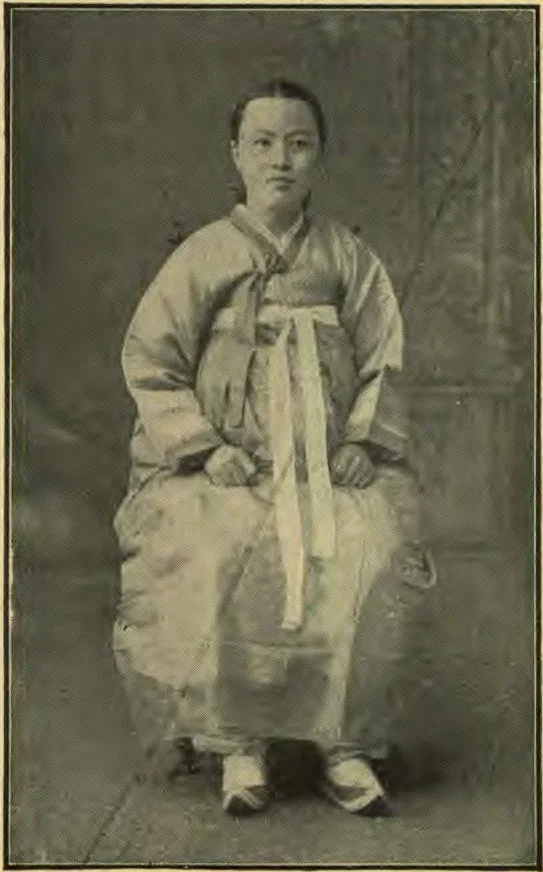
A Korean Lady.
A Korean Lady.
But since that time the work has gone forward by leaps and bounds. Hyeng Yang, the old capital, was one of the first places occupied by mission workers; and after six years of labor, the Presbyterians had twenty-eight converts in that city. But at the present time the whole number of Christian converts in the city is said to be over five thousand. This remarkable increase in this particular locality will serve as an example of the progress made in other places. The missionaries who have been connected with the work from the beginning speak of the results as a marvel of God's grace. From a few isolated localities, the work has been extended from the south far toward the north, and from the western to the eastern shores.

Korean Liberality.

The Korean Christians are often spoken of in terms of praise for their missionary zeal, and for their liberality in the support of Gospel work. It seems to be the rule that the little companies of believers in country districts build their own meeting-houses. They have very little money, but only a small outlay of cash is required. The materials for the walls, roof, and floors, are readily supplied from their own fields; so that the timbers of the frame would be the principal expense in money. Donations of work reduce the carpenter's bill to a minimum. They are also liberal in their support of their native evangelists. In addition to this, it is a common practise for believers to devote a certain number of days or weeks, as they may be able, to active evangelical labor among their neighbors who have not yet heard the Gospel. These graces of liberality and zeal, it would appear, have been carefully cultivated by the missionaries, who have taught the Koreans to bear their share of the work.
All the various lines of missionary effort are being systematically developed in Korea, including evangelical, educational, publishing, and medical missionary work. Korea presents great opportunities to consecrated workers along all these lines. The lack of a regular system of public schools leaves a large place for Christian schools for the education of the youth and children. The practical results of the rational treatment of disease are the best refutation of the superstitious claims of the sorcerers. Native laborers, trained in mission schools, are seconding the efforts of missionaries from abroad.
We rejoice in what has been done and, is being done for the evangelization of Korea; for we recognize this as a part of the great work of evangelizing the world. But as a preparation for the Saviour's coming, the people of Korea must hear the closing message of the Gospel as proclaimed by the three angels of John's prophecy. The whole truth concerning the commandments of God and the faith of Jesus is to be preached in Korea, as in all the world. The claims of the true Sabbath are to be presented; every error in faith and practise is to be laid bare, and the "faith once delivered to the saints" is to be heralded thru all the land. And we rejoice also that this closing message has found an entrance into Korea, and that it is making substantial progress. But the particular account of this remarkable work of the Lord must be reserved for a later article.
Tokyo, Japan. F. W. FIELD.