"HIGHER criticism" that has been working such havoc in the ranks of Protestantism has not been idle in the Catholic field of operation. And while in Protestantism with its greater freedom of thought and its less arbitrary ecclesiastical rule this tendency has manifested itself much more quickly and openly, Catholicism with its domineering ecclesiastical authority, aided by its power to suppress objectionable books, has been able to conceal and restrain for a time this same tendency in its midst.
But in these days when a perverted science has captured almost the entire field of education, the Catholic laity, at least, have been forced to take their stand on one side of the question or the other; and, consequently, the battle in favor of present-day criticism as opposed to the dogmatic declarations of the church has also been declared in the Catholic camp.
Within the Vatican for some time there have been heard mutterings and threatenings, indicative of the forthcoming storm that was ready to burst. The modern scientific scholars of Germany have already incurred the wrath of the Papacy. Professors of the Catholic university, prelates, and students have been in open rebellion against that prerogative of the church which suppresses all books that do not meet its approval. They claimed that books upon which men of genius had labored for years should not be relegated to oblivion by one stroke of the inquisitor's pen. They went so far as to form a society for the purpose of erecting a monument to a great German theologian whose works had been condemned by the Sacred Congregation of Rome.
The Thunderbolts Launched.
Against these persons and their project the pope launched the first thunderbolts of his ire. Then came the thickest of the storm, in which Pius X hurled into the camp of his rebellious subjects a Syllabus of sixty-five articles, whereby he hopes to reduce in abject subjection every Catholic thinker and smite to the ground every tendency toward present-day criticism in the ranks of the church.
As space will forbid my giving all of the sixty-five articles of the Syllabus, I shall call attention to a few of the more pertinent ones that will prove of special interest to us.
In the introduction to the Syllabus, the pope deplores the fact that "not so few Catholic writers go beyond the limits established by the Fathers and the church itself, seeking to explain those dogmas, the attempted explanation of which in itself is a subversion of the dogmas themselves." In other words, the dogmas must not be explained or touched, but blindly accepted and believed.
Introduction to the Syllabus.
The articles of the Syllabus begin by condemning those who hold that the censure of the church extends only to books that deal directly with the Holy Scriptures, but not to those that treat scientifically and critically the books of the Old and New Testaments. Another article is aimed directly against those that would like to see the abolition of the church's censorship over Catholic books, and reads as follows:
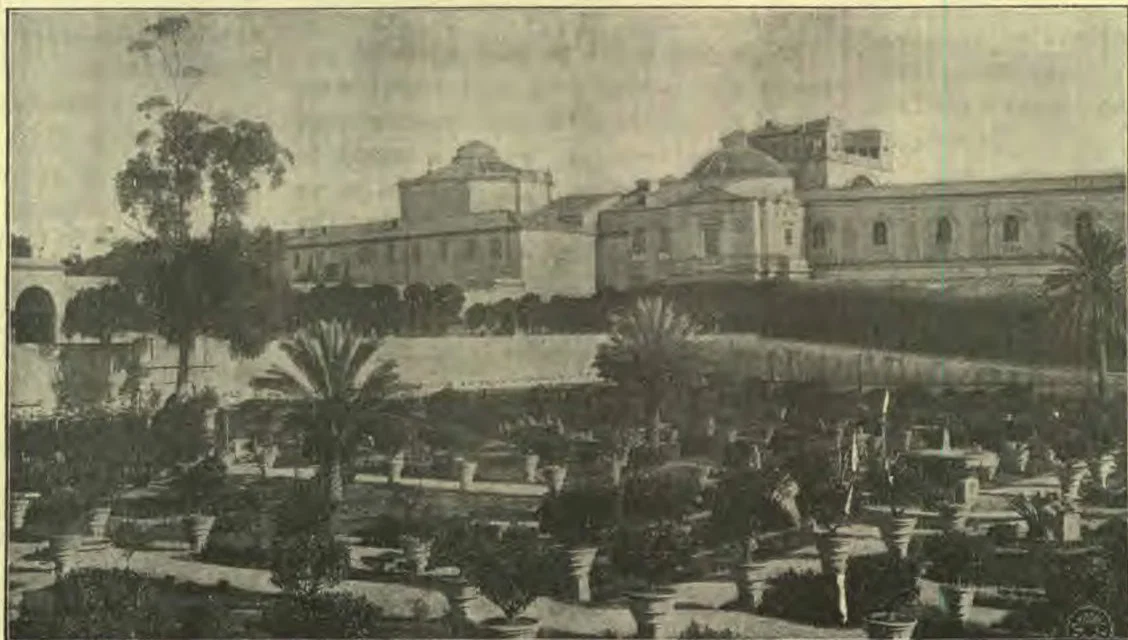
Panorama of the Vatican Gardens, Rome.
"They who take no account of the condemnations of the Sacred Congregation of the Index or the other congregations of Rome, may consider themselves immune from any guilt in so doing."
Those who hold to this proposition have been declared hostile to the church. Another proposition that has been condemned is the following:
"From the judgments and censure of the church against the right of free interpretation of the scientists, one can conclude that the faith as proposed by the church in its present form contradicts history and Catholic dogmas and can not be made to accord with the true origin of the Christian religion."
The foregoing articles held by many in the Catholic Church would seem to indicate that a serious state of affairs exists in the Catholic fold.
Certain Propositions on Rationalism.
And that rationalism has made as marked inroads into the Catholic camp as in the Protestant will be evident from the following propositions condemned by the pope in the Syllabus:
"Those who believe that God is the Author of the Sacred Scriptures err either thru too much credulity or ignorance."
"The divine inspiration does not extend itself to all the Sacred Scriptures in such a manner that all its parts are free from error."
"In many of their narrations, the evangelists gathered together not only true accounts, but also those false ones which they judged of greater profit."
"The account given by John is not history, but a mystical consideration of the Gospel; and the discourses contained in that Gospel are theological meditations about the mystery, destitute, however, of historical truth."
"John invests himself with the character of a witness of the life of Christ, but this is not true unless we understand it as meaning that he was a living witness of the Christian life of Christ at the end of the third century."
"The divinity of Jesus Christ is not demonstrable by the Gospels, but only by the dogmas which the Christian conscience deduced from the knowledge of the Messiah."
"Christ during His ministry did not teach with the object of making known that He was the Messiah, nor do His miracles aim to demonstrate it."
"Christ did not always have the consciousness of His Messianic dignity."
"The resurrection of the Saviour is not really a historical fact."
Perhaps these statements taken from the recent Syllabus of the pope will suffice to demonstrate that also in the Catholic Church rationalism in its most aggravated form is stalking about seeking whom it may devour. While this Syllabus brings to light the deadly miasma of rationalism in the midst of the Catholic fold, it also reveals another tendency that is struggling for an existence. This latter tendency we might call a revolt toward Protestantism.
The following articles condemned by the Syllabus will plainly show a Protestant tendency existing in the midst of Catholicism:
"Simon Peter never held that Christ had invested him with the primacy of the church."
"The Roman Church was made the head of all the churches, not by order of the divine Providence, but simply by reason of political questions."
"The practise of baptizing infants was a disciplinary evolution that arose solely for the purpose of separating the sacrament in two; that is, in baptism and repentance."
"There is no proof that the sacrament of confirmation was ever derived from the apostles, and that a formal distinction between the two sacraments, baptism and confirmation, existed in the history of the early times of Christianity."
"'Receive ye the Holy Ghost: whosoever sins ye remit, they are remitted unto them; and whosoever sins ye retain, they are retained,' does not at all refer to the Sacrament of Repentance however much the Trentinian Fathers have wished to assert it."
"The Christian Communion assumed only little by little the character of a liturgical function."
"One can say without falling into paradox that no chapter of the Bible from the first of Genesis to the last of Revelation contains a doctrine identical with that which the church has handed down to us, and in like manner one can say that no chapter of the Scriptures has the same meaning for the critic and the theologian."
"The heterodox exegetics express more faithfully the true sense of the Scriptures than the Catholic exegetics."
11"The present-day Catholicism can not accord with the true science if it does not transform itself into a Christianity not dogmatic, that is, in a Protestantism wide and liberal."
The fact that the church has had to declare itself in such clear terms in the propositions just cited, certainly indicates a strong tendency toward Protestantism existing in the midst of Catholicism. And we who are here on the ground are in a position to sustain from our own observations that this is really a fact. Many of the Catholic clergy would be happy to cast aside the priestly garb, but are held fast either from fear of public censure or because they see no way open to them to gain an honest living. The Loss Vom Rom movement of Austria is but a bold stroke for liberty, undertaken by the more courageous, but a sentiment that animates many others in the different countries who are sighing for freedom and liberation from ecclesiastical tyranny.
Popular Discussions of the Syllabus.
This Syllabus will mark an important era in the history of the Catholic Church, as it is a challenge to the "modernists" to submit themselves to the "infallible" utterances of the pontiff, or deny their adherence to the Catholic faith. For as one noted professor of the Roman Church has observed, "The solemn act of the holy Father can not be judged according to our personal sympathies. When the pontiff speaks in matters of theology and discipline, to good Catholics there remains no other alternative than to adhere with all their soul to the condemnations pronounced." This prelate further observed that "among his many students he has found a strong sympathy manifested in favor of the principles condemned by the Syllabus." He also affirmed, "You can well understand that it was imperative that the ecclesiastical should interfere with the present diffusion of higher criticism among the clergy. The word of the pontiff in this case must be held as sacred by every Catholic. This will be the proof of fire for the modernists by means of which we shall see if they are really good Catholics, and if they are sincere in their allegiance to the holy See."
A leading journal of Rome makes the following comment on the situation:
"The 'modernists' of the Catholic camp had hoped perhaps that their voice would have some weight and that their good intentions would be recognized; but the decision was entirely contrary to their expectations. With the recent Syllabus the Vatican repels the consciences aspiring for freedom, and constrains them to submit to a renunciation of their own thought. Will they obey? We do not know in what manner will be required adherence on the part of the Catholics to the Syllabus, if only a tacit adherence, which is required of all the faithful, or a public adhesion with an explicit submission to the sixty-five articles condemned. If the Vatican should choose this latter way, perhaps the Syllabus instead of forming the grave of modernism, would mark the beginning of a great and tremendous schism."
Another journal, commenting on the Syllabus, says:
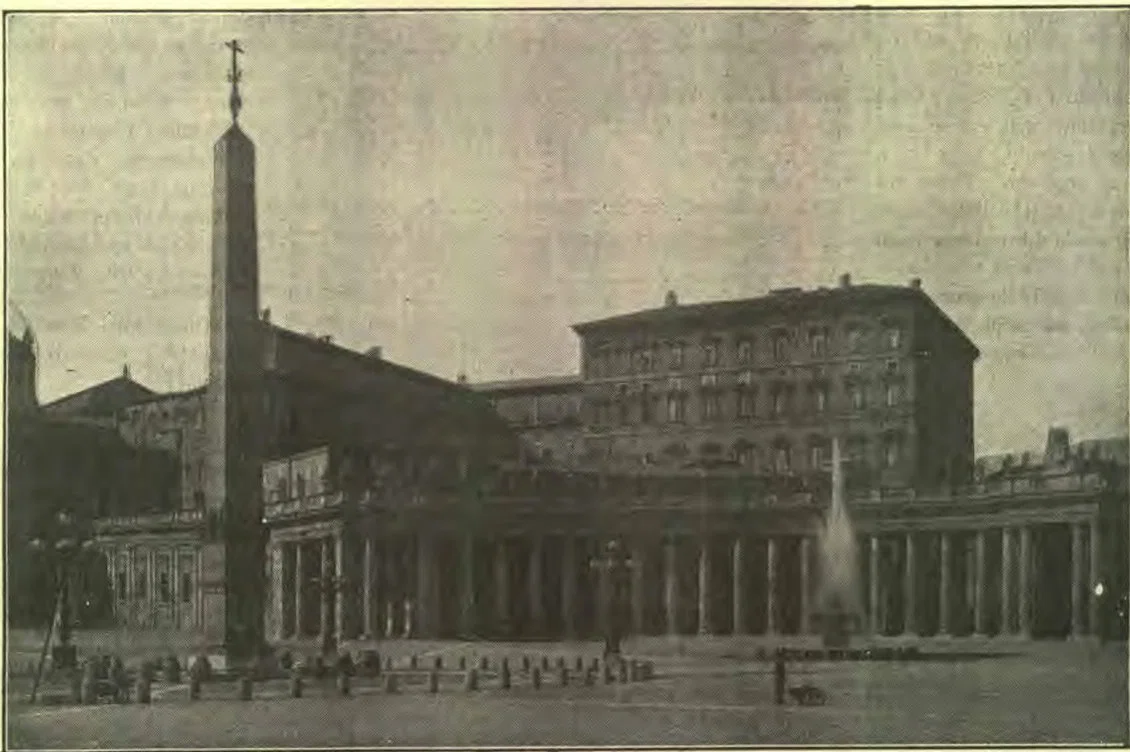
The Vatican Palace, Rome.
"From the new Syllabus one must draw the conclusion that one can remain faithful to the church only on the condition that he does not think; and vice versa one can think only on the condition that he does not remain faithful to the church."
A Roman prelate makes the following pertinent declaration:
"If one must stand by this decree it would not be possible to admit that the Catholic Church were capable of progress, and it would be necessary to believe that its dogmatic evolution had become stagnant, and that the study of its sacred books would be useless to every Catholic because it would be sufficient to address oneself to a clique of Roman prelates to receive historical elucidations which, stamped by the official seal, would be sufficient proof of their veracity."
Concluding Deductions.
From what we can judge even by a hasty study of the question, rationalism must be deeply imbedded in the Catholic Church and it will not be so easily uprooted. The "modernists" may give a tacit consent and remain in the Catholic fold, but they will still be of the same opinion. For, after all, we can not avoid the conclusion that Catholicism is honeycombed with rationalism and atheism. This very lack of a positive Christian experience and a true religion makes men cowards, who, instead of protesting against the violation of their rights, basely submit.
The church knows its own, and therefore the "Osservatore Romano," the official organ of the Vatican, remarks:
"In every one of the propositions condemned, we perceive that modernism is inexcusable and hypocritical in that it is afraid of the formal excommunication of the church."
To resist the formal excommunication of the Papacy one must possess more than simply a modernism that lacks that element of faith which the Bible inculcates in the heart. Rome does not tremble before men who cast aside faith and the Bible, for without Christian fortitude and faith the battle is always lost in the realm of religion. For, after all, man is by nature a religious creature, and feels the need of some spiritual comfort.
In these days of uncertainty, when science is ever changing like the shifting sands, and the very foundations of faith and eternity are slipping away from under us, men begin to grope and feel after something firm and immovable. Two things present themselves, apparently both of an immovable character: The one, the Roman Church, which claims that it never moves nor changes; and the other, the immutable, everlasting word of God.
Many whose feet are slipping in the uncertain, miry clay of science will plant their feet upon the Roman Church in order to find a solid foothold, and will sink into a blind, bigoted formalism. Others will plant their feet upon the eternal, immutable word of God as revealed in the Bible, and will receive an assurance of peace and safety and a life of liberty in Christ.
The former class blindly follow on accepting the words of a mortal as infallible without question, and asking for no reason for their belief; while the latter class take the everlasting words of the eternal Father as their guide, and with the heart touched, the mind illuminated, and the life changed, have abundant proofs and reasons for their faith.