THE condition of the Inca Indians of Peru is worse than that of the Negroes in the South and is comparable only to that of the Kongo natives.
The Inca Indians are descended from the inhabitants of the great Inca empire which the Spaniards found when they discovered Peru in the sixteenth century. They numbered at that time twenty million, settled over the territory now occupied by the republics of Peru, Bolivia, Ecuador, Colombia, Chile, and Argentina. The Incas, with the Aztecs of Mexico, were the most civilized people of America at the time Columbus discovered the continent, and they realized such a degree of civilization as to be a wonder to students of archeology and the history of past civilizations.
With the Spanish conquest came the downfall of the Incas. The Roman Church combined with the government of the new colonies to compel the people to accept the Roman Catholic faith. Since then the Indians, under the system of forced labor in the mines, etc., have been the objects of most unjust treatment.
Markham, in his "History of Peru," says:
"Within two hundred years, nine-tenths of the Indians were destroyed, and the survivors were ground down by pitiless slavery and oppression, which became unendurable.
"Many districts which originally contained one thousand adult male Indians and yielded 8,000 dollars of tribute, were reduced to a hundred within a century; YET THE ORIGINAL TRIBUTE WAS DEMANDED FROM THE SURVIVORS, and payment being impossible, they were carried off into slavery. Vast tracts were thrown out of cultivation, and the country was rapidly depopulated."
The result of this system of rapacity and oppression was that of the ten million Indians of Peru in 1580, only one and one-fourth million survived in 1795. Since the political Spanish yoke was broken in 1821, the condition of the Indian has somewhat improved, but not to any great extent, as a much worse form of tyranny—the Roman slavery—has not been banished from the country.
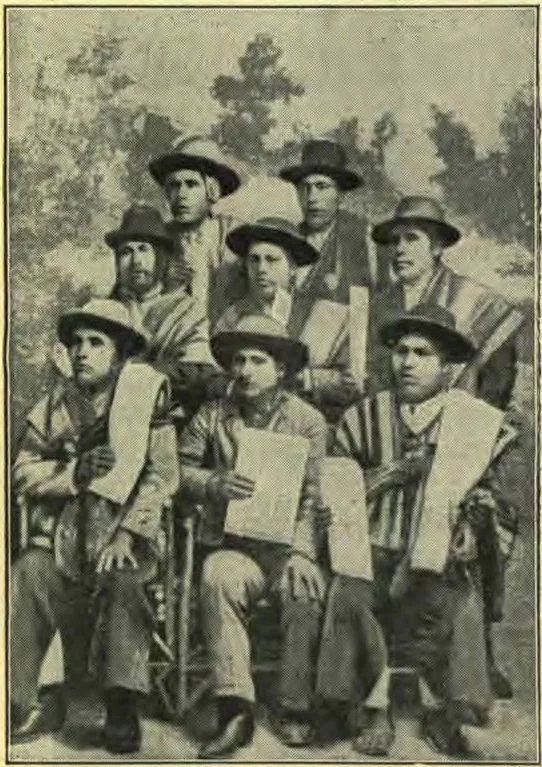
An Indian Deputation to Lima.
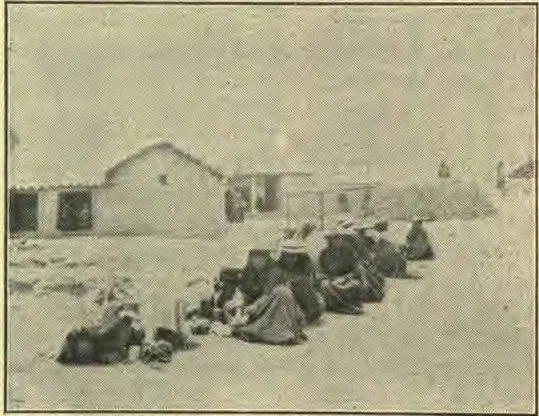
An Indian Village in the Sierra.
But how sad is their present condition! To the descendents of his conquerors, the Indian is in most cases but a beast of burden. These people, after four hundred years of Spanish tyranny and Romish rule, are for the most part "servile, filthy, and drunken, the victims of every vice," says Mr. D. F. Watkins, who has spent the greater part of thirty-six years in missionary labors in behalf of the Indians of Mexico, and who has recently traveled among the Indians of Peru.
As soon as the Indian is born, he becomes the prey of both priests and local authorities. When he is twelve months old, his parents must pay $8.50, and the same amount again when he is three and seven years old. In addition, baptism and other ceremonies cost a considerable amount, and if these taxes are not promptly paid, the priest will take the Indian's property by force, and sometimes imprison him.
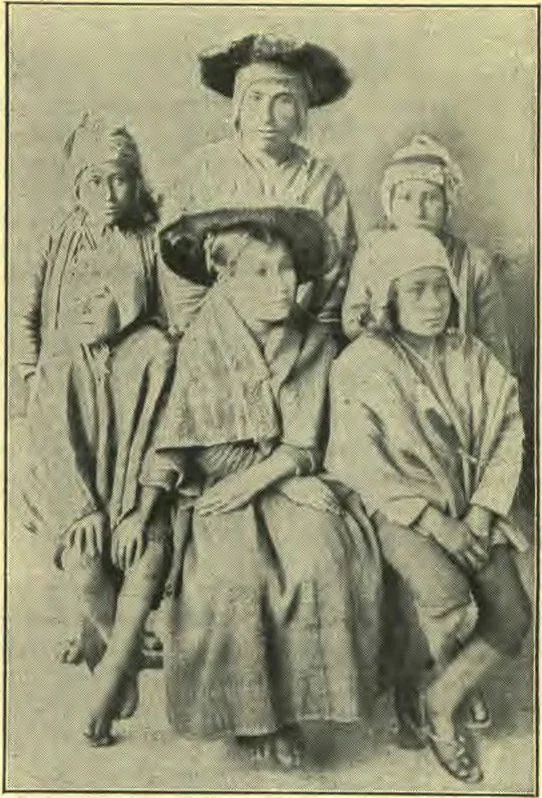
An Inca Family Group.
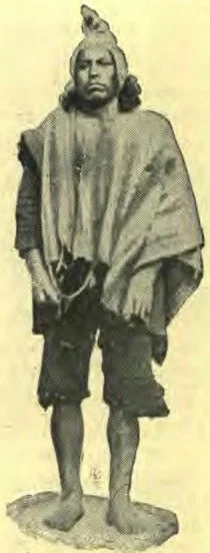
An Inca Indian.
When the Indian, like other men, falls in love with one whom he hopes to make his wife, both he and his intended must serve the governor gratuitously for one month, and the second month they must serve the priest under the same condition. If any utensils are broken, the woman has to pay more than three times their value. If neither she nor her future husband has sufficient means to do this, the man is put in prison until he can pay. Meanwhile his fiancée is subjected to all kinds of ill treatment. For the marriage ceremony the priest sometimes demands as much as $40.00 or $50.00.
Religious feasts, or rather bacchanalian revelries, where vice is rampant, are greatly encouraged by the priests. These feasts, according to the confession of some of the best priests of Peru, the tales of foreign travelers, and from what we have personally seen, are hotbeds of fetishism and gross idolatry.
When one is held in a village or town, a certain Indian is made responsible for the expenses,—perhaps three hundred soles
(about $150),—while a dozen others have to pay ten or twelve soles (about $5.00 or $6.00) each for a solemn mass. Many Indians are compelled to sell and spend all they have, leaving themselves without a cent; but they are proud to have been at the head of their religious feast. If they can not pay, their property is sold; and if they possess nothing, they are imprisoned.
It is a common saying among the Indians that they work both day and night and forever remain poor. No wonder, since the priests and the governors regard the Indians' produce as their greatest source of wealth.
The encouragement they receive to indulge in drunkenness is fearful. Vendors of liquor carry the poisonous stuff all over the country, and it is their practise to leave a certain quantity near the door of the Indian, generally against his will, and a few months later return with authority to collect by force goods equal to three times its value. If need be, everything that he has is sold without his consent, to pay the unjust debt. In this way many an Indian has lost all his property. If he takes his case into court,
nothing is done for him, on account of the influence of the governors, priests, and rich merchants, and the injustice of the judges.
The priests and the local authorities employ an Indian to collect the debts of his fellow Indians, and in case the real debtor fails to pay, the collector himself must do so. Of course many of these things are quite contrary to the laws of the land, but there is no redress. The judicial treatment of
the Indian is cruel and unjust beyond description.
13The life of the Indian is of little value. He has been known to be shot down for his debts; but even when he dies, his widow is frequently the victim of the priests' rapacity. She must pay about $60.00 for his interment in consecrated ground; and to secure this money she is often shamefully abused, beaten, and insulted in her own house, or put into prison. Finally, if nothing else can be done, the children are disposed of by the priest, that he may make sure of his money.
Again and again deputations of Indians have gone to Lima, the capital of Peru, to ask help from the central government. Recently the government appointed a dispassionate lawyer as delegate to investigate conditions among the Indians and make an independent report. The report confirms absolutely the statements of the Indian deputation, but only part of it was published, probably because it contained accounts of such terrible procedure perpetrated by the priests, etc., that it could not be brought to light. All these things happen in spite of the good laws of the country, which are written, but remain a dead letter.
The efforts of the central government to help the Indians are unsuccessful because it has no power to reach the innermost lives and consciences of individuals. The Roman Catholic Church, which is the church of the state, has power over them and controls them, even as she controlled souls in the past. But, thank the Lord, the power of that church is becoming weakened. We have in Peru now a strong anti-Catholic feeling, and the hope of that country, as well as of the Indian, lies in the growing influence of true Christianity.
With the object of bringing the Gospel of Christ to the Indians, an Inca Evangelical Society was formed in Arequipa, in connection with the Evangelical Independent Church there. In order to secure means, that society appointed Mr. D. F. Watkins delegate to foreign countries, and there was given him the following petition signed by more than seven hundred and sixty gentlemen from many cities and towns of Peru, some being lawyers and doctors and men in prominent positions, and others plain working men:
Considering:
"1. That it is a fact that the Peruvian Indians are in a most lamentable condition from the intellectual, moral, and social standpoint;
"2. That it is a sacred duty of patriotism and humanity to save the Indians from so abject and sad a state;
"3. That Romanism, after four centuries of labor, has proved its impotence to elevate the Peruvian Indians;
"4. That the means employed by the government up to the present time, with the object of civilizing the two millions of Indians in Peru, have resulted in barrenness;
"5. That the propagation of the Gospel among them, together with the benefits of general instruction necessary to render their lives happy, is the best means within human reach tending toward their emancipation;
"6. That in order to give so great an undertaking its needed impulse, it becomes necessary to make an appeal to the great philanthropists of evangelical lands;
"Agreed,
"To appoint Mr. David Watkins, an honorable apostle of the Gospel, as representative of the Arequipa branch of the Inca Evangelical Society in foreign countries, principally in the United States and in England, especially in London; authorizing him to raise financial
assistance and solicit moral support wherever he may think it most convenient, to the end of carrying to the Quechua Indians the Gospel in its simplicity, and employing teachers and schoolmasters who will take the initiative in a new era of civilization about to dawn among the unhappy descendants of this historic empire.
"EDUARDO F. FORGA, President,
"EUSEBIO S. CABELLO, Secretary.
"Arequipa, Peru, July 25, 1905."
In March, 1906, as president of that society, I went with Mr. Watkins to London. There Dr. H. Grattan Guinness, acting director of the Regions Beyond Missionary Union, profoundly interested in what he called "a Macedonian cry," took the matter in hand, and published articles and pamphlets, circulated by the hundreds of thousands, spoke publicly in England, Canada, and the United States, and succeeded in raising approximately ten thousand dollars, with the purpose of buying a large farm, which would serve as a center of protection and Christian education for the Indians. Lately he went to Peru with his daughter, Mr. Watkins, and a special worker to carry out this plan.
Regarding myself: A few months after my arrival in London, I was providentially led to the British Union camp-meeting of the Seventh-day Adventists, where I accepted the truth. From that time I could no longer work with other Protestant denominations.
Now I understand that the many marvelous ways which the Lord has opened during these last few years to strengthen the spirit of reform and to carry the light of reform, are providential openings that the people of God may soon powerfully carry the last great message for the nations to that downtrodden people.
Perhaps no other people in the world so enslaved in the awful darkness of Roman Catholicism are in their despair more earnestly looking and longing for the coming of a Redeemer. How much would they appreciate the message of the third angel!
In the name of my country, and in the name of six million unhappy Quechua Indians who live scattered along the Andes chain of South America, I make an appeal that they be helped, and that most speedily.