OCTOBER 22 the Knickerbocker Trust Company, of New York, with deposits aggregating more than $62,000,000 failed. It paid out to the extent of $8,000,000, and closed its doors. This was the only failure recorded that day, but it set the country wild. In New York, according to reports in one of the papers, it was a day bordering on wide-spread financial panic. The situation was so serious as to bring Secretary of the Treasury Cortelyou from Washington. Money was at a prohibitive premium; when the Stock Exchange opened at ten o'clock the rate was six per cent; before one o'clock it had jumped from six to ten, and within fifteen minutes ruled as high as seventy per cent. Toward the close of the day, however, it dropped back to six per cent.
The slaughter of railroad, mining, and other stocks was terrific, reaching a lower figure than in years. The authorities at Washington and the leading financiers in New York did everything they could do to allay the panic, but the fears of the people were aroused, and that which was thought would be only local in its effect, affecting only the great money centers of the United States, swept westward like a great wave.
It has been well remarked that the wealth of this country is divided into many different divisions, of which money is but one. It is almost the sole division in which all the people have confidence, because back of that stands the government, and the people have made it. Therefore when discredit is brought upon any division of property, like stocks in railroads, trust companies, etc., those who are alarmed will at the earliest opportunity seek to convert all their holdings in the things in which they do not have confidence into the one thing in which they do have confidence—money.
There are very few banks in the country which can stand a continued run from their depositors. The law requires but from twenty to twenty-five per cent of their capital to be held in reserve. It has been found in many instances that the reserve was below this. Of course as soon as the people heard it, effort was made to withdraw from the banks their deposits. This forced the various banking men, and especially in the great financial centers, to radical action. Bank holidays have been declared in which the banks could not be forced by depositors. This has been especially true on the Pacific Coast. Stronger banks in various cities have combined into clearing-house associations, and they have issued clearing-house, or credit, certificates in lieu of gold. Great effort has been put forth to secure all the money from the Old World possible, and in order to meet the need of the country the federal government decided to issue one hundred millions of credit certificates, and to float fifty million dollars' worth of Panama bonds, hoping that these would be taken very quickly by banking institutions, the government returning the money to the banks to be put in circulation. Since the action of the Secretary of the Treasury in this matter, gold has been coming in freely from the Old World and it has not been thought necessary to issue more than from fifteen to twenty-five millions of credit certificates, and the Panama bonds have been placed at an issue of twenty-five million. "Reports" from all the great money centers and in the newspapers seem to be reassuring,—for the banks.
Results.
Right in the very height of the panic many business houses in the East closed, large factories and systems of factories discharged their men, 8,000 railroad men were discharged in Chicago, great department stores and mercantile houses also discharged help, making the outlook very serious indeed for the coming winter. However, since this action was taken, and supplies of money have come in from different sources, many of these manufacturing establishments have resumed work, 6,000 of the 8,000 railroad men have been taken back, and while these reports on the face are hopeful, yet on the other hand there are thousands upon thousands of working men thruout the United States who have nothing to do. These are not reported. For instance, in San Francisco the other day the writer was told that there were from 20,000 to 30,000 men out of employment in that city. One working man declared that where he was employed 200 men called the day before looking for work; and in all parts of the city where work was carried on there were almost invariably more men looking on longing for work than were at work.
The Causes.
What are the causes of the financial panic? Never did the country seem to be more prosperous than when it was precipitated. Men had been predicting financial panics for two or three years; it was felt that the tremendous risks and daring speculations would bring this result, and yet there was never a greater demand for the products of the mills and the earth than at the very time when the panic came. It was impossible for mills to meet the demands. Crops were fairly good and the demand for them, not only in this country, but in the Old World, was very great. But the crash came like thunder out of a clear sky.
Various Theories.
What were the causes? These would be much more easily suggested if there was any agreement on the part of the financiers in regard to the causes. But here they are hopelessly at loggerheads. "Everybody's Magazine" for December stopped its presses and consulted with such well-known financiers as Lyman J. Gage, ex-secretary of the United States Treasury; Prof. W. G. Sumner, Professor of Political and Social Science at Yale University; Stuyvesant Fish, ex-president of the Illinois Central Railway; James J. Hill, president of the Great Northern Railway System; Byron W. Holt, editor of "Moody's Magazine," and the well-known Mr. Thomas W. Lawson. Some of these men, like Mr. Gage and Mr. Fish, give as one of the reasons the large destruction of capital in the recent wars and earthquakes. Mr. Gage tells us that "the pressure for the use of capital has outmeasured the supply of capital," and that this condition being reached at the time of the annual harvest when there was a real demand for more than a hundred millions of currency for the moving of the harvest, left matters in a very serious condition, and intimates further that if the United States had had a proper system of currency so that money could be issued to meet this demand, as in England, we would have weathered the storm without any difficulty.
Professor Sumner gives one of the reasons for the panic—the loss of confidence on the part of the people, this loss of confidence growing out of the denunciation of the great masters of industry as corrupt and dishonorable managers of the interests under their control. This has been led by President Roosevelt, resulting in "confusion and wrangling, with stagnation of industry, suppression of enterprise, and a loss of the great and joyous energy which has hitherto characterized our people."
Mr. Fish declares that he looked for this very storm ten months before it came, that despite the unprecedented output of gold, money is dear the world over, and that "because of high prices and activity in trade." This is aggravated, he claims, by such nations as Great Britain, Japan, and Russia, who are endeavoring to make up their losses from recent wars. Added to this "Wall Street has absorbed and is absorbing more than its share of the loanable fund." Mr. Fish also presents the fact that while we are one of the wealthiest nations, we are still a debtor nation. "Europe holds vastly more of our securities than we hold of all foreign securities;" and he feels that there is needed "A GREAT MORAL FINANCIAL REFORMATION, which, like the religious Reformation of the Middle Ages, will thru much cruelty work out good in the end."
While Professor Sumner and Mr. Fish declare that money is stringent and scarce, Mr. Hill declares that "neither is there an insufficient volume of money in the country." He holds that the difficulty with all is the lack of confidence. While Mr. Fish talks of dear money, Mr. Holt speaks of the declining value of gold and lays the cause of our crisis to our inelastic currency system and our uncivilized tariff laws. Mr. Lawson declares that it is the lack of confidence thru the trickery of what he calls "the System."
It is seemingly very clearly evident, as the English papers themselves look upon it, that President Roosevelt has done nothing to cause the panic; he has simply turned on the light and shown how predatory wealth is aiming to grasp and control the very heart-blood of commerce in the money of the nation.
The real causes have been well stated by Governor Gillett of California, before printed in the "Signs." He declares that the present causes are "found in the extravagant living, wild speculations, the effort to get rich quickly by giving nothing for something, the frenzied finance of the stock and bond manipulators of Wall Street, and the attempt dishonestly and by misrepresentation to float all manner of enterprises upon a sea of water. These are the things which have been mostly, if not entirely, responsible for the present financial stringency, and it is only the unparalleled prosperity distributed among the masses, that saved us from financial ruin."
The Remedies.
Various remedies have been suggested, yet in all probability nothing will be done. Some have counseled the organization of a great national bank in which the government itself shall be responsible. Another has advised the government to stand behind the national banks of the country (embodied in a bill by Mr. Condler of Mississippi) assisting them to a sufficient extent to meet whatever failures may take place, so that all depositors shall be assured that every dollar is safe; and this doubtless would restore confidence; but in all probability this will not be done. These measures would make too much for the protection of the people, and give less power to the great financiers. In the recent message of the President to Congress he commends for favorable considerations of Congress a Postal Savings Bank System, and that too would restore confidence because the people would feel that the government is behind it, and their money would be perfectly safe deposited with the government. The same opposition would be brought against this by the financiers as is brought against the national bank, and so we are told by some of the leading representatives of the people that there will probably be no legislation at all concerning financial matters, while on the other hand some of the best thinkers in the country declare that the United States money system is the worst in the world.
The Outcome.
What will be the outcome? Some look for harder times, especially for the poor, those who are dependent upon their daily labor for bread. The many unemployed is bound to decrease wages. This would not be so bad if prices for the commodities would come down with the price of labor. If the masses of the people can not buy, mercantile institutions will be bound to go to the wall. These things may not affect the great financial centers, but they will affect the great mass of the people.
The Lesson.
What is the lesson which ought to come home to the workers, the poor people?—It is to economize in every way possible. Retrench in expenditures wherever they can. Cultivate little pieces of land when they are not employed otherwise and there raise many of the necessities of life. Dispense with expensive clothing and entertainments.
Shall we look for better times?—Temporarily, yes. And yet the united testimony of the word of God is that we are living in times which are perilous, times which are unsettled, times which will see more and more of the awful strife between labor and capital. It is an apostle of Jesus Christ who declares that miseries are coming upon the rich. He tells us that they heaped treasures together "in the last days," that in their heaping treasures together they have been utterly regardless of their poor fellow men; the wealth they have gotten has resulted in the oppression of the poor; and there will come a time when the poor, driven to madness, led by unprincipled and unscrupulous leaders many times, will rise up in their wrath and overthrow the wealthy.
Read chapters one and two of Habakkuk, the first part of Amos 8, Isaiah 5, and James 5:1-8. These are not our words, they are predictions of the living God. And yet we deprecate with all our souls the violence which is bound to follow the unnatural conditions in the country which make so many men fabulously wealthy and leave so many with the bare necessities of life. It is better to suffer wrong than to do wrong. It is better for the poor, suffering soul to trust in God and leave all to Him who judgeth righteously, and who, beyond this vale of tears, will usher in a realm where there shall be no want or sorrow or death.
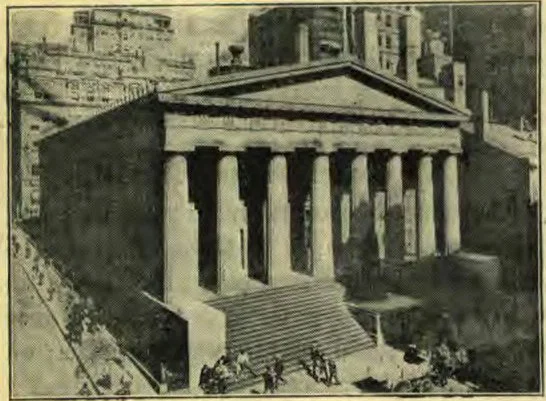
Subtreasury, New York.
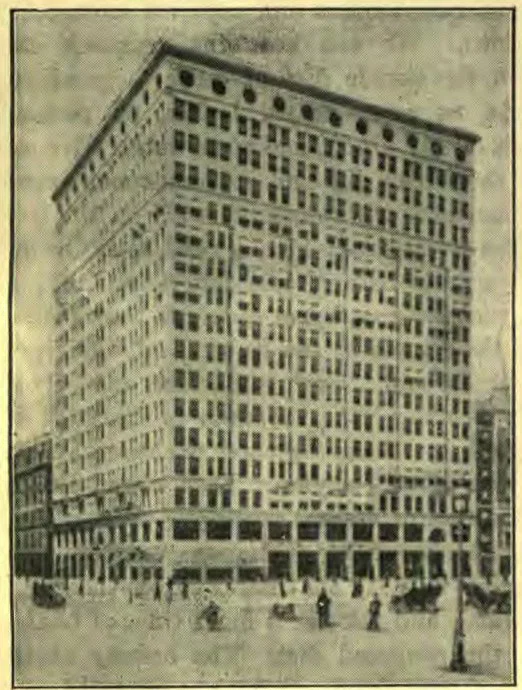
The Chicago Railway Exchange, the Greatest Center of Railway Operations in the World, Controlling the Freight and Passenger Tariffs of a Continent.
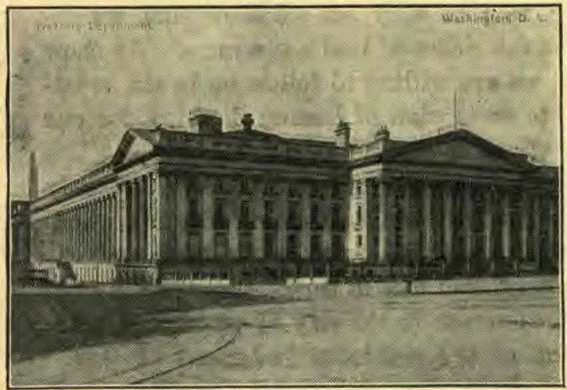
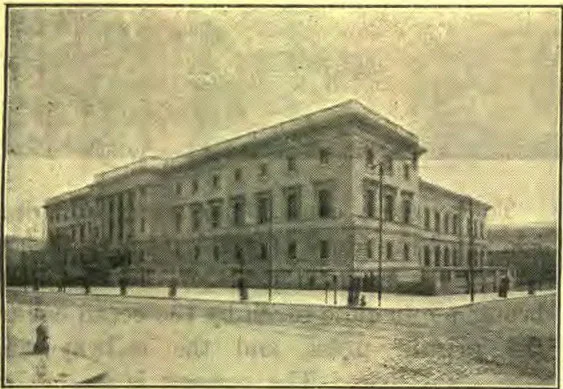
Treasury Department, Washington.
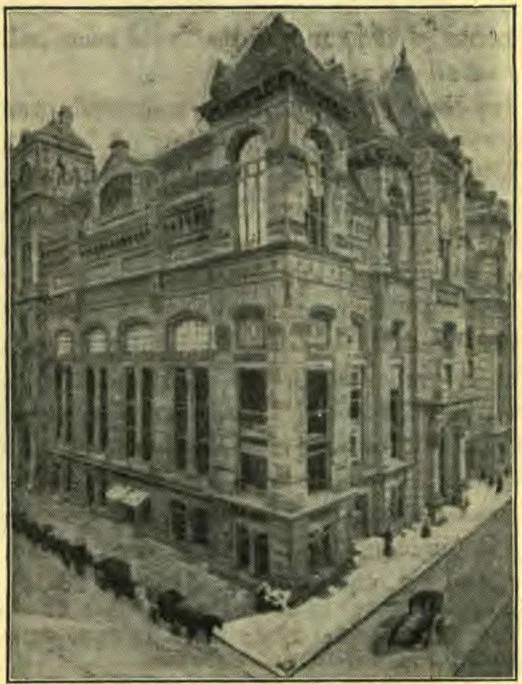
Chicago Board of Trade, the Greatest Gambling Center of the World over the Products of Agriculture.
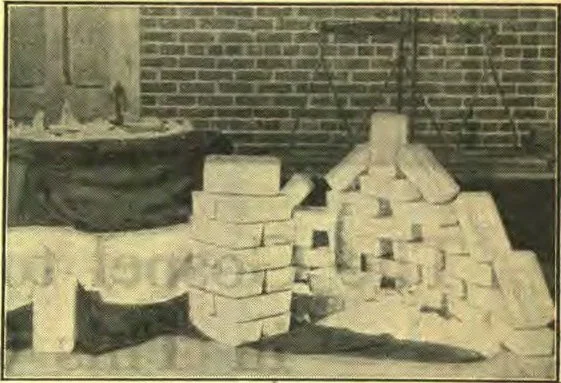
New United States Mint, Philadelphia.
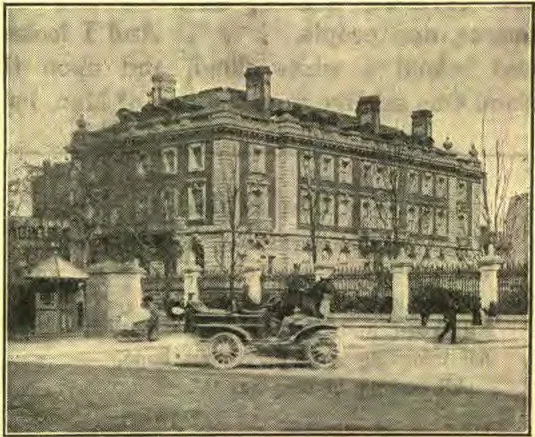
The New York Residence of One of America's Retired Rich Men, Andrew Carnegie, Whose Wealth Increases More Rapidly than He Can Spend It.
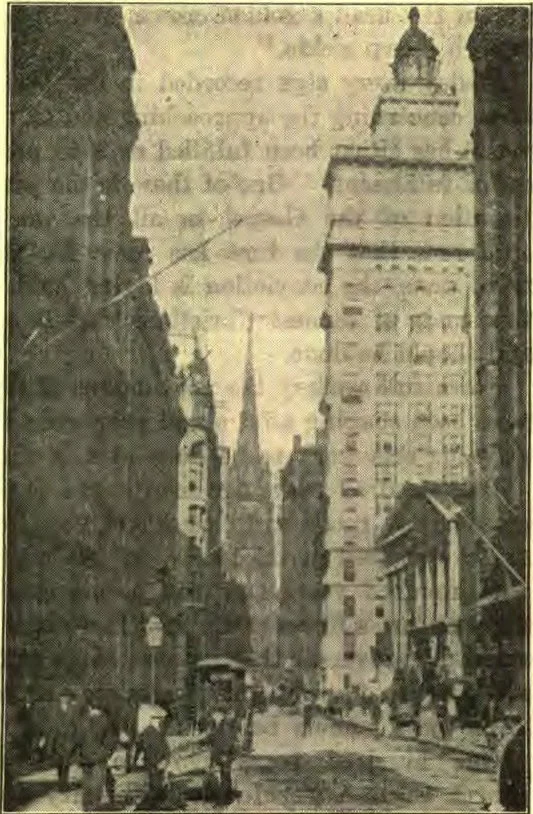
Wall Street, the Great Money Center of America, Whose Operations Affect Every Money Center of the World.