“THE Spaniards were Christians,” said a leading Filipino, “but we like the Americans better, because they are not Christians.”
“I do not care to go to church,” said an American girl in Manila, “because one meets such an indiscriminate gathering there.” The young lady had been to a cock-fight on the previous Sunday afternoon, but she showed plainly the irritation she felt at being invited to attend a religious service.
If the question were asked, “What is the greatest obstacle to Christian work in the Philippines?” probably every clergyman in that archipelago would say:—
“The Example of Americans.”
The gross violations of financial confidence by Americans in civil, military, and business life, resulting in newspaper exposures and terms of imprisonment; the indulging in customs which offend the Filipinos, and which fill the society columns of the newspapers, lead the natives to reject that form of religion which the Americans represent. . . . The friars do not let an opportunity slip for deepening or creating the impression that the Spaniards, and not the Americans, are the real Christians.
The attitude of the American Government is strictly non-partisan. Any man may worship God as he pleases. A Roman Catholic, an Aglipayan, a Protestant, or an infidel, will be protected equally in his worship or non-worship. At the same time, there is an impression among the American teachers and civil government employees that their superiors will be better pleased if nothing is done by Protestants which serves to emphasize their religious tendencies, such as the entertainment of missionaries or Bible agents, or the attending of Protestant services.
Aside from the attitude of the government, whose non-Catholic representatives have not been openly in favor of Protestantism, the social customs of many Americans do not aid the missionaries, who ought to be assisted by the people from the home land. The Filipinos drink their native wines, but seldom to excess. After weeks of travel throughout the provinces and of residence in Manila, I have seen only one native who seemed to be under the influence of liquor.
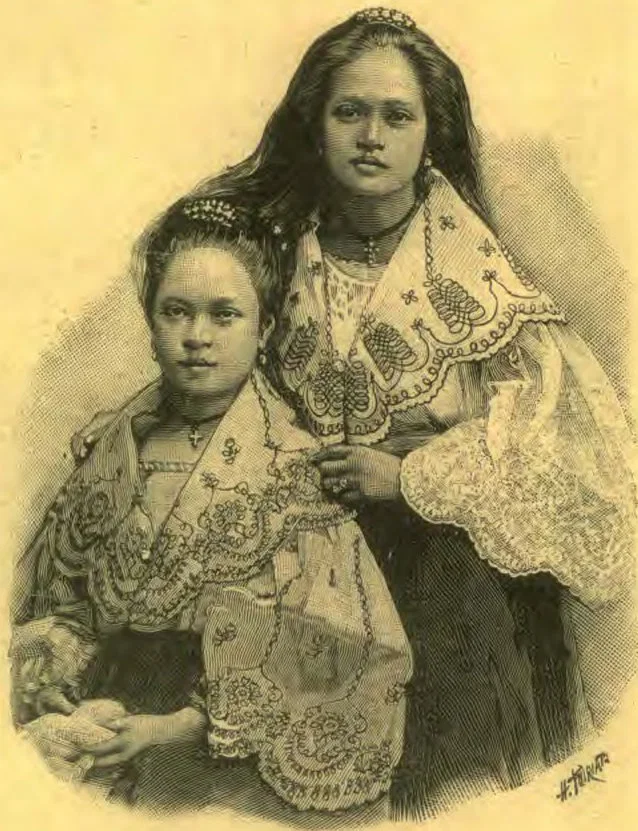
Montigo Girls, Malutca, Philippine Islands.
“I do not know what your custom is,” said our American host in a provincial town, as we were on our way to call upon the Filipino priest, “but unless you are strongly opposed to drinking wine or beer, I hope you will not refuse it. The priest will not understand your refusal; but if, on principle, you can not take anything, it will not matter so much, as I will take a glass of everything that is offered.” Not only did he keep his word, but his wife also took both beer and American wine, and gave each of the children a sip or two from her glasses, and later, at another home, took a cigaret, when they were passed, not to smoke, as she admitted, but because she was afraid to offend her neighbors, whose customs meant so much to them.
It seems pitiable that Americans consider it necessary to sacrifice their own sense of right in order to conform to the customs of those whom they should teach Christian principles. When a Filipino calls upon another native, the host never thinks of offering him beer or whisky, but these are considered necessary when an American calls.
The church-going habit by Protestants seems to have been well-nigh forgotten. With thousands of Americans in Manila not Roman Catholics, the three small Protestant churches are never full. The Methodist, Presbyterian, and Protestant Episcopal bodies all contemplate the erection of new church buildings, but not because the present ones, seating from one to two hundred each, are ever crowded. On a recent Sunday, at the second service, fifteen persons were in the audience, including eight who were in some way connected with the church and its official work. The sermon would have done honor to a Philadelphia or a New York audience.
It is not infrequent to hear a person say: “I have not been to church in a year, or more than twice in two years,” adding, as if there were some virtue in the confession, “I would never think of staying away from church so long at home, nor would I have supposed it possible that I could do so before I came to the Philippines.”
In the provinces, outside of one or two cities and army posts where there are chaplains or association secretaries, there is practically no church attendance on the part of the Americans, Protestants or Catholics. A mission to the Americans in the Philippines is quite as necessary, perhaps more so, than a mission to the Filipinos. The clergymen in Manila and Iloilo, and in one or two other places, are doing all that they can to help their countrymen who are willing to be helped.—Missionary Review.