HE city of Paris has just been visited by a strange and unexpected disaster. This word is not too strong when we remember that out of 85,000 buildings 14,100 have been disturbed by water either in their basement or at the surface, and when we add that over a dozen neighboring cities have been inundated and have had to be abandoned by most of their inhabitants.
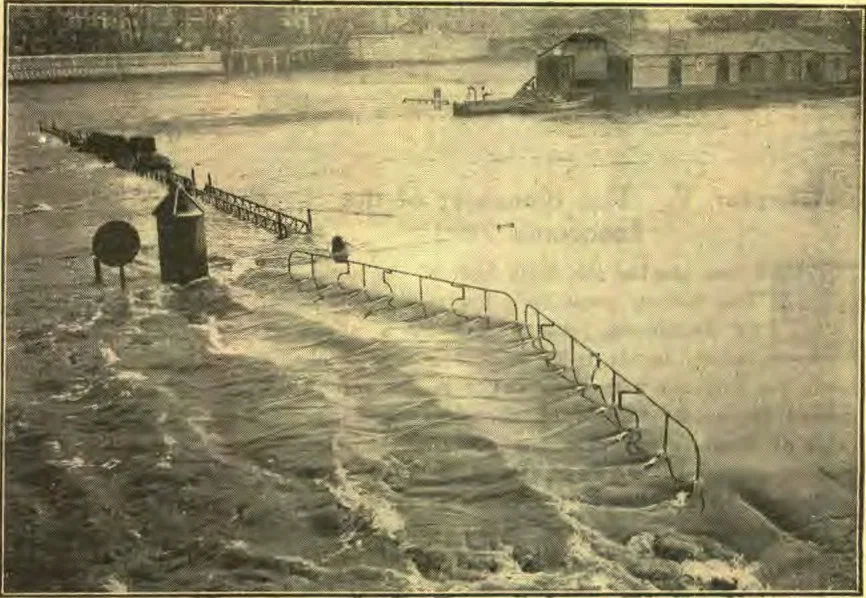
The river Seine rose from nine to eleven feet above its ordinary level. It thus became a wild and devastating torrent, invading the wharves, the squares, some of the leading avenues and boulevards, and hundreds of streets.
It is perhaps easier to imagine the havoc created by such a body of water rushing irresistibly forward through a city like Paris, than it is to describe it.
What a change came over this huge and complicated beehive of over 3,000,000 inhabitants!
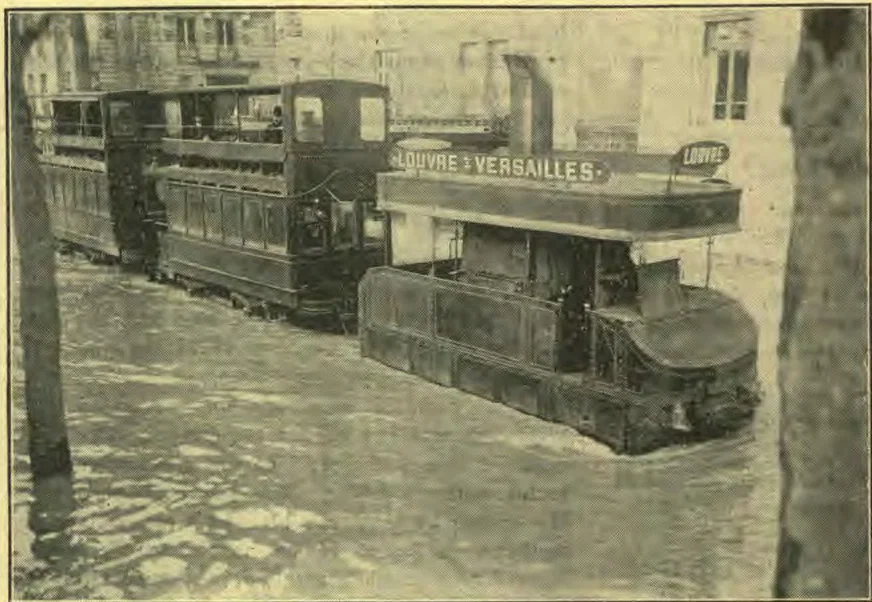
Street-cars crossing the Hotel de Ville Square
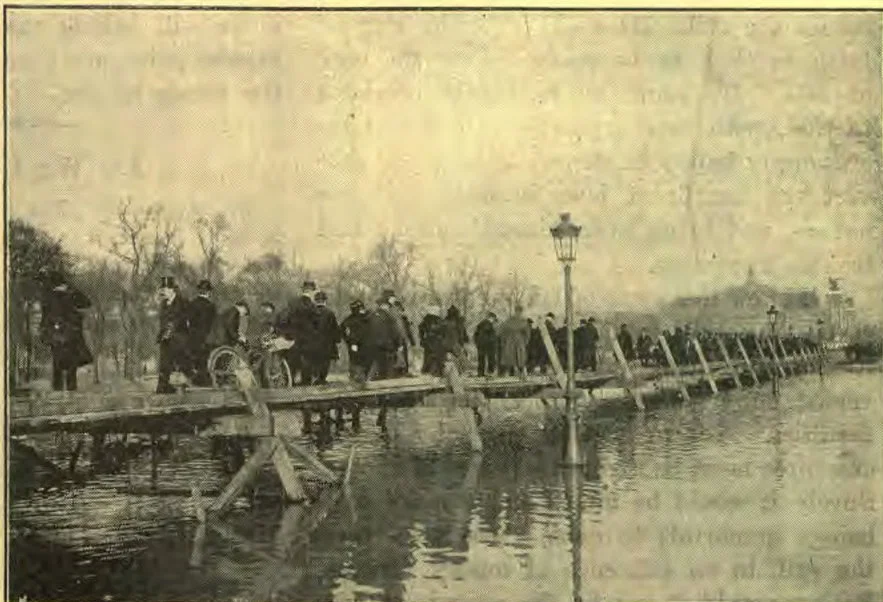
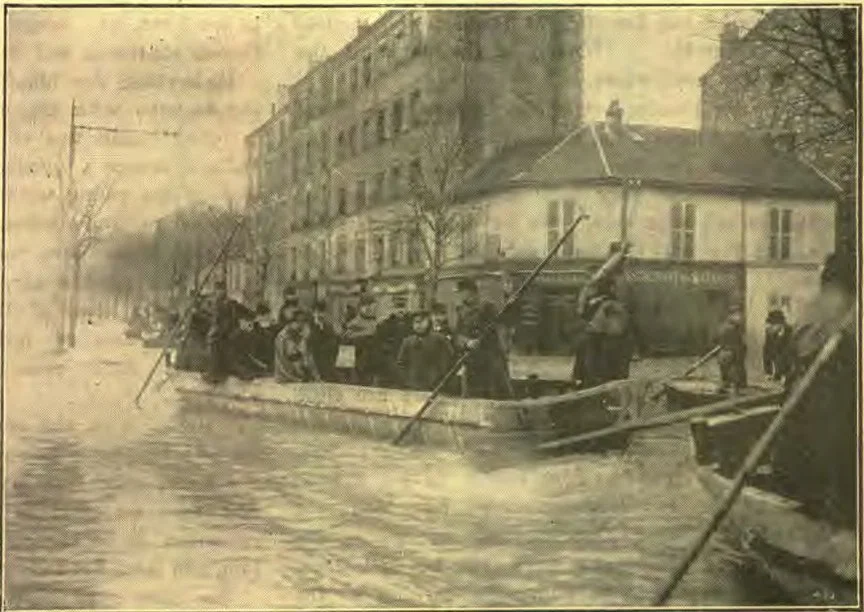
Parisian Venice — Crossing the Esplanade des Invalides
Imagine some of the finest and largest squares transformed into lakes! Look at these streets, a few days ago swarming with busy people, with cabs, automobiles, and autobuses running in all directions, now vacant and silent, or perchance traversed by some sort of boats!
Both poor and rich had to submit to many inconveniences; many were either shut up in their houses or else obliged to find shelter elsewhere. Government buildings like the foreign office, the Hotel de Ville, the Palace of Justice, the Magasine du Printemps, the Parliament Printing Office, the Hotel-Dieu Hospital, found themselves more or less invaded by water, so that the work done in these buildings had to be removed, at least from the lower floors.
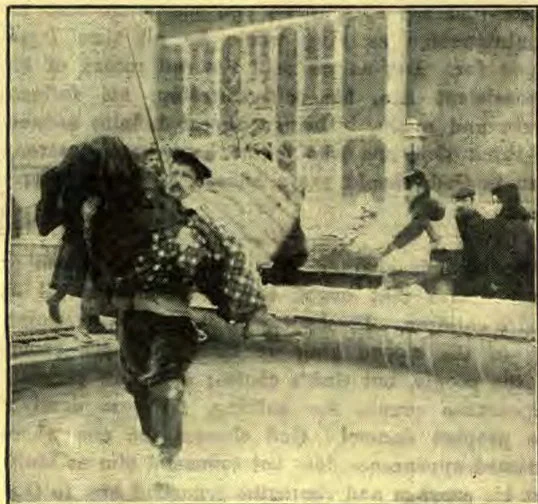
A sick woman rescued at Alfortville
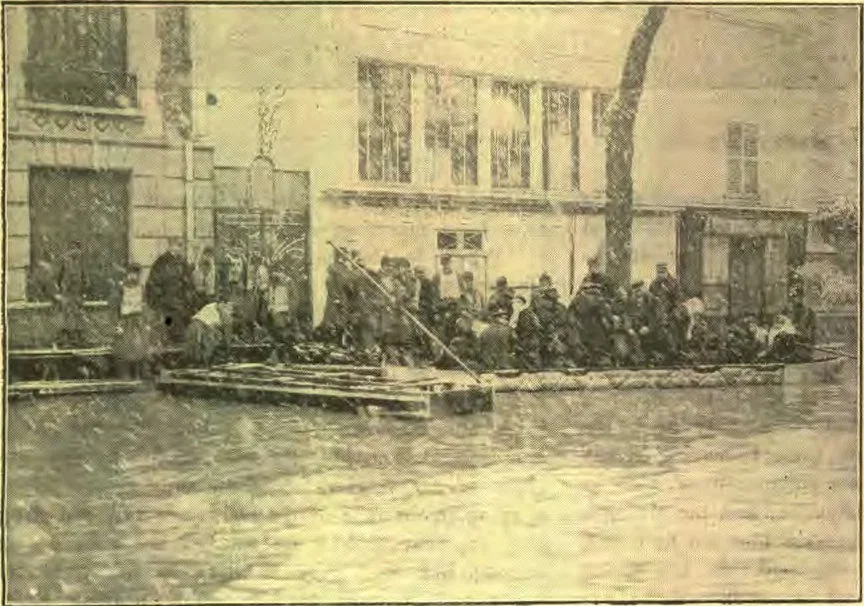
Some streets were entirely inundated, so that boats and temporary bridges were used.
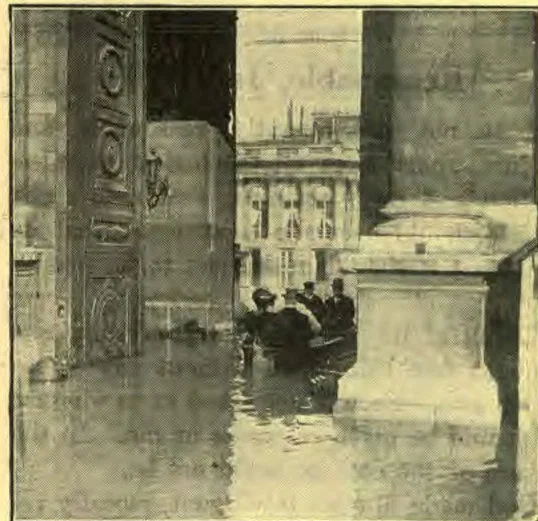
The deputies reached the Palais Bourbon either in boats or over a temporary bridge. Some went to church in the same way. Some people were furnished victuals by means of baskets let down from upper stories by a rope.
Of course street-car lines, as well as most of the lines on the well-known Metropolitan Subway, were interrupted. So were telephone communications, leaving 14,000 offices and homes deprived of this useful invention. Public clocks no more told the time. Electric light no longer shed about its radiance. On the other hand, strange enough, January 26 at noonday, while the sky was threatening and the angry river carrying loads of timber, barrels, and everything else before it, you might have seen along the Seine thousands of gaslights burning, but just extending out of the water.
Parisians, sobered down, anxiously watched the progress of this mute visitation. Generally speaking, they remained remarkably quiet and self-possessed during these days of alarm. Said Le Soleil, "Man remains impotent in the face of this invasion of unchained elements." Not a few thought of the flood; and from many lips came the words, "The end of the world." An ex-minister of state, M. Charles Dupuy, writes in a morning paper:
"The water is decreasing! In a few days, Paris will have resumed its bustle and pleasures, will have forgotten yesterday's anguish, and, careless of to-morrow's possible disasters, will return to its theaters, or find fresh amusements in the cavalcades of Lent.
"Such is the world: one wave drives the other away, and it is quite unlikely that the lessons of experience will succeed better than those of moralists in curing us of our superstitions and lightness."
100,000 working men in Paris were obliged to quit work on account of the inundation. Thousands of persons from the suburban towns had to leave their homes and enter the city to find shelter and food. Alfortville, for instance, a city of 18,000 souls, had to be entirely abandoned. Most of these persons were sheltered in the public buildings of the capital. At Gournay-sur-Marne the houses were drenched in seven feet of water. Ivry, Vitry, Cliguancourt, Levallois-Perret, Bezons, Villeneuve-le-Roi, and Villeneuve-St. Georges, were mostly under water. At Corbeil the affluent Essonne grew seven feet in one night. At Clichy, two blind women and one old man were rescued just as the water was about to reach their beds. Many persons had to run for their lives, wading through the flood while carrying their children or some valuable objects in their arms.
Deputies on their way to the Chamber by boat
It is needless to say that this disaster is greater than can be described. Millions of francs have been lost, many streets, thousands of homes, and many public conveniences have been practically ruined. Among others might be mentioned the first floor or basement of the National Museum, some fine railroad stations, and the national printing establishment. Speaking of museums, the Botanical Garden presented a rather sad looking sight when the white bears, the elephants, and the giraffe were found flooded and piteously begging help from their more fortunate guardians.
Happily, this calamity did not last over ten or twelve days. Otherwise Paris would soon have been facing a starvation problem. The arrivals at the Villette meat market on one day were one thousand oxen instead of four thousand, the usual number. Means of transit into Paris and out of it had become so disorganized and11roads so dangerous, that vegetable sellers dared not undertake the journey.
Help for the suffering population came in from all sides in great abundance. Americans in Paris and in the States sent 800,000 francs. A subscription started by the lord-mayor of London brought over 1,300,000 francs. All told, foreign countries contributed four million francs.
It must be said that this calamity was borne by the people of Paris with a good degree of courage, fortitude, and resignation. In fact, several papers have taken occasion of this to compliment their nation, and to comfort themselves against the accusation of having become degenerate. It is to be hoped that this warning will be heeded by many in the gay capital, and lead them to make serious reflections on the uncertainty of life, and the meaning of the signs of the times.
At Alfortville, near Paris — Persons rescued by the soldiers
The Seine in the heart of Paris
JEAN VUILLEUMIER.
M. Fallieres accompanied by MM. Briand, Millerand, and Lepine visiting and viewing conditions at Ivry
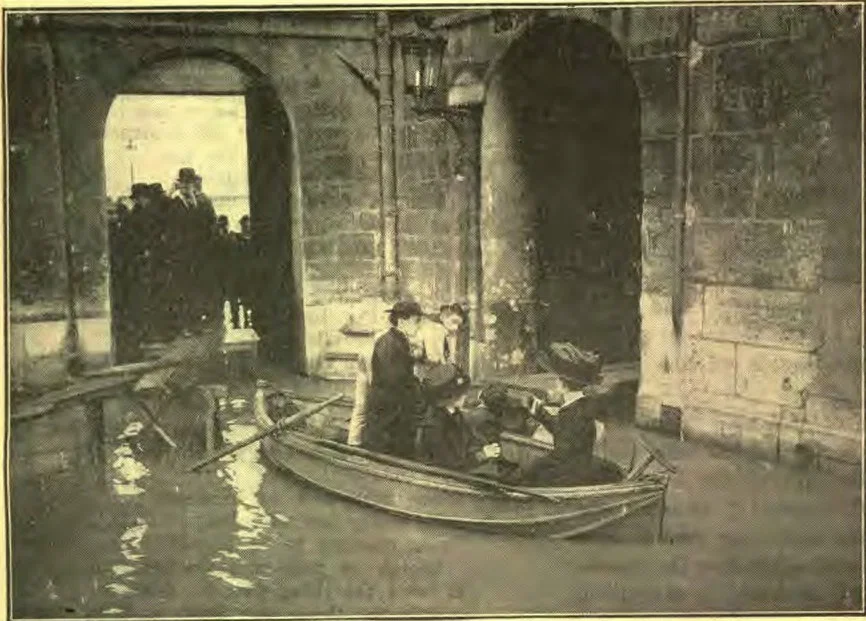
Leaving church, Sunday, January 30, 1910 — Paris for a time becoming a Greater Venice