Burying a Dead Empire

3%

Pacific Press Publishing Association · Mountain View, California · Sep 26, 1916

FromSigns of the Times, Vol. 43, No. 38.

Read the full edition

Burying a Dead Empire

Rome's Dying Convulsions

Her Demise and the last Obsequies
By JEAN VUILLEUMIER
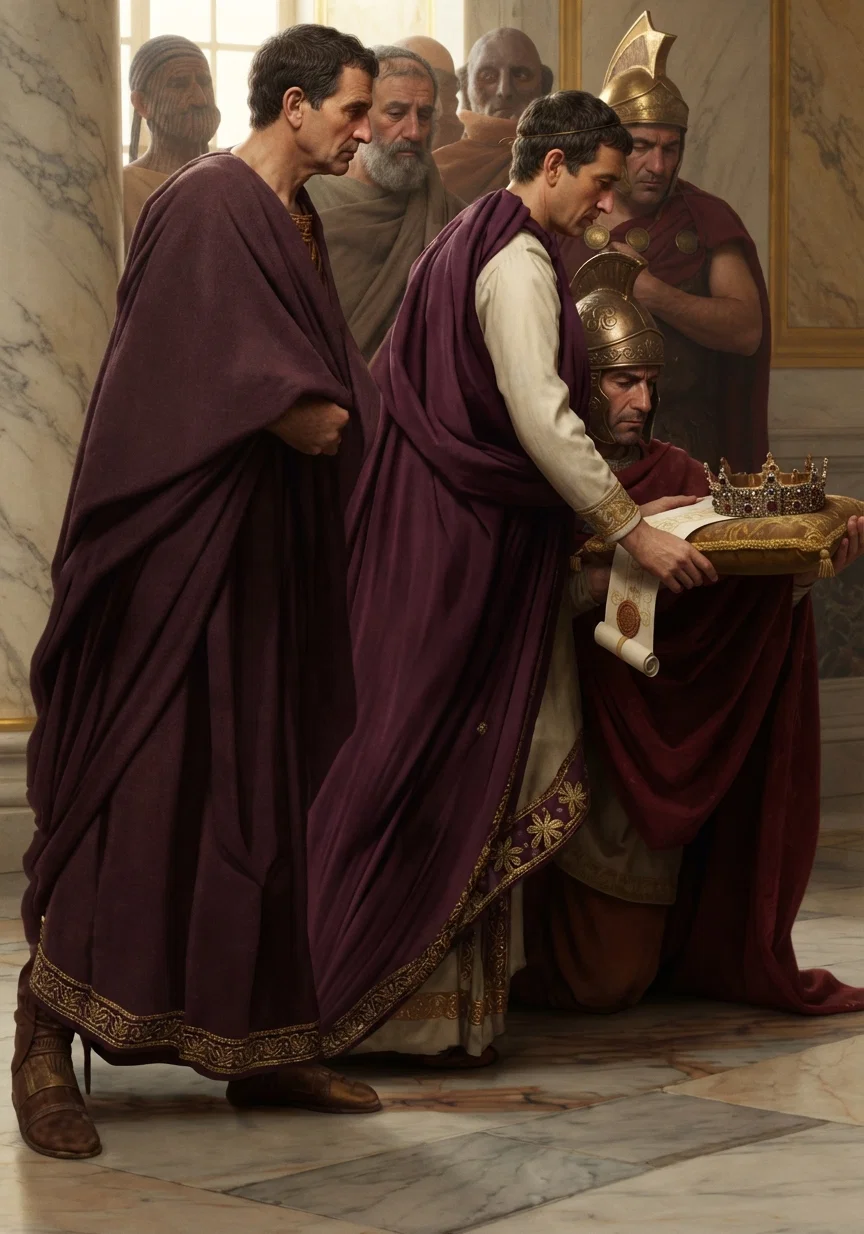
Yielding the crown of Western Rome to Odoacer
Synopsis This interesting prophecy of the seven trumpets portrays the downfall of nations during the Christian era. The first article of the series, in our issue of August 29, gave a general view of this desolation as it began to unroll before the ancient prophet. The trumpets were shown to be the symbols of war, referring definitely to the mighty irruptions from the barbaric hordes that swept over the Roman Empire, dethroning her from the position of proud mistress of empires. The first trumpet symbolized the wars waged by the renowned Alaric and his victorious Goths. Hail, fire, and blood falling upon the earth is the prophetic description. Rome was pillaged, was humbled in the dust. The fulfillment of the second trumpet is found in the conquests of Italy and Africa by the Vandals under the terrible Genseric. The third trumpet was fulfilled by the Huns under the leadership of Attila, called the "scourge of God." The prophetic description was fulfilled. His career was brilliant, but short. His light went out like the snuffing of a candle.
"AND the fourth angel sounded, and the third part of the sun was smitten, and the third part of the moon, and the third part of the stars; that the third part of them should be darkened, and the day should not shine for the third part of it, and the night in like manner." Rev. 8: 12.
No bloody wars, desolations on land or sea, are here foreshadowed, as was the case under the former trumpets. This symbolic language seems rather to indicate that the blows of the fourth trumpet strike at a higher sphere than the ordinary theater of battles. This sphere is compared to the firmament of heaven and its luminaries, in opposition to the earth, the sea, and the rivers. The great change to take place in the political world will be brought about in a peaceful manner, like the going out of a lamp. The great Roman Empire is dying. The only thing left now is to bury it. How well these symbols were fulfilled in the closing chapter of the history of the empire of the West will be seen in what follows.

A Festering Mass of Corruption

BUT before we pass on to what might be called the decent burial of the empire, we must take a general look at the situation of this old, huge, decrepit body, tottering under the repeated onslaughts of the barbarians.
The moral condition of the so-called Christian empire at the time of the invasions called loudly for the terrible judgments sent by the hand of the omnipotent Ruler of the nations. A well-known Catholic writer and historian, often quoted in these articles — Chateaubriand — draws the following picture of Christian Rome at the time of the invasions:
"Dignities, age, profession, religion, did not put a stop to the fury of debauchery. In the midst of provinces in flames, the people could not tear themselves away from the amusements of the circus and the theater. Rome is sacked, and the fugitive Romans come to Carthage, still Roman for a few days, there to exhibit their depravity. Four times Treves is invaded; but in the midst of these bloody ruins, the remaining portion of its citizens sit upon the deserted seats of its amphitheater.
'Fugitives of the city of Treves,' exclaims Salvian, 'you are asking the emperor for the permission to reopen the theater and the circus; but where is the city, where are the people, in behalf of whom this request is made?'

Abandoned to Pleasure

"THE fall of Cologne takes place in the midst of a general orgy; the leading citizens were not in a condition to leave the table when the enemy, having mastered the walls, was pouring into the city. Nearly every house in Carthage was a house of ill fame. . . . Genseric arrives: outside the din of arms, inside the noise of amusements; the voice of the dying and the voice of a drunken population mix up together; hardly can the cries of the victims of war be distinguished from the acclamations of the crowds which fill the circus."—"Etudes Historiques," pages 427-440.
As to the extent of the desolations that followed the passing of the barbarians, the same historian speaks of them in language which recalls that of the inspired revelator when eleven times he repeats the phrase, "the third part of the earth," "of the grass," "of the trees," "of the sea," "of the ships," "of the rivers," "of the creatures in them," etc. Chateaubriand says: "It is impossible to-day to form more than a meager idea of the spectacle which was offered by the Roman world during the incursions of the barbarians: the third (perhaps the half) [italics ours] of the population of Europe and of part of Africa was mown down by war, pestilence, and famine."

The World's Moving Day

THIS writer continues: "The spoils of the empire passed over to the barbarians. The chariots of Goths and Huns, the barges of Saxons and Vandals, were loaded with all that the arts of Greece and the luxury of Rome had accumulated during so many centuries. The world had come to its moving day. . . . Society was shaken off from its very foundations.
"Fleeing from the barbarians of Europe, the Romans sought refuge in Africa and in Asia; but in those far-away provinces, they found other barbarians. Thus driven from the heart of the empire to the extremities, and thrown back from the frontiers to the center, the earth had become a hunting ground, in which the people were chased by a circle of hunters. . . . The wilderness moved about with the barbarians; it changed places as they marched, and spread itself upon the face of the most fertile provinces. In countries where unnumbered nations had thrived, there remained only the earth and the sky."
The empire was dying; it only needed to be buried. And this is what takes place under the fourth trumpet, to which we must now turn our attention.

The Empire's Last Convulsions

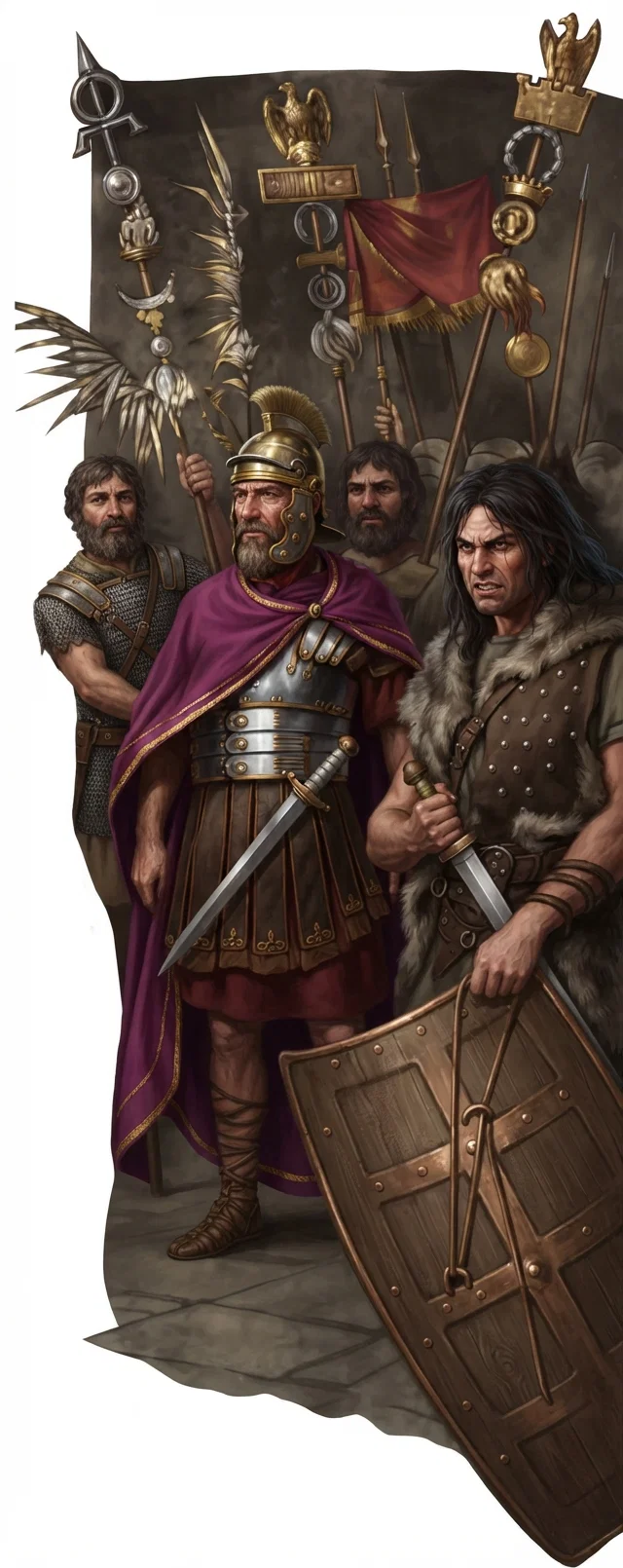
THE remains of Attila's nomadic warriors were lost in the steppes of southern Russia, while the barbarian nations that had served under his standards asserted their independence. Many of them, Heruli, Burgundians, Alani, and others, enlisted in the army of confederates that the emperor Majorian had formed for the defense of Italy, the only remaining portion of the Western empire. This skeleton of an empire had for several years been in a state of anarchy. The old Romans were at the mercy of the very barbarians whom they paid to defend them. The Suevi had for several years had the upper hand in Roman affairs, making and deposing several emperors in succession. The imperial dignity had become a puppet in the hands of strangers, who, for some reason, dared not ascend the throne of Augustus, Diocletian, and Constantine. Ricimer, says a historian, had "tramped on the ruins of Italy, exercised the power, without assuming the title."
In the space of twenty-one years, not less than nine emperors had occupied the throne in quick succession. "This calamitous period," says Sismondi, "comprises the last convulsions of the empire of the West" (455-476).
The arrival of the disordered bands of confederates from the collapse of Attila's army made matters worse if possible. Two men who had served under Attila, Orestes and Odoacer, now vied with each other as arbiters of the dying empire. The former succeeded in placing upon the throne a barbarian youth in the person of his son Romulus, a beautiful lad of fourteen. But it was decreed in the counsels of the Almighty that Rome must die, and not be rejuvenated by any of the barbarian nations. The iron monarchythat had ruled the world for over six hundred years must pass away, and be divided among its conquerors, never more to be resuscitated. The first barbarian emperor who dared to sit on the throne was to be its last occupant.

The Death Blow Administered

It came about as follows: The barbarian confederates, who were, as we have seen, the last defenders of Rome, tiring of adventures, wished to establish themselves permanently, like the other barbarians who had created kingdoms in Gaul, Spain, and elsewhere. They asked for the third (notice this number) part of the lands of Italy as their portion. Orestes, whose little son had just been appointed emperor, refused to accede to their wish. Their demand, however, was soon granted by Odoacer, Orestes' rival.
'The army of Italy,' says Montesquieu, 'composed of strangers, required what had been granted to other less civilized nations: under Odoacer, it formed an autocracy, which gave itself the third [italics ours] of the lands of Italy; it was a death blow to that empire.'
Odoacer placed himself at the head of a rebellion in which Orestes was killed, and the remains of the agonizing empire fell into Odoacer's hands. He chose rather to be at the head of a barbarian kingdom than to take upon himself the dangerous and miserable dignity of a Roman emperor. He resolved, says Gibbon, to abolish 'that useless and expensive office.'
At his order, the young Romulus sent his resignation to the Roman senate. That august assembly, 'in their last act of obedience to a Roman prince,' addressed a unanimous letter to Zeno, the emperor of the East, by which 'they solemnly disclaimed the necessity, or even the wish, of continuing any longer the imperial succession in Italy.' (Gibbon.) The imperial ornaments were sent to Constantinople. Odoacer, proclaimed king of Italy by his soldiers, received from Zeno the title of patrician, while to Romulus was granted an honorable pension.

Breathing Its Last

THUS, almost without the shedding of blood, like the peaceful scene of a deathbed, or rather like a lamp going out for lack of oil, did that empire which had been the terror of the world for centuries, breathe out its last. Its sun, to speak with the prophecy, had set by the submissive abdication of a boy. 'In the year 476,' says Vulliet, 'the power of the Cæsars of the West went out [italics ours] slowly and silently in the person of a child; and a seventh barbarian kingdom, the kingdom of the Heruli, found itself established in the very center of the ancient Roman empire.' Jerome, speaking of the event, said that the 'light of the world was extinguished.'
Two generals sent to Italy by the emperor of the East, Belisarius and Narses, abolished what still remained of the imperial dignities. In 541 the consulate, and in 552 the senate, were also abolished. The consulate, in its relation to the imperial dignity, may well be compared, as in the prophecy, to the moon, which is a reflection of the light of the sun; while the Roman senate, composed of three hundred senators, may properly be symbolized by the stars of the empire. See Gen. 37: 9-11.

The Lights Extinguished

THUS, exactly as the prophecy of the fourth trumpet had foretold,—in the 'third part of the earth,' all the lights of the political sky of the Roman Empire of the West had become extinct. The appalling catastrophe predicted had come. The power that had ruled the third part of the world was a thing of the past. But listen: Three more trumpets yet are coming; and of these, the revelator says:
'And I saw, and I heard an eagle, flying in midheaven, saying with a great voice, Woe, woe, woe, for them that dwell on the earth, by reason of the other voices of the trumpet of the three angels, who are yet to sound.' Rev. 8: 13.