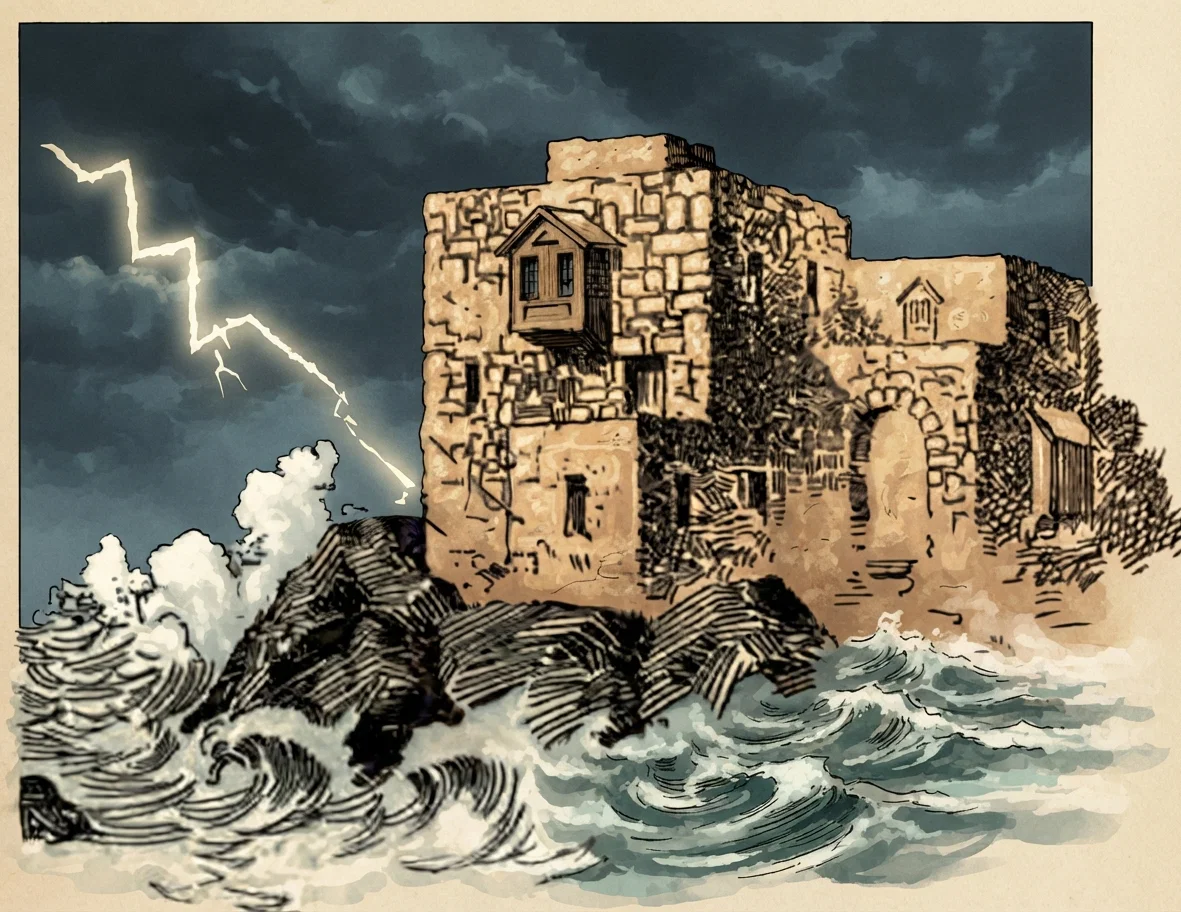
Some Fall on the Rock and Are Broken—Others Are Crushed to Powder as the Rock Falls on Them
By Walter E. Gillis
The Rock of the Eternal Ages
By
Walter
E. Gillis
ASKED what he considered the most potent proof of the genuineness of the Bible, Sir William Gladstone, England's "grand old man" of the nineteenth century, quickly replied, "The Jew."
The annals of the origin and history of the Hebrew people constitute a major portion of the Old Testament. Of their beginning, the inspired record says: "The Lord thy God hath chosen thee to be a special people unto Himself, above all people that are upon the face of the earth. The Lord did not set His love upon you, nor choose you, because ye were more in number than any people; for ye were the fewest of all people: but because the Lord loved you, and because He would keep the oath which He had sworn unto your fathers, hath the Lord brought you out with a mighty hand, and redeemed you out of the house of bondmen, from the hand of Pharaoh king of Egypt. Know therefore that the Lord thy God, He is God, the faithful God, which keepeth covenant and mercy with them that love Him and keep His commandments to a thousand generations; and repayeth them that hate Him to their face, to destroy them: He will not be slack to him that hateth Him, He will repay him to his face. Thou shalt therefore keep the commandments, and the statutes, and the judgments, which I command thee this day, to do them." Deut. 7: 6-11.
The romance attending the divine call of Abraham, and the wonderful story of his faith that resulted in the founding of a nation at the close of almost a century of severest trial, have given him a charmed place in the hearts of millions of his own race, and proved a magnet of superior power in binding the worship of the gentile world to Israel's God.
Abraham Obeyed
GOD appeared to Abraham in Ur of the Chaldees, and invited him to leave his ancestral home, with its idolatrous practices, and go out whithersoever the Spirit would lead him, and serve in spirit and in truth the Creator. God did this that He might save Abraham, it is true, but primarily to launch a challenge to every individual of every race to do likewise; in proof whereof we read, "If ye be Christ's, then are ye Abraham's seed, and heirs according to the promise." Gal. 3: 29. "For the promise, that he should be heir of the world [2 Peter 3: 13], was not to Abraham, or to his seed, through the law, but through the righteousness of faith." Rom. 4: 13.
The enthralling story of Jacob, with his complex character, and the vicissitudes attendant upon his transformation from the supplanter to Israel, the upright one, who as a prince prevailed with God, must prove of more than historic interest; for we find him declaring to his sons, by the spirit of prophecy, what will befall them in the last days (Gen. 49: 1); and for each one represented, the apostle John records by the same spirit of prophecy, a gate of pearl swings in the walls of the heavenly Jerusalem (Rev. 21: 12), and through these precious portals will pass the nations of the saved, led by twelve thousand of each tribe, a remnant translated from the earth when the Lord shall come (Revelation 7).
The charm of history that must inevitably bind us as we give time to the study of this people, eventually deepens into the conviction that they hold a vital place in the spiritual story of all nations and all peoples; for the reason that for nearly two thousand years, the Lord made them the custodians of His oracles, and in the development of their family, tribal, and national existence, they exhibited, for the world's enlightenment, the character of Jehovah-God, and the one plan by which a rebel race might be won back to its allegiance to heaven. The story of the intimate place the altar of sacrifice maintained in the daily life of the patriarchs, and the revelations of God connected therewith, becoming the mainspring of their life, was recorded with intent that all might learn that Heaven expects all departments of practical life to be molded by the principles of the spiritual realm.
Thus we see the interdependence of sacred history and divine revelation, and how the warp and woof of man's salvation is developed in all of it.
Has God Changed His Plans?
FROM the ancient days when Enoch walked with God and was translated, the divine plan for man has remained unchanged. Man's best works disintegrate and are lost in the dust of ages, but the centuries have only served to reveal the symmetry and effectiveness of the plan of salvation. Like a great rock in a weary land, it has loomed upon the vision of earnest souls longing for light amid the grossness of earthly pleasure and commercialism. The infinite treasures of truth have been accumulating while man has attempted to build empires and perpetuate his puny fame; but, like the wonders revealed by the telescope to the patient astronomer, or by the microscope to the untiring investigations of the student, these vast and rich resources of divine wisdom are only revealed to those who appreciate them, those who hunger and thirst for them, those who will sacrifice for them. "The meek will He guide in judgment: and the meek will He teach His way. . . . The secret of the Lord is with them that fear Him; and He will show them His covenant." Ps. 25: 9, 14.
The Tested Corner Stone
To the Hebrews, their Jehovah-God, and more especially the promised Messiah, were known as the Rock.
The Lord Himself proclaimed through the prophet Isaiah, "Behold, I lay in Zion for a foundation a stone, a tried stone, a precious corner stone, a sure foundation." Isa. 28: 16.
The royal singer of sacred themes often referred to the Lord as a rock, in such familiar lines as: "The Lord is my rock, and my fortress, and my deliverer; my God, my strength, in whom I will trust; my buckler, and the horn of my salvation, and my high tower." "For who is God save the Lord? or who is a rock save our God?" Ps. 18: 2, 31.
And Moses, who lived as seeing the invisible, sang: "Ascribe ye greatness unto our God. He is the Rock, His work is perfect: for all His ways are judgment: a God of truth and without iniquity, just and right is He." Deut. 32: 3, 4.
To the disobedient he declared, "Of the Rock that begat thee thou art unmindful, and hast forgotten God that formed thee;"; and again, "Their rock is not as our Rock,588even our enemies themselves being judges." Deut. 32: 18, 31.
Isaiah, the gospel prophet, admonishes, "Trust ye in the Lord forever: for in the Lord Jehovah is the Rock of ages." Isa. 26: 4, margin.
During the formative period of the nation, water for the thirsty multitude flowed from the smitten rock, typical of the water of life that flows from the smitten Son of God. The faithful apostle Paul, referring to that experience, says, "They drank of that spiritual Rock that followed them: and that Rock was Christ." 1 Cor. 10: 4.
Thus in all their sacred literature, the Hebrew people were familiar with the rock as representing the confidence-inspiring character of their Jehovah-God, who assured them, "I am the Lord, I change not." Mal. 3: 6.
The Same God Still
As God revealed Himself to the Hebrew people in the time of their visitation, so is He to-day revealing Himself to seekers after truth who will obey Him. When the madness of human ambition has filled the earth with the turbulent strife of war, the mystery of divine revelation is to be finished. The messengers of salvation have girded the world.
The time is at hand when the Rock is to finish history by smiting the remnant of the nations, as foretold by the prophet Daniel (Dan. 2: 31-45); and as the Saviour assured the Jewish people, "Whosoever shall fall upon that Stone shall be broken; but on whomsoever it shall fall, it will grind him to powder." Luke 20: 18.