Would the Pope Be the Logical Head of the Proposed United States of the World?
By SANFORD B. HORTON
THE first ten verses of Revelation 13 bring to view a system of sovereignties, the center of which is a power to whom the dragon — symbolizing primarily Satan, and secondarily pagan Rome — gives "his power, and his seat, and great authority." John sees this power receive a deadly wound; but "his deadly wound was healed; and all the world wondered after the beast." Moreover, "they worshiped the dragon which gave power unto the beast: and they worshiped the beast, saying, Who is like unto the beast? who is able to make war with him?"
John is called to write that "there was given unto him a mouth speaking great things and blasphemies; and power was given unto him to continue forty and two months. And he opened his mouth in blasphemy against God, to blaspheme His name, and His tabernacle, and them that dwell in heaven. And it was given unto him to make war with the saints, and to overcome them: and power was given him over all kindreds, and tongues, and nations. And all that dwell upon the earth shall worship him, whose names are not written in the book of life of the Lamb slain from the foundation of the world."
THE ENTIRE WORLD WONDERS
Protestant commentators agree that the papacy is the "head" that received the deadly wound. This is the same power that Daniel tells of in the seventh chapter of his book, notably verses 8 and 24-26. The apostle Paul also refers to the same power in 2 Thessalonians, second chapter, verses 3-8. In this article, our purpose will be to consider only that feature of the prophecy in which the statement is made, "All the world wondered after the beast."
In his very first encyclical, Pope Benedict XV said that one of the causes of the war was "disregard of and for authority," and recommended religion as the only safeguard of authority, saying: "Let princes and rulers bear this in mind, and bethink themselves whether it be wise and salutary that public authority should divorce itself from the holy religion of Jesus Christ, in which it may find so powerful a support. Let them seriously consider whether it be politically wise to banish from public instruction the teaching of the gospel and of the church. Experience teaches, only too well, that where religion is away, public authority falls."
In this encyclical, the pope gives as another correlated cause of the war, that the temporal power having been taken from the pope, he was not free in the exercise of his apostolic ministry, and would demand, as did his predecessors, that "the abnormal condition in which the head of the church finds himself, and which in many respects is highly injurious to the peace of the peoples, should cease."
DIPLOMAT OF EXCEPTIONAL BRILLIANCY
A series of facts in connection with the pope’s desire to exert an influence upon the warring nations is significant at this juncture. The New York Times of January 31, 1915, contained an article from the pen of a "Veteran Diplomat," in which he stated, among other things:
"Benedict XV, unlike his immediate predecessor, Pius X, is not only a statesman of the type of Leo XIII, and of Cardinal Rampolla, but also a diplomat of exceptional brilliancy and experience. . . . Thanks to this blend of statecraft and diplomacy, Benedict XV has already succeeded in securing his acceptance by all the belligerent powers as a friendly intermediary. . . . Indeed, Benedict XV has met with so cordial a response from all the belligerent powers, who have shown a readiness to accept his intervention, as to create the conviction at Rome and in other foreign capitals that he is destined to become the principal intermediary in all the negotiations among the warring nations looking toward peace. . . . Benedict XV therefore remains, by reason of these conditions, the most suitable and acceptable intermediary to all the belligerents."
PAPAL COURT ENLARGING
By no means the least significant diplomatic move in connection with the world war was the dispatching of Sir Henry Howard by Great Britain to the Vatican as its representative. This move produced a profound impression, because it threw to the winds the precedents of several centuries, and aroused the ire of those known in England as the ultra-Protestants.
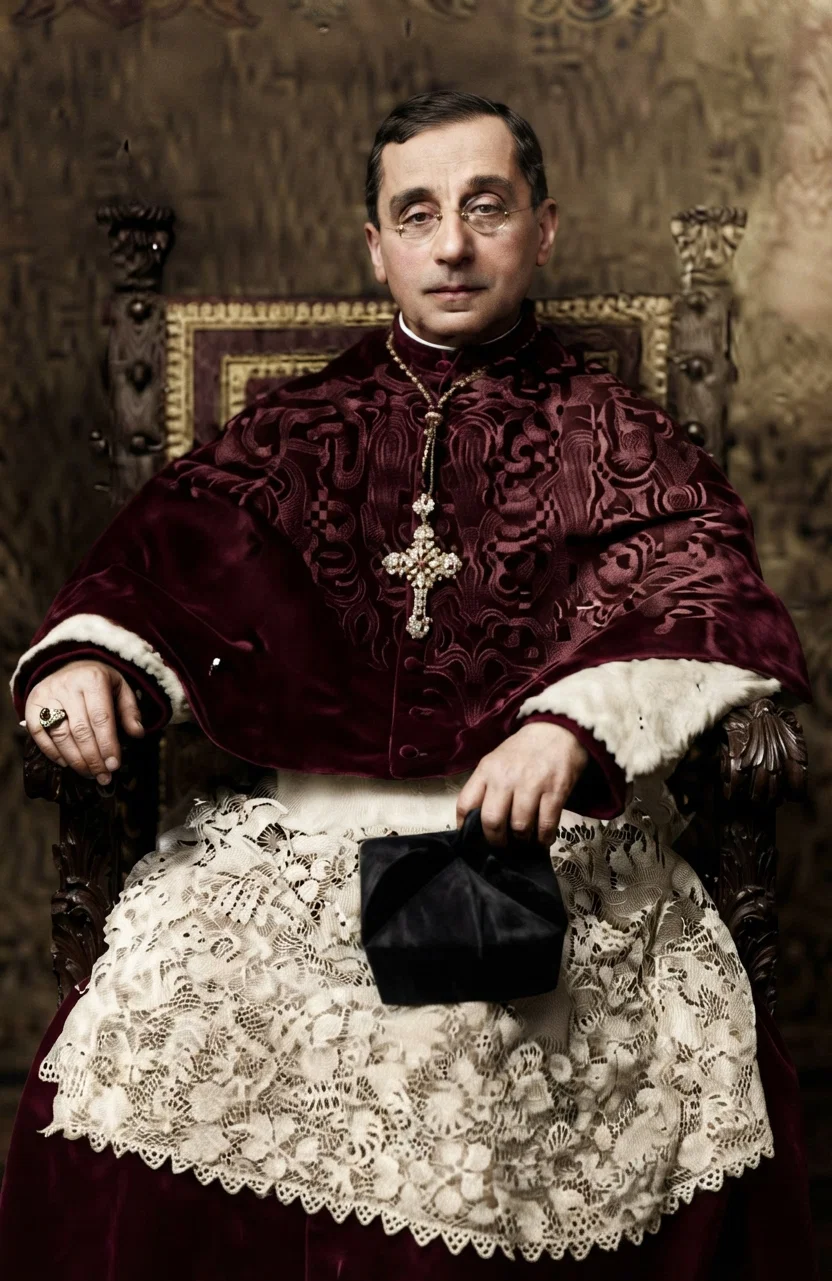
BENEDICT XV
The mikado of Japan followed soon after with his embassy to Rome. In fact, the entente between the papacy and such nations as Russia and Bulgaria has been reestablished; and many reasons are presented by Romanist, as well as by Protestant, urging the United States to send a representative to the pope to join in bringing about peace. The bishop of Limerick, in a pastoral quoted in the Catholic Mind of July 8, 1915, said:
"Already we have read with great interest and satisfaction the pronouncement of some distinguished English Protestants that a general council of the church should be summoned by our holy father, the pope, to find some means of ending this abominable war. . . . They feel the want of some moral authority in the world; of some one raised above the rivalries of nations, who could speak in behalf of God and His holy religion. . . . Essentially it is a Catholic ideal: one church, one fold, and one shepherd."
The bishop evidently had in mind the Rev. Reginald J. Campbell, one of the most prominent Congregationalists in London, and minister of the City Temple, who was quoted in a London dispatch of January 6, 1915, as saying, "There is only one person, namely, the pope, who could, with any chance of success, call such a conference."
Sermonizing upon the subject of the temporal power of the pope, Archbishop Glennon, of St. Louis, on December 7, 1913, the year before the war, as quoted in the Western Watchman of December 11, said:
"We may utter the hope that Christendom would, as it did in the Middle Ages, re-create as a court of last resort the supreme spiritual head of Christendom. Such a court would obtain a more historical setting than the one now established at The Hague, to which the nations appeal and sometimes don’t. It would be more in the order of Christian development that the last word of justice and right should be spoken by the head of the church that has the Just One as its founder. Such a court would be free from prejudice, and would not be affected by a desire for an extension of power."
REGAINING ITS FORMER POWER
From all these significant statements and facts, to which might be added many more, it must appear logical that the one potentate whom the nations would presently place at the head of a peace congress, or as the presiding officer of the United States of the World, is the pope. There does not seem to be in sight any political ruler of sufficient neutral stature to fill such position. The Roman Catholic Church has been cast out from the influence it once exercised in Europe; but it survives, and now seems to be on the road to resuming its wonted position among the nations. Macaulay, in his "Miscellaneous Writings," page 403, has this to say about the papacy:
"Four times since the authority of the Church of Rome was established in Western Christendom has the human intellect risen up against her yoke. Twice she remained completely victorious. Twice she came forth from the conflict bearing the marks of cruel wounds, but with the principle of life still strong within her. When we reflect on the tremendous assaults which she has survived, we find it difficult to conceive in what way she is to perish."
Had Macaulay been familiar with the prophecies relating to the papacy, he would have found — not as the Church of Rome has so often claimed, that she is the body of which the Saviour said, "The gates of hell shall not prevail against it," but that she is in very truth the power of which Daniel said, "I beheld then because of the voice of the great words which the horn spake: I beheld even till the beast was slain, and his body destroyed, and given to the burning flame."
Is it too much to say, in view of all that is referred to herein, that in Mr. Kingsley’s panacea for the world war, and the fundamental change necessary to bring about a united world authority, we are moving in the direction of fulfilling the prophecy, "All the world wondered after the beast"? And is not the time near when, according to prophecy, Rome will say, "I sit a queen, and am no widow, and shall see no sorrow"?
Next week, Mr. Horton will show that professing Protestantism has failed to carry to completion the work so triumphantly begun by the Reformation.