Impelled by Demons, the Nations Are Preparing for the Final Plunge
By ARTHUR G. DANIELLS
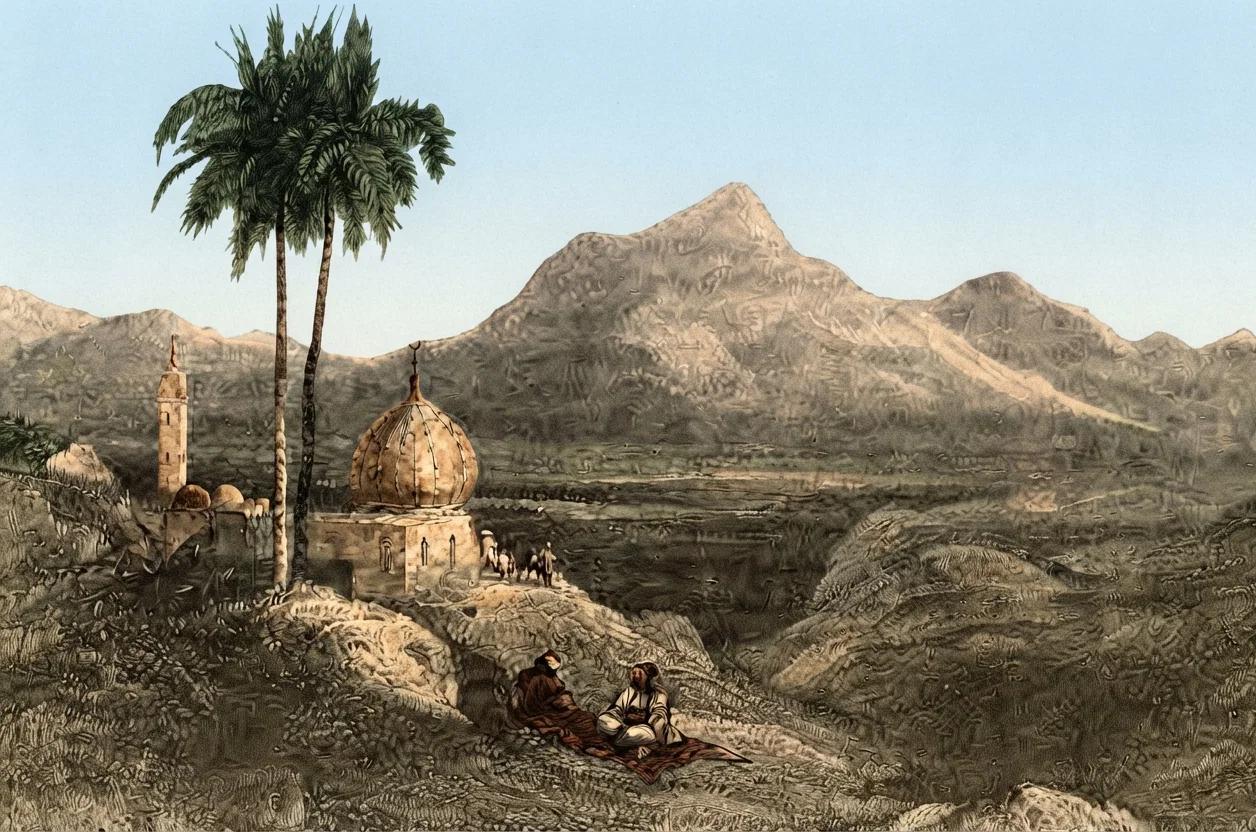
The Plain of Esdraelon, north of Jerusalem, in Palestine, the scene of the coming world war of Armageddon.
ALTHOUGH the apostle John is the only Bible writer who uses the word "Armageddon" in foretelling world struggles, he is not the only prophet who foretold the great war of Armageddon. His prophecy agrees in every detail with the prophecies given by other inspired writers centuries before his time.
In John's prophecy of Armageddon, recorded in Rev. 16: 12-16, there are given the following specifications:
1. The drying up of the waters of the Euphrates, to prepare or clear the way for the gathering of the kings of the east. Verse 12.
2. The deceptive working of demon spirits on the minds and hearts of all the kings and nations of the earth, inciting them to war and bloodshed. Verses 13, 14.
3. The gathering of the misled, war-maddened nations of the whole world to fight "the battle of that great day of God Almighty." Verse 14.
4. The place of the battle of Armageddon, in the great Plain of Esdraelon, north of Jerusalem, in Palestine. Verse 16.
5. The time when all this is to take place; namely, when Christ, the Saviour and Deliverer, is about to come. Verse 15.
The Scriptures furnish data for a clear, rational interpretation of each specification in this prophecy.
TURKEY SYMBOLIZED BY THE EUPHRATES
The river Euphrates is mentioned many times in the Scriptures. The name is the same as one of the four rivers that flowed from the Garden of Eden. Starting in the mountains of Armenia, it flows through the Mesopotamian valley to the Persian Gulf. On its banks once stood the city of Babylon, "the beauty of the Chaldees' excellency." To-day the Euphrates is a Turkish river, the land through which it flows being Turkish territory.
The prophecy foretells the drying up of the water of the Euphrates. Does this mean the drying up of the literal water of the river?—This is not the understanding of the students of prophecy. Water, when used in prophecy, stands for people. This is the interpretation given by the angel to John, as follows: "The waters which thou sawest . . . are peoples, and multitudes, and nations, and tongues." Rev. 17: 15. The same interpretation is given by the prophet Isaiah: "Now therefore, behold, the Lord bringeth up upon them the waters of the river, strong and many, even the king of Assyria, and all his glory: and he shall come up over all his channels, and go over all his banks." Isa. 8: 7.
These scriptures establish the fact that water, whether rivers or seas, is used to represent people and nations. When so used, a river would naturally represent the people through whose land it flows. On this principle of interpretation, it is claimed that the river Euphrates, being a Turkish river, would at the present time represent Turkey. The language used, very appropriately describes the drying up, shrinking, disintegrating process that Turkey has been under-going during the last half century. The prediction will be fully met when Turkey comes to his end, as it is expressed by the prophet Daniel, chapter 11: 45.
DRIVEN ON BY DEMONS
It is not claimed that the war now devastating Europe and staggering the whole world is the entire fulfillment of the prediction in reference to the deceptive work of demons by which rulers and people are blinded, maddened, and led into wanton, devastating war. But if ever warring nations seemed to be under the control of satanic powers, it is at this time. This is the view of many who have had the best opportunities for observation. Dr. Courtney, editor of the London Fortnightly Review, in his series of articles entitled "Armageddon and After," says:
"In the clash of the two great European organizations—the Triple Alliance and the Triple Entente—we have all those wild features of universal chaos which the writer of the Apocalypse saw with prophetic eye as ushering in the great day of the Lord, and paving the way for a new heaven and a new earth. It is a universal upheaval."
Dr. Courtney's statement of the present situation is true to the facts, and represents the opinions of many men of keen vision and great opportunities for observation.
Granting that the terrible war now going on is not Armageddon, it certainly seems an alarming prelude to it.
INVOLVES THE ENTIRE WORLD
In "the battle of that great day of God," the whole world will be represented and involved. In the study of this prophecy fifty years ago, it was impossible to suggest the international complications that would drag the whole world into the vortex of war. But the nations have been making history during this last century, and to-day it is not difficult to outline a tangle that would involve every nation in the world. In fact, the tangle is well in sight. What is now going on appears, to many onlookers who have a comprehensive grasp of affairs, to be what the prophets foretold—a world war, Armageddon. Mr. H. G. Wells, of England, describes it in the following terse statement: "This
is already the vastest war in history. It is a war not of nations, but of mankind. It is a war to exorcise a world madness and end an age."
President Wilson says: "The world has never before in the history of mankind seen war on such a scale, seen war with so many terrible features, seen the sweep of destruction comparable to that which is now devastating the fields of Europe. . . . We are witnessing a cataclysm, and God only knows what the issue will be."
Instead of our being unable to see and state conditions that could involve the world in the Armageddon war, it is now very difficult to see how the causes of the war now going on can possibly be prevented from eventually plunging the whole world into the battle of Armageddon.
At least four of the great powers now at war—Russia, Germany, Great Britain, and France—stoutly maintain that they are fighting for their existence. If the claim is true—and it certainly appears as though it were, in each case—how is peace ever to be brought about? Surely there can be no peace among these nations as long as the conditions that imperil their existence continue.
These conditions may be briefly stated as follows:
While possessing one eighth of the land area of the earth, and a population consisting of one ninth of the human race, Russia is practically cut off from the high seas. Without a suitable outlet for a merchant fleet and a navy, she is at the mercy of the other great powers of the world. This is a real peril to her existence. She has realized this for centuries, and all the while has been working with tireless energy to secure suitable and permanent outlet to the open sea and the world's commerce.
While slowly yet surely cutting her way from the Black Sea through the Bosporus and the Dardanelles to the Mediterranean, Russia worked her way across Siberia and down through Manchuria to Port Arthur, on the Gulf of Pechili; but being beaten back by Japan, she turned resolutely to the old, difficult task of pushing through to the Mediterranean.
WHY THE NATIONS ARE AT WAR
Although Germany had an outlet to the world, it was considered both insufficient and insecure for the growth and maintenance of the nation. To make her position invulnerable, Germany began, a quarter of a century ago, to make secure a highway from the North Sea eastward to the Persian Gulf.
After years of tireless effort, large expenditures of gold, and far-sighted diplomacy, she placed herself in a dominant position throughout the Turkish empire. The concessions Germany secured from Turkey for the building of the railway to Bagdad, and for mining, dredging, wharf-building, etc., not only gave her a highway from Constantinople to the Persian Gulf, but placed in her hands the resources for maintaining her paramountcy in Asiatic Turkey as far east as the Persian Gulf, and as far south, as the borders of Egypt.4
Unlike Russia and Germany, England had unlimited access to the seas. But she saw, in the movements of both Russia and Germany in the Balkan peninsula and Asia Minor, what she considered dangers to her widely extended empire. For years, she feared that if Russia secured the waterway from the Black Sea to the Mediterranean, she might declare the latter a Russian sea, close the entrance at Gibraltar, and take possession of the Suez Canal. This would cut off England's short route to her Indian and Australasian possessions. It would break her hold on Egypt, and seriously imperil her position as a world power.
She saw equal danger in Germany's paramountcy in the Balkan peninsula. A naval base for either Germany or Austria in the vicinity of Saloniki, on the Ægean Sea, would make it possible for these powers to take control of the Mediterranean. Germany's position in Turkey would enable her to get dangerously near to the Suez Canal in the south and England's Indian possessions in the east. Thus in recent years, Germany came to loom up as a greater danger than Russia to the interests of the British empire.
AN UNFORGOTTEN BLOW
The French have never forgotten nor forgiven the blow dealt them by Germany in 1870; and as they have watched the growth of militarism in Germany, and the aggressive policies carried out, they have counted on having to fight, some day, for their existence. Facing these and many other serious complications, the powers have kept themselves busy plotting and intriguing and forming alliances to preserve what they have termed "the balance of power," while making every possible preparation for self-defense.
And now the long looked-for struggle is on. The effects are already terrible beyond expression, and still there is no abatement. In their most recent official statements, each nation declares that its sword shall not be sheathed until it is completely victorious over its enemies.
In view of the complications, the dangers, and the grim determination of each nation to triumph, how can peace be established? Will a present, decisive victory of either side bring peace? — Surely not with anything short of the extermination of the vanquished. It seems doubtful whether either side is prepared to destroy the other so completely as to prevent a renewal of hostilities as soon as preparations can be made for a more deadly conflict and a more decisive victory.
The resolute determination, the colossal preparations, and at last the final plunge into a not far distant struggle, will bring about "the battle of the great day of God," the Armageddon of the Apocalypse.