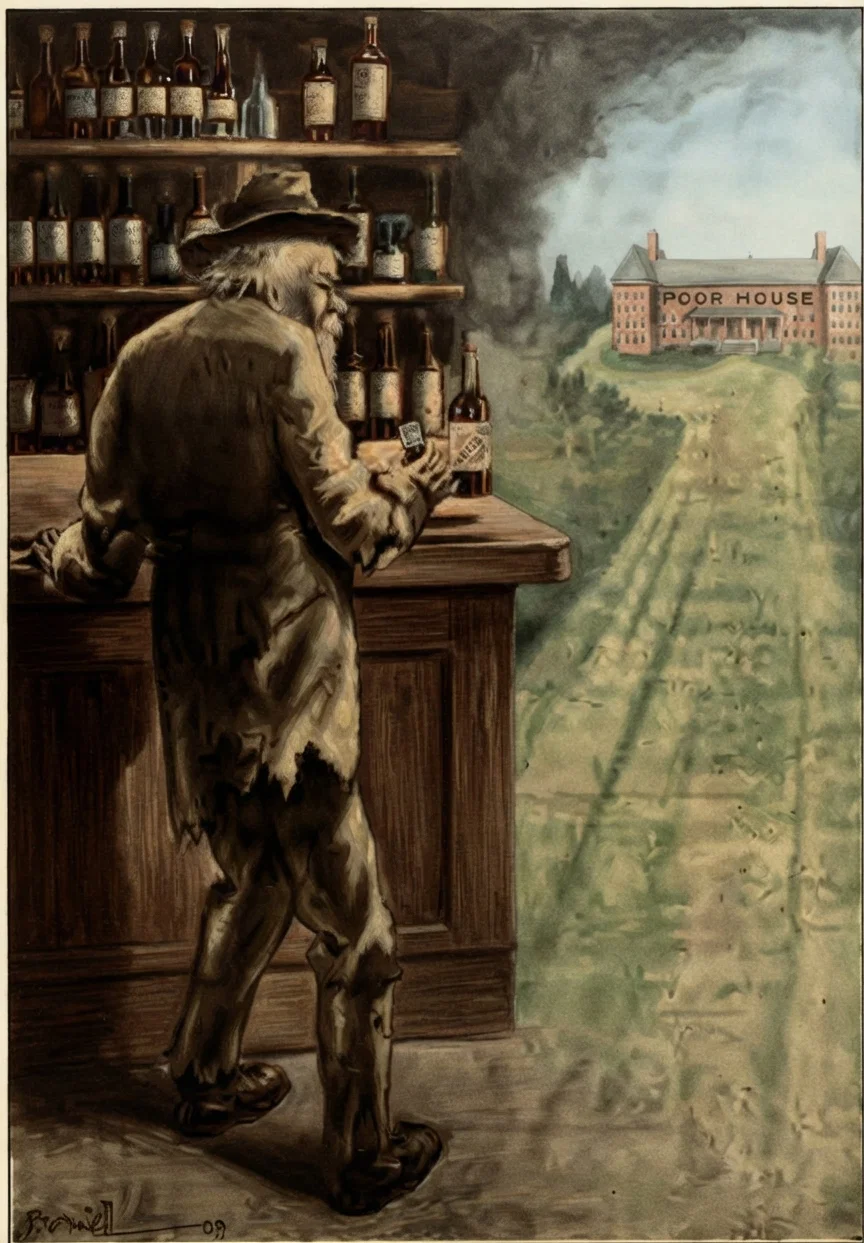
A STALWART champion of prohibition is Major Dan Morgan Smith, of Chicago, formerly chief counsel of the Model License League. His conversion to the interests of the Anti-Saloon League of America was again and again lauded at the recent convention. Well it might be, for he is a powerful speaker, and exerts a telling force.
In his address "The Price of a Drink," he gave some of the best arguments on the liquor evil. We quote the following:
"If the results of drinking were purely personal, then the complaint of the wets that the anti-liquor forces are trying to interfere with the personal liberty of drinkers might carry with it some force; but drink is sold on the installment plan — first payment is made when you get the drink, the others when the drink gets you.
"The greater part of the payments are made by those who do not drink.
WHO PAYS THE PRICE?
"The price of a drink ranges from a dime to damnation — the drinker pays the dime, and humanity pays the damnation.
"The immediate payment is made in cash; some of the delayed payments are made by the drinker in brawn and brains, ambition and efficiency, morality and decency, duty and honor; but you and I, although we never touch liquor, must pay the price of a drink in loss of trade, in loss of profits, in damage suits in one way or another, depending upon our business, profession, or occupation; but no one is exempt.
"The merchant pays in loss of trade; for the moderate drinker of to-day is the drunkard of to-morrow, and drunkards do not buy liberally of groceries, clothing, shoes, or of anything else, except liquor.
"If we be manufacturers, we help pay the price of a drink when our machinery lies idle because the operator is sobering up; help pay the price when fewer workmen report Monday than were working the preceding Saturday; pay in sluggish brains and trembling limbs; in damage suits caused by carelessness, or inefficiency, or drunken workmen; pay in less output than the pay roll justifies us in expecting.
EVERYBODY PAYS
"True, employers of labor are seeking to avoid this great drain upon their profits by discharging the drinkers; but a man permanently out of work becomes a charge upon the taxpayers, and the manufacturer is a taxpayer. Supplanting trained workmen with untrained men is expensive, and yet it is less expensive than to put up with the drinker.
"The union men are paying installments upon the price of a drink; for ultimately wages and hours of labor must be based upon the earning capacity of the workman, and the earning capacity depends absolutely upon willingness, health, and ability — upon efficiency, and science leaves no doubt that even one drink lessens efficiency.
"Farmers pay their installments, even though no person on the farm were to drink; for the farmer pays for the drink of the miller who grinds his wheat, and of the clerk who sells the flour of the middleman and who stands between the maker and the consumer. The farmer also pays because of the lessened demand for the products of his farm; but pays most of all in taxes expended to support the cities' poor and criminals — the victims of drink.
"Professional men help pay, because the drunkard pays no professional fees.
POPULATING THE PENITENTIARY
"Every taxpayer is assessed to pay the price of a drink; and let us not forget that every renter, every buyer of anything, is a taxpayer. The taxpayer's money is used to pay the judges and juries that are trying, with so little success, to stem the tide of crime that is unquestionably attributable, in the main, to the use of drink. The taxpayer supports the penitentiary that is largely populated with men who violate the laws either when drinking or after drink has made them moral lepers.
From “The Shadow of the Bottle”
“Payments are made by the drinker in brawn and brains, ambition and efficiency, morality and decency, duty and honor.”
"Men who should know, assert that seventy-five per cent of crime can be directly traced to drink; that thirty-three per cent of the inmates of asylums are there because they or their ancestors were poisoned by drink. Social workers assert that a large number of women walk the street because the use of liquor has lessened their resistive powers, blunted their moral senses, or excited their sexual desires.
"Are these percentages true? Do these statisticians know what they are talking about?
"I do not know; but if there be in any penitentiary one person who is there because the government permits the sale of liquor; if in some asylum there is one person who is spending all of life muttering foolish nothings; if in all the world there is one girl — just one little girl — who has kissed her mother good-by and can never come home again, because of drink, then I am in favor of national constitutional prohibition.
"If these things be true — and I believe them to be true — I want to see this country so dry that a rattlesnake's bite won't dig up a drink between oceans.
THE SALE OF DAMNATION
"No small part of the price of a drink is paid by the drinker's family. His wife pays in lost happiness, deprivations, shame, and tears; his children pay in lack of opportunity, in lessened advantages, and, worst of all, in physical infirmities, mental deficiencies, and moral degeneracy. Many children come into the world doomed to have stunted bodies, warped minds, and blunted moral senses, because they were sired by a drunken father.
"Cities pay their installments in waves of crime, lowered standards of conduct, the unwarranted, pernicious, and controlling influence of the liquor interests in politics. Cities pay in the inefficiency and dishonesty of men elected to office by the interests that make but one inquiry of the office seeker — 'Are you a wet?'
"States pay the price of a drink in the passage of vicious laws, and the defeat of needed legislation, by legislators whose election was made possible by the activity of the liquor interests in politics.
"The national government helps pay the price of a drink by putting its seal of toleration upon the sale of this damning article to its citizens; by ignoring the fact that a government, as an individual, cannot be pure if the source of its income is impure; by pleading the need of its treasury — thus weighing dollars against decency."