THE TRUE RICHES

8%

Pacific Press Publishing Company · Mountain View, California · Sep 26, 1906

FromSigns of the Times, Vol. 32, No. 37.

Read the full edition

THE TRUE RICHES.

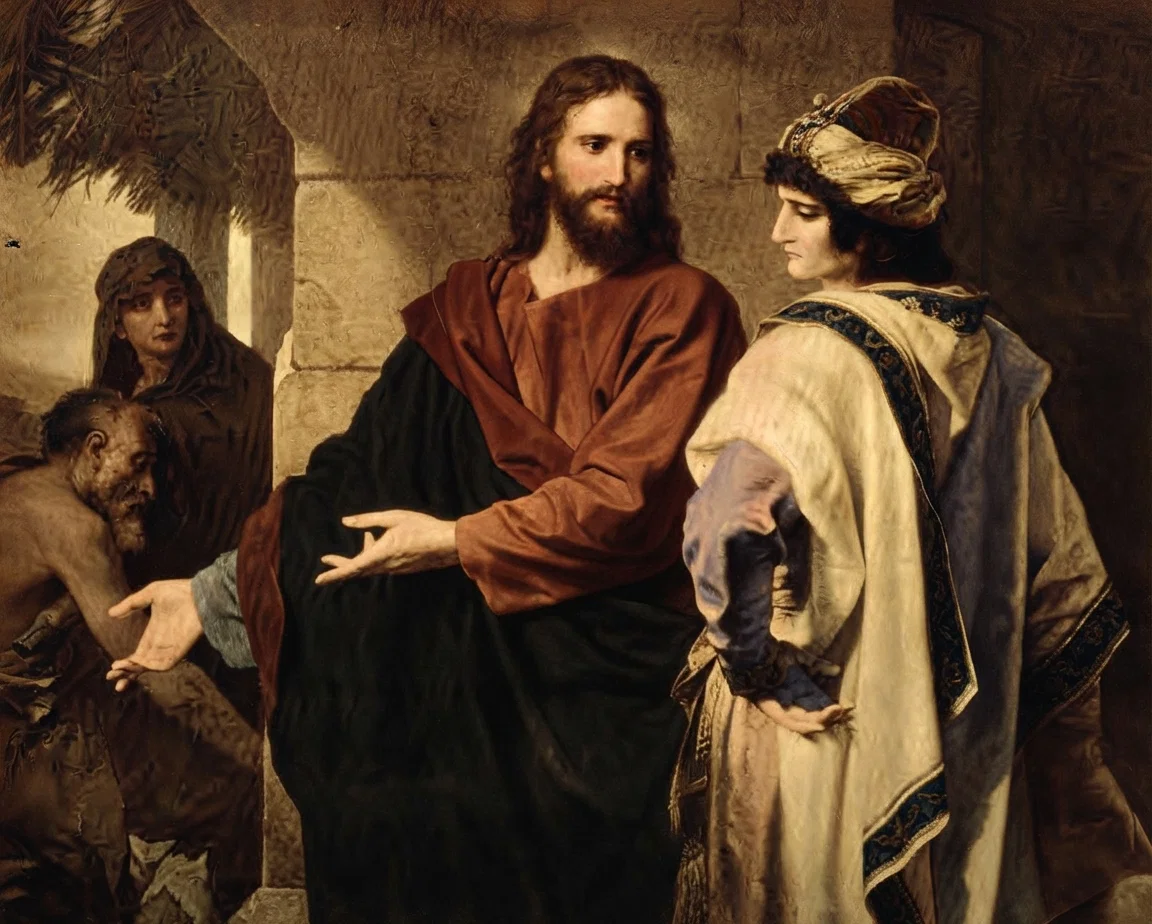
POWERFULLY, indeed, has Hoffman depicted by brush the scene set forth in Matt. 19:16-29; Mark 10:17-30; Luke 18:18-30. Our picture on this page is from a photograph of his great painting.
THE story is that of a rich young ruler, concerned about his soul's salvation, and eagerly coming to Christ and asking, "Teacher, what good thing shall I do, that I may have eternal life?" The young man was in earnest about it. He was willing to brave the criticism of the crowd. He ran to Jesus, and kneeled before Him, as the Master walked in the way. It was a question of more than passing interest, as it should be to every soul.
THE human idea, the Pharisaic idea, the heathen idea, possessed him; namely, that he must himself do some good thing which would merit him eternal life. He must earn it in some way, by some works of supererogation,—a belief which has been responsible for all the ingeniously cruel means which men have invented and devised to torture the human, to do penance to the flesh, and at the same time pile up colossal mountains of self-righteousness.
MAN can never earn eternal life. Jesus Christ alone can bestow it, and He bestows it by gift, wholly and solely by gift. "The wages of sin is death;" the sinner earns it. He is entitled to his wages. "But the gift of God is eternal life through Jesus Christ our Lord." Rom. 6:23. Only by believing in Christ, coming into harmony with the law of His life, can it flow into our being. John 3:16, 36. We may do and do and do till the day of doom, but we can no more lift our souls from the plane and prison of sinful flesh than we can fly. Christ, Christ only, can lift us up, and by His life—eternal life—make us to stand.
NOTE the answer of our Lord. While He demands obedience, He does not declare that obedience would earn life; but "If thou wilt enter into life, keep the commandments." Nor does this mean that at the end of keeping the commandments life lay as a prize. Not at all. It meant that in harmony with God's commandments was the very law of life. "In the way of righteousness is life; and in the pathway thereof there is no death." Prov. 12:31. And this doesnot say that at the end of the way of righteousness is life; but "in the way of righteousness is life." Just as soon as the young man should truly enter that way, he would enter life. Just as soon as we truly enter the way of keeping God's commandments, we enter into life. God's life flows in perfect purity and mighty power in the channel of His law. Outside of that channel it is perverted, and becomes the "vain life" of man.
BUT the keeping of God's commandments can be accomplished by man only through faith, simple, childlike, submissive, obedient faith in God and God's means of salvation. Apart from such faith in Christ, all our obedience becomes superficial, outward, selfish, self-righteousness. This was the unsatisfactory righteousness of the young man. While keeping outwardly God's commandments from his youth up, he was still unsatisfied. He did not know that the law demanded more than the outward morality; he had not been taught it by the formalists of his day.
JESUS knew it and pitied him. But He could not for this reason make the way easier. "One thing thou lackest," "if thou wilt be perfect, go and sell" "all that thou hast, and distribute unto the poor, and thou shalt have treasure in heaven: and come, follow Me." Jesus looked upon him and loved him. His heart yearned over him. He saw the possibilities for good in him. He placed before him four incentives: Sell that which did not give him relief; give to the poor and needy, and receive their blessing; lay up treasures where they were forever safe; and go with the Good Master. How the poor ought to have appealed to him! The artist presents it as tho Jesus were pointing to the patient, sad-faced woman, standing, perhaps, by her sick, suffering husband, herself the worse sufferer, looking longingly for the response of the young man, as he waits, thoughtful and perplexed, while the calm eyes of Jesus read his very soul.
THE rich young ruler wants eternal life, but he wants more his own great possessions and the position he occupies and the praise of men, which his great wealth brings, and he turns away sorrowful. He has allowed the lust of gold and gain to wind their tendrils about his heart till they bind him fast. Sad decision, perhaps for eternity.
THERE are many to-day to whom the Master is calling, "Sell," "distribute," "come, follow Me." The needs of the poor are calling, but they heed them not. God's suffering cause is in need, giving them opportunity to identify themselves with Him, and so lay up treasure where no earthly poison can corrupt or corrode, where no enemy can steal. He is inviting them into companionship with Himself. He asks them to take no step that He has not taken before them, that He will not take with them. Yet they hesitate, wait, and turn away. Eternal character is weighing against temporal gain, and the temporal gain is chosen.
CHARACTER is determined by such little things. On the roof of a house in Ohio the autumn rains fall. Those on one side find their way to Lake Erie on the north, over turbulent Niagara, down the swift St. Lawrence, and out into the cold frigid regions of the North. Those on the other side find their way into the Ohio, down the Mississippi, and out into the Gulf of Mexico, whose warm, strong current blesses and makes habitable what would otherwise be bleak, barren shores of sea-girt lands. The little act in our lives may be on the wrong side of the "divide." Count character more than coin. Reckon the riches of God more than the treasures of earth. Know that the way of righteousness and life is more than the way of selfishness and death. "If thou wilt enter into life, keep the commandments." "Come, follow Me."