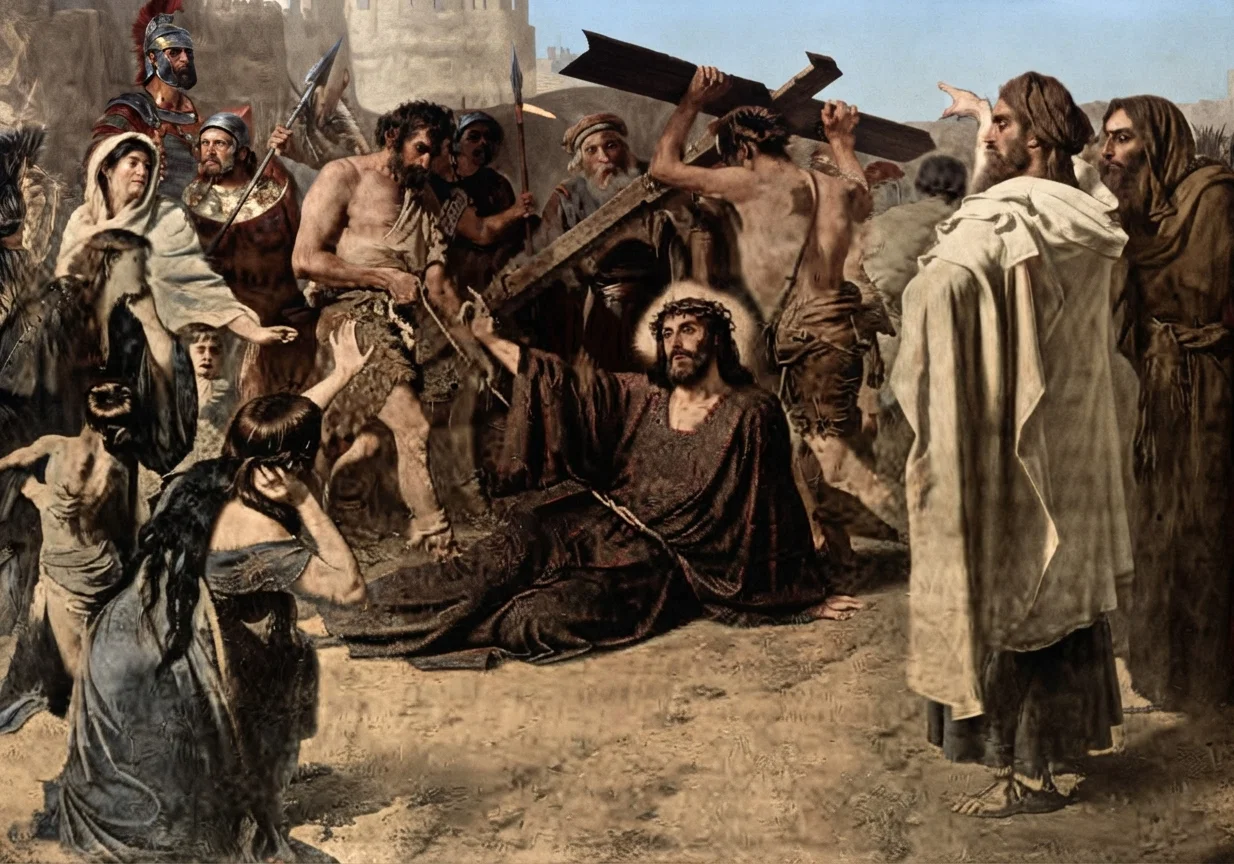
MEN so designate the passing of our Lord from Pilate's judgment hall to the elevation of ground on which He was crucified, called Calvary. Just where it was, we do not know, the probable site seems just north of Jerusalem, through the Damascus gate, the distance of a half-mile or more from His place of trial. It matters little, tho men warred for hundreds of years to obtain possession.
AFTER Pilate's sentence, Jesus was again mocked, ridiculed, smitten, spat upon, by the mad rabble and soldiers, till they grew weary of mocking. Then they removed, in no tender manner, we may well believe, the gorgeous garments with which they had clothed Him, placed upon Him His own garments, and led Him out to be crucified. Upon His own shoulders was laid the rude, heavy cross. But human nature was too weak to bear it. For hours He had been passing through the greatest anguish of soul for His disciples, His people, and the world. That agony was intensified by the awful thought that He might fail. This He must not do; and the trial of Gethsemane with its bloody sweat bears mighty witness. Through all the remaining hours of the night after His arrest, He had been dragged from pillar to post; He had been thorn-crowned, struck, beaten, scourged, till human nature could bear no more; the cross was evidently too heavy, and the Man of sorrow and suffering sank under it. Meeting Simon of Cyrene coming from the country, the father of two young disciples, the soldiers impress him into service, and he bears the cross of Christ after his Master. Blessed is he that beareth His cross without compulsion.
ON THE WAY TO CALVARY.
THE pitiful condition of Jesus as He walked along the way touched the hearts of the mothers and sisters who beheld Him. They doubtless thought of how it would be if He were their own son or brother. They were touched by more than mere curiosity. A great many of the women who followed "bewailed and lamented Him."
It need not be said that Jesus appreciated their sympathy because of His physical suffering. That is all they knew or saw. They did not see that the cause of His suffering would bring still greater trouble upon the nation. They saw His present sufferings, and they wept. Jesus looked beyond that. Turning unto them, He said: "Daughters of Jerusalem, weep not for Me, but weep for yourselves, and for your children. For behold, the days are coming, in which they shall say, Blessed are the barren, and the wombs that never bare, and the breasts that never gave suck. Then shall they begin to say to the mountains, Fall on us; and to the hills, Cover us. For if they do these things in the green tree, what shall be done in the dry?"
THEY did not know that the deeds then being done would come back upon them a hundredfold. The leaders, and the people led by their leaders, did not know that the wind they were sowing would be reaped by them in a whirlwind. They did not know that in leading to His death the Anointed of God, who came to take away their sins, they were allying themselves with all the sins of the past, and were joining hands with the primal revolter who sought to overthrow the throne of God. If they would weep for themselves and Jerusalem now, for the awful sin of striking at the4very throne of God in the slaying of His Messenger, they would save the weeping by and by.
THERE is another thought in this last instruction of our Lord. Over and over in the Scriptures with which the Jews were familiar is God called the Rock, the Refuge of His people, the Shelter in the time of storm, the Shade in the weary land. It was their privilege to hide in that Rock; but they refused. They would not see the refuge, the shelter, the shade, the hiding-place. They would not be cleansed by the blood of the Lamb. But the time was coming when they would say to the material, insensate crags and rocks, "Fall on us," "cover us," "hide us from the face of Him that sitteth on the throne, and from the wrath of the Lamb; for the great day of their wrath is come; and who is able to stand?" Rev. 6:16, 17.
THESE things in which Jesus was the central figure, were a judgment upon sin. The Innocent suffered the punishment of the guilty, the Righteous One for the sinner. The time would come when every incorrigible sinner must bear his own sin. If this awful penalty of death so falls in awful judgment upon the Innocent, upon the green, fruitful tree, bearing only the sins of others, what will that punishment be when it falls upon the incorrigibly wicked at the destruction of Jerusalem, or at the great antitype of that destruction, the judgment of the last day? How awful, how solemn, the warning!
THE great journey of Christ to the cross did not begin at the Roman Prætorium. It began when He gave Himself for a lost and sin-marred universe, the Lamb slain from the foundation of the world. Every step from that time till He was nailed to the cross of Calvary was a step in "the journey to the cross." From the time He entered His earthly ministry, He could see the cross on before, and every step was a pace nearer the consummation of His infinite sacrifice at Golgotha. And when He died and rose again, His people took up the journey with the cross and to the cross of suffering for the sake of others, to fill up what is behind of the sufferings of Christ. Well has Lowell sung:
"We see dimly in the present what is small and what is great,
Slow of faith, how weak an arm may turn the iron helm of fate;
But the soul is still oracular, amid the market's din,
List the ominous stern whisper from the Delphic cave within—
'They enslave their children's children who make compromise with sin.'
'By the light of burning heretics, Christ's bleeding feet I track,
Toiling up new Calvarys ever with the cross that turns not back,
And these mounts of anguish number how each generation learned;
One new word of that grand Credo which in prophet hearts hath burned,
Since the first man stood God-conquered, with his face to heaven upturned,
'For humanity sweeps onward; where to-day the prophet stands,
On the morrow crouches Judas with the silver in his hands;
Far in front the cross stands ready, and the crackling fagots burn,
While the hooting mob of yesterday in silent awe return
To glean up the scattered ashes into history's golden urn."
"Count me o'er earth's chosen heroes,—they were souls who stood alone,
While the men they agonized for hurled the contumelious stone,
Stood serene, and down the future saw the golden beam incline
To the side of perfect justice, mastered by a faith divine,
By one man's plain truth to manhood, and to God's supreme design."