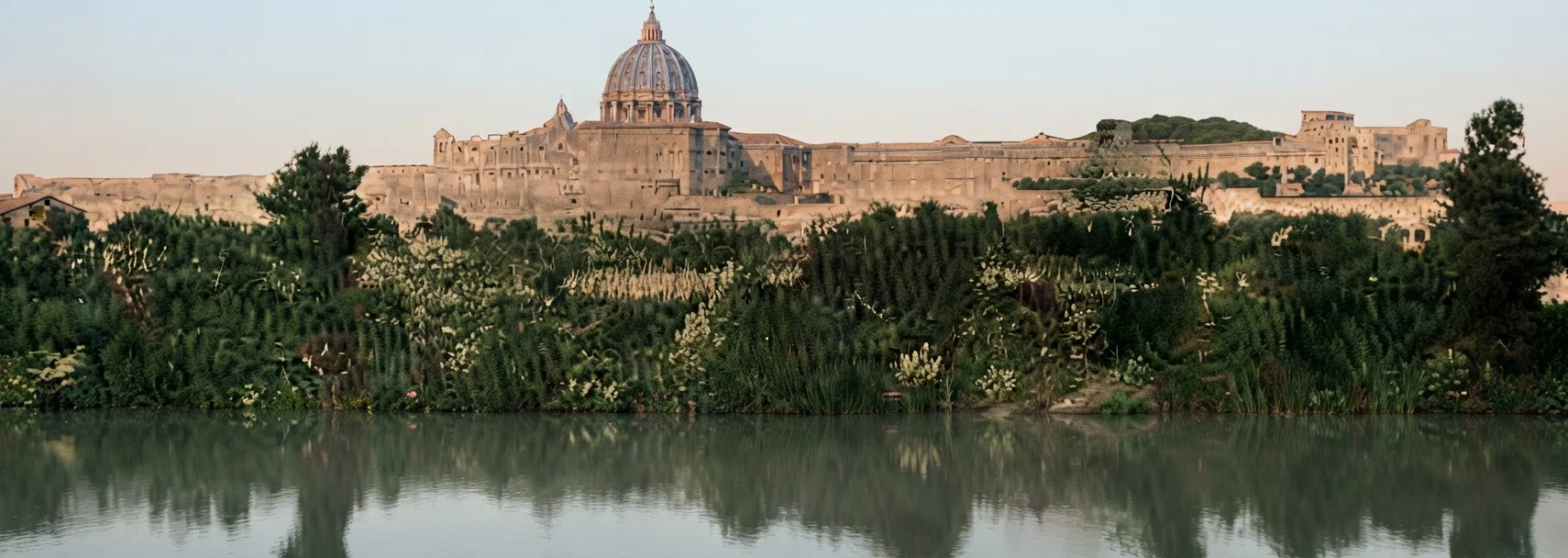
"Attached to the great temple [St. Peter's] is the palace of his successors. A palace of some 11,000 or 12,000 rooms, or chambers, and containing enormous wealth and untold treasures, it is not unworthy for the successors of the greatest of kings and the mightiest palaces of the emperors of old Rome; such is the Vatican."
THE above quotation from a recently-published book, altho somewhat exaggerated in its account of the number of rooms which the Vatican contains, yet gives a good idea of the papal palace. If history has taught us anything, it has surely established this fact, that great luxury and riches go hand in hand with corruption. That the Vatican is no exception to this rule, we shall endeavor to show in the present article; and being a point quite well conceded, our task will be rendered more easy.
Constantine's Influence.
For the first three centuries of the Christian era there were no edifices dedicated solely and expressly to church purposes. During this time the Christians were largely subject to persecution, and therefore were not able to erect permanent buildings for worship. Hence we read, in the Bible, of churches held in private houses; and even at Rome, the capital of the empire, the church met in the house of Acquila and Priscilla. But with the so-called conversion of Constantine to the Christian religion, and the union of the Roman state with apostate Christianity, there began for the church a period of great material prosperity. The original edifices of the largest churches of Rome, such as St. Peter's, St. Paul's, St. John Lateran, St. Lorenzo, etc., were founded by Constantine himself.
Constantine not only caused numberless churches to spring up in Rome, but wrote letters offering both political and financial reward to the other cities of the empire, proposing to build them churches at public expense, and give them large sums of money for the maintenance of the poor if they would forsake the pagan religion. The heathen were not slow to take advantage of these offers, not from a religious, but wholly from a material, point of view. And as political honors also became associated with the profession of the Christian faith, the statesmen and politicians vied with each other to do homage to the new religion. As a consequence, the influence and friendship of the bishops and priests were greatly sought after, and these persons grew in importance and riches by leaps and bounds. The bishop of Rome, being in the capital of the empire, exerted an extraordinary power in the affairs of the state, and consequently "became a prince of the empire, and lived in a style of luxury and pomp that awakened the envy and just indignation of the heathen writer Marcellinus. He rode through the streets of Rome in a stately chariot, and clothed in gorgeous attire; his table was supplied with a profusion more than imperial; the proudest women of Rome loaded him with lavish donations, and followed him with their flatteries and attention." Is it any wonder that a heathen exclaimed, "Make me bishop of Rome, and I will be a Christian"?
Luxury and Corruption, Strife and Violence.
This pomp and luxury carried with it a flood of corruption and immorality, so that merely to name the dark and debasing sins committed in private life, and the terrible abuses practised in public life, by these self-styled successors of Peter, would fill volumes. I shall endeavor, therefore, to stir up but slightly the murky and slimy waters of the pontifical history, in order not to contaminate the air too much with the horrible stench and poisonous fumes of the bottomless pit of papal corruption.
As we have already noticed, the bishopric of Rome carried with it great influence, luxury, and riches, and hence it became a position highly sought after by ambitious and corrupt men. As a consequence, the election of the pope from very early times was an occasion of bloodshed and riot on the part of the different factions that supported their aspirant to the papal chair. The same bloody scenes that in the time of Pagan Rome were enacted on the occasion of the election of the consuls were repeated in the election of the popes. As for example, in the year 366 there were two candidates, Ursicinus and Damasus, who had been elected to the bishopric of Rome, and the contest for the supremacy lasted for several years, until finally the latter succeeded in taking undisputed possession of the See. But during this time "churches were garrisoned, churches besieged, churches stormed and deluged with blood." And Damasus himself, who is recognized by the church of Rome as a prominent pope, "at the head of a gang of gladiators, charioteers, and laborers with axes, swords, and clubs, stormed the church [of Liberious]; a hundred and sixty of both sexes were barbarously killed." And yet this pope has been canonized, and is among the so-called saints to whom the Catholics pray.
Thus we see that the papal chair became, early in its history, the object of contention and bloodshed, and it continued to be so for centuries. More than once, therefore, in its history the Catholic Church has beheld the spectacle of two popes reigning at once, and has seen even five popes at one time that endeavored to preserve the papal continuity.
Some Pages of Papal History.
As the subject under consideration is very vast, and our space is limited, we shall only take some incidents here and there throughout the papal history, and let them serve to give an idea of the epoch from which they are drawn. Having considered the corruption existing at the beginning of the union of church and state, let us open a page of the papal history of the ninth century. Without stopping to speak of John VIII., who rewarded with gold the bishop of Naples,—a man that, after putting out the eyes of his own brother, sent him to be imprisoned at Rome because he was allied to the Turks;—and passing over the account of this pope's order to the same bishop to decapitate twenty-two Neopolitan prisoners, allies of the Turks, together with the captains of the Saracens, let us speak of Stephen VII., who ascended the papal throne in 896. This pope hated Formosus, one of his predecessors on the papal throne, because he had hindered him from ascending earlier to the pontificate. But Formosus was dead. As Stephen could not wreak his vengeance upon him in life, he attacked his corpse. The body of Formosus was disinterred, placed on trial, and adjudged guilty of simony, the head was then cut off, and also the three fingers with which he had blessed the people; and the poor corpse was thrown into the River Tiber,10and all the pontifical decrees enacted by Formosus were annulled.
The historian comments thus on this incident:
"A very strange example of cruelty and revenge from which one can see that the wrath of the priest wreaks vengeance even on putrid flesh, and his ire reaches even beyond the tomb."
The friends of Pope Formosus, greatly indignant at such horrible proceedings, arose in rebellion and strangled Stephen VII. And thus perished two of the so-called infallible guides of the Roman Church.
A Female Pope-Maker.
Shortly after this time the power in Rome lay largely in the hands of a woman, by name Marozia, who, together with her son, Alberic, elected and deposed popes according to her will. She caused her son to be elected pope, who assumed the title of John XI. "After the death of John, Alberic caused to be elected successively the popes, Leo VII., Stephen IX., Marinus II., and Agapetus II." And when he was near his death, he made the nobility swear that they would put his son on the papal throne when the ruling pope should die. And, in fact, when Agapetus died, the son of Alberic succeeded to the pontificate under the name of John XII. He was only a youth of eighteen years when elected pope, and he "devoted himself wholly to hunting, reveling, and women." "He made use of his power to satisfy every wickedness and vice; so much so, that during his pontificate the women of other cities had to refrain from visiting the tomb of the apostle for fear that the successor of Peter might violate their honor and virtue." I might observe in passing that it is evident the Holy Spirit had no part in electing the popes, as the Catholic Church claims. For, as we see in this instance, there were at least six popes put into the papal chair by a harlot, assisted by her son, a corrupt nobleman.
During the reign of this last-named pontiff, the emperor of Germany came against the city of Rome, and the pope fled from the city. The emperor instituted an inquiry into the affairs of his pontificate, and he found it corruption personified. "It was found that there were rioting with women, and practises of incest, to the extent of reducing the Vatican to a brothel. The pope had caused to be mutilated, blinded, and killed, bishops and cardinals; he had made a child of ten years old bishop, and had drunk in honor of the pagan idols and of demons." To cut the account of his reign short, we shall mention that on his return to Rome he visited cruel vengeance everywhere, but was finally killed by a citizen who surprised him in the outskirts of the city in illicit relationship with his wife. And thus perished another self-styled successor of Peter.
A Page from the Fourteenth Century.
Let us pause by this seat of corruption no longer, but open a page of papal history of the last part of the fourteenth century. Dante, the great Italian poet, has described the Papacy of his time in clear words as follows: "O the day that the church of Rome, uniting in itself two powers, fell into the mud and bedaubed itself and its load!" And again the same poet represents Peter as saying, "Those that have in earth usurped my place, have rendered it devoid of the presence of the Son of God, have made my tomb a pool of blood and stench, where the perverse one who fell from Paradise to earth finds himself consoled."
This expression reminds one of the fact that "the dragon gave the beast his power and seat and great authority."
The poet further likens the Papacy to a beast "that has a nature so wicked and malicious that it can not satiate its evil desire, and after its repast has more hunger than before." And, in fact, he even goes so far as to compare the Papacy to the woman seated upon the scarlet-colored beast of Revelation 17, as follows: "Your avarice has made the world sad, treading down the good, and elevating the depraved. Of you, shepherds, did the evangelist prophecy, when she who sits upon the waters fornicating with the kings, was seen by him." Again he says, "You have made yourselves gods of gold and silver, and in what do you differ from the idolators, if not in that where he has one, you adore a hundred." The famous poet Petrarch, writing of the same period from Avignon, where was then situated the papal throne, writes: "I am in the land of Gaul; the western Babylon, a place more contaminated than which the sun does not look upon; and the cruel Rhone, which resembles the boiling Cocytus and the Tartarean Acheron; where the head of the fishermen, poor at one time, and now in a marvelous way forgetful of his principles, possesses a kingdom which he says he has by heredity. It amazes one to think back upon the apostles, and then to look on those loaded down with gold, clad in purple, proudly adorned with rich spoils which they have robbed from princes and people."
And of the moral condition of the time, the bishop of Orvieto, writing concerning Rome in 1362, says: "I believe that in no city has there ever been so many fallen women as there are in Rome in our days. Here are gathered from far and near those that are married and those that are nuns, consecrated to God; here they are maintained, nourished, and defended as fallen women, and recognized as such, because from these they derive benefit, advantage, and an enormous revenue." The bishop concluded by saying that "one understands that the papal government does not want sheep without wool." These are strong words regarding the papal corruption, especially coming from a bishop of the same church.
Rome, Italy. C. E. MILTON.
(To be continued.)
The Basilica of St. Peter and the Vatican from the Tiber.