CHINESE JEWS

5%

Pacific Press Publishing Company · Mountain View, California · Oct 10, 1906

FromSigns of the Times, Vol. 32, No. 39.

Read the full edition

CHINESE JEWS.

"For, lo, I will command, and I will sift the house of Israel among all the nations." Amos 9:9.
"My God will cast them away, because they did not harken unto Him; and they shall be wanderers among the nations." Hosea 9:17.
"And they shall fall by the edge of the sword, and shall be led captive into all the nations." Luke 21:24.
THERE are perhaps no predictions in all the field of divine prophecy that have received a more literal, specific, and minute fulfilment than the ones quoted above. In response to the query as to what is the great outstanding evidence for the inspiration of the Bible, the court chaplain of the skeptical old Frederick the Great said, "The Jews." In the light of Jehovah's wonderful dealings with this people during almost four thousand years, all of which are vividly portrayed in both the Old Testament and the New, this conclusion may not be far amiss.
Even a casual and hasty glance at the sacred and profane history of this unique people reveals the fact that they have been both the "children of promise," and the objects of divine wrath, as no other nation. No nation ever approached so near to God, nor has any nation ever become so estranged from God. By rejecting Christ and His message God sifted them; they are wanderers, and indeed captives among all nations.
In the light of the foregoing prophecies it is of interest to study the fortunes of this, the most scattered race, in the midst of the Chinese, the most self-contained race on earth. There have been Jews in China for centuries, scattered in various parts of the empire. The first authenticated accounts of the Chinese Jews we owe to the Jesuits, who came to China in the time of Queen Elizabeth, being commissioned by the church of Rome. While at Peking, for these Jesuit missionaries were men of the world seeking political power and social standing, one of their number, Ricci by name, received a visit from a scholar who had come from Kai-fung-foo, the ancient city of Honan, to the imperial capital to attend the literary examinations. He disclosed the fact that he was a Jew, and that at Kai-fung-foo there was a large community of his people, a synagog, which had recently been repaired, in which there was a roll of the law over four hundred years old. At Hang-chow-foo, he said, there was a larger congregation of Jews, who also had a synagog; Jews dwelt in other provinces also.
Succeeding Jesuits wrote fuller accounts of these Jewish colonies. They gave full details of their customs, describing their synagog, and making a sketch of their communal buildings.
Chinese Jews.
Chinese Jews.
Still others obtained copies and made translations of their inscriptions on the walls and on certain monumental stones.
These inscriptions deal with the original construction and rebuilding of their synagog, and at the same time references are made to the ancient history of the Jews, their religion, the time of their coming to China, and their fortunes and experiences since coming to China. Here again we are reminded of the word of the inspired prophet, when he said, "And there [among other nations] thou shalt serve other gods, which thou hast not known, thou nor thy fathers, even wood and stone." Witness the following: "The patriarchs handed down the tradition forbidding the making and worshiping of images and spirits, and the holding of superstitions. Abraham pondered over problems of nature and arrived at the belief in the one true God, and became the founder of the religion we believe in to this day. . . . It is incumbent on the Jew to venerate his ancestors. Twice in the year, in the spring and in the autumn, he offers them oxen and sheep together with the fruits of the season."
In this we see that they had ancestral worship in all of its hideousness; and in a long preamble of one of the other inscriptions an attempt is made to show that there is nothing in the sacred law of the Jews which is not in conformity with the six canonical books of the Chinese. They had indeed the law, a rabbi, a synagog, and all the other necessary sacred things, but what was the value of all this in the face of avowed and outspoken idolatry?
From the inscriptions we learn that their synagog was first erected in the year 1163; and it was rebuilt about one hundred years later in the year 1279. Again in the year 1421 it underwent some repairs, and forty years later the entire structure was completely destroyed by the overflow of the Yellow River. After having withstood a furious siege of six months, in the year 1642, Kai-fung-foo fell into the hands of the attacking Tartar general, who had recourse to the strategem of diverting the course of the Yellow River, thus inundating the city. The loss of life was frightful, amounting to not less than 100,000 persons. The city was practically destroyed; the synagog was laid in ruins, and only 200 families of the Jewish community were saved by passing over to the north side of the river. A large part of their scrolls and sacred writings were rescued from the waters, all that was left to them of their sacred things. For ten years the surviving Jews worshiped in a largehouse on the river bank, when a Jewish mandarin from the province of Shen-si came to Kai-fung-foo and restored the city and rebuilt the synagog in the year 1653.
The scattered bits of historical reference in the inscriptions and in the accounts of the Jesuit fathers go to show that the Jews first settled in China in the Han dynasty, which ruled from 200 B. C. to 220 A. D. Some hold that the settlement was made just after the terrible persecution of the Jews in Babylon in the year 34 A. D., while others contend that it dates from the fall of Jerusalem. Of course they came overland across the deserts and steppes to central China, settling in such cities as Kai-fung-foo, which was then a city of the first rank in the empire, both in population and trade. It has since suffered severely from inundations of the Yellow River, and frequent conflagrations, reducing it to much less importance, tho it is still the provincial capital and now has communication with the outside world by means of a railroad.
The Jews in those parts were then, and are still, known as "the sect that pluck out the sinew." As of old, form and ceremony played a large part, in fact the leading part, in all their worship; and, little by little, the surrounding heathenism and idolatry insinuated itself into their worship and practise. Their own worship and the synagog gradually fell into decay, and to-day it is only the remnant that is left, with no temple, no law, no priest, no rabbi, no Sabbath, no God—the whole Hebrew community being all but swallowed up by the heathenism all about.
Several attempts have been made both by Jews and Protestant missionaries to revive this withered olive branch by seeking to educate them to restore their worship, but all to no purpose. Years ago there were flourishing communities of Jews, not only in Kai-fung-foo, but in Hangchow, Nanking, Peking, Canton, Ningpo, Ningkiang Chow, in Shen-si, Shay Hung, in Seechuan, and in other places. Some among them attained to considerable prominence, both politically and in the literary race, but with these few exceptions they were the despised race in China as elsewhere.
They were very particular about their writings, and it is written of them, "All these books are preserved with greater care than gold or silver." They prayed toward the west in the direction of Jerusalem, following their ancestors in that they made supplication three times each day.
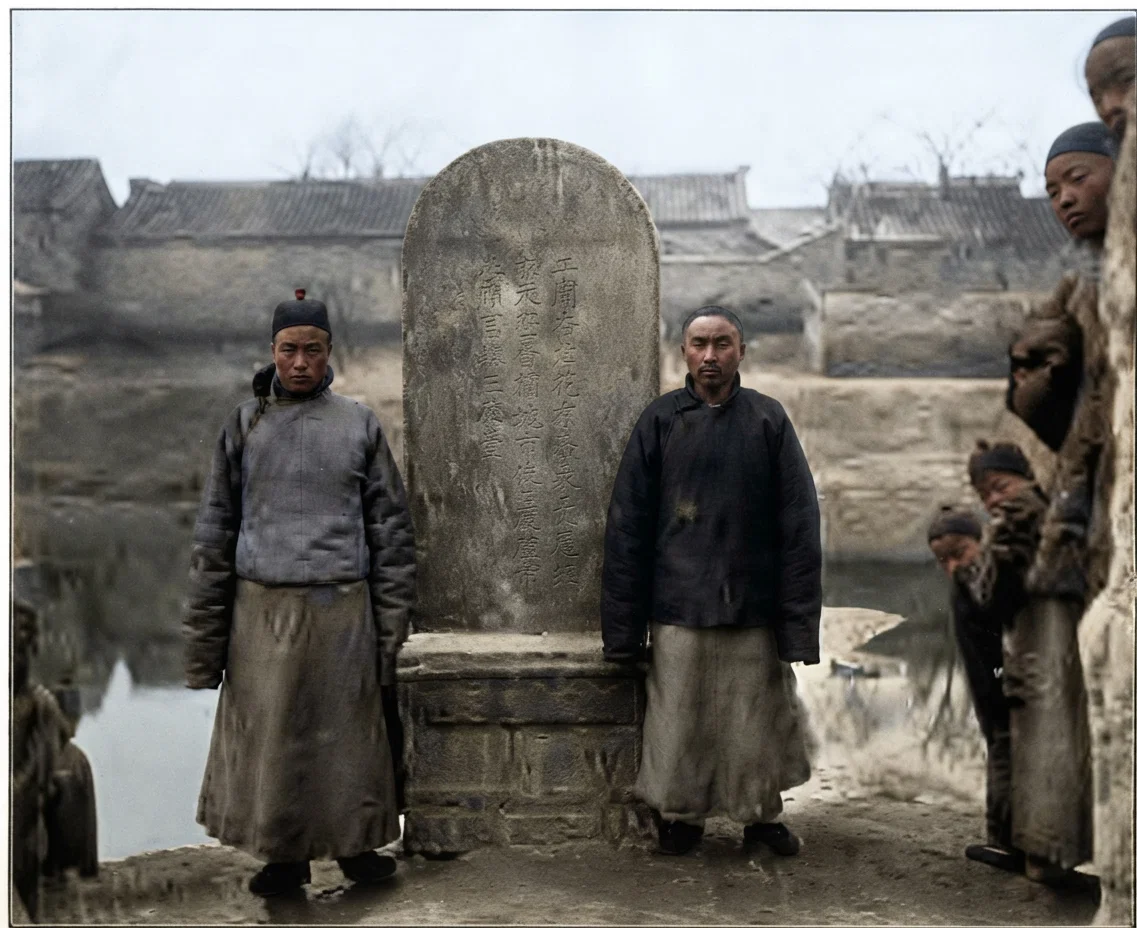
In company with Dr. Miller it was my privilege to visit this historic place last February, which afforded us an opportunity of seeing their ancient seat of worship, which now is a desolate space some three or four hundred by about one hundred and fifty feet, full of all kinds of filth and refuse, as if in derision of the unfortunate and pitiful worshipers. Only two stone slabs are left of them, one of them standing in the open space while the other is set in the wall of a house. They bear inscriptions severally dated, 1489, 1512, and 1663. There are some sixty or seventy men, women, and children, in Kai-fung-foo who claim to be the descendants of these Jews. Several gathered about us, and in some instances it seemed quite easy to read Jewish features in their faces, and upon questioning them they manifested no little pride in counting themselves Jews, giving us fragments of their history. The desolation of the place and the ignorance and apostasy of the people, all combined to make a melancholy sight. Insensibly it impressed on our minds one truth—the great danger of rejecting light.
By request of Dr. Miller two of them consented to stand for a photo, standing on either side of one of their stone slabs.
J. N. ANDERSON.