IN the Catholic World for October is a review article on new books entitled, "Protestant Persecutors," in which the writer says:
"Educated Protestants are well aware of the crushing tu quoque ['you too'] to which they expose themselves if they advance against the Catholic Church the old charge of being a bloody persecutor which their forefathers urged so vociferously and so long. Catholic writers, for two hundred years, pointed out, in vain, that if Catholicism had its Inquisition, and if Catholic rulers did not hesitate to employ the sword against heretics, the reformers and their followers, with less excuse and in defiance of their own special principles and professions of tolerance and the right of private judgment, in practise equalled, if they did not better, the example which they reprobated in words."
Professed Protestants did persecute, and we have no more defense for the persecutors of the Elizabethan period or the intolerance of John Calvin than we have for the Roman Inquisition or the spirit of Torquemada. But there is a vital difference between the attitude of Protestantism toward persecution and intolerance and the attitude of Catholicism. And this is admitted by the writer above quoted. Roman Catholicism has ever tried to explain away the intolerance by declaring that all the prosecutions were not of the Church but of the State, or has openly justified the persecution. Of course the Roman Catholic would not call it persecution, but prosecution. Church and state were united. The dogmas and tenets of the church were entrenched in civil statutes. They were upheld and promoted by the civil power. He who trespassed upon those tenets, who showed contempt or disrespect for the dogmas, was a criminal, and ought to be, must be, proceeded against by the civil power and suffer its penalties.
But all the persecutions of the Papacy are inherent in her theory of a union of church and state. Out of it is bound to grow intolerance, injustice, and persecution for conscience' sake. To justify that union is to justify all that logically grows out of it, and those Catholic writers are consistent Catholics who defend the cause that church pursued toward heretics and who defend the Inquisition in Spain and Rome.
There are Roman Catholics in America who contend that their church does not ask for a union of church and state. Of course she does not where and when there is no hope of securing it; but she nor her prelates do not so express themselves when some government is anxious to bring about this separation. Take for instance the following anent the troubles in France, from Cardinal Lecot, Archbishop of Bordeaux, quoted in the New York Independent of October 4:
"The priests will not leave the churches until they are forced by the authorities to do so, when they will say mass in places which are already being prepared. Seminaries will be transferred to other buildings owned by the church. I personally will leave the palace for a house rented by me. We have appealed to the generosity of the faithful and have gathered together a large amount of money, which I will distribute to the most needy of the priests, and we shall live as best we can. We shall be careful to observe all laws except that of separation of church and state. That we can not accept because it tramples upon the dignity of the Pope and the bishops, not only of France, but of the whole world. The pope must look at the question as a whole. He can not abdicate his authority for a moment when the church is the object of attacks. In other countries, notably Spain, all eyes are watching to see the outcome of the struggle between the government and the Vatican. It is impossible for Pius X. to countenance the act which broke off the relations between France and the Vatican, and since he rejects it, no arrangement of the matter is possible if the government does not modify its laws."
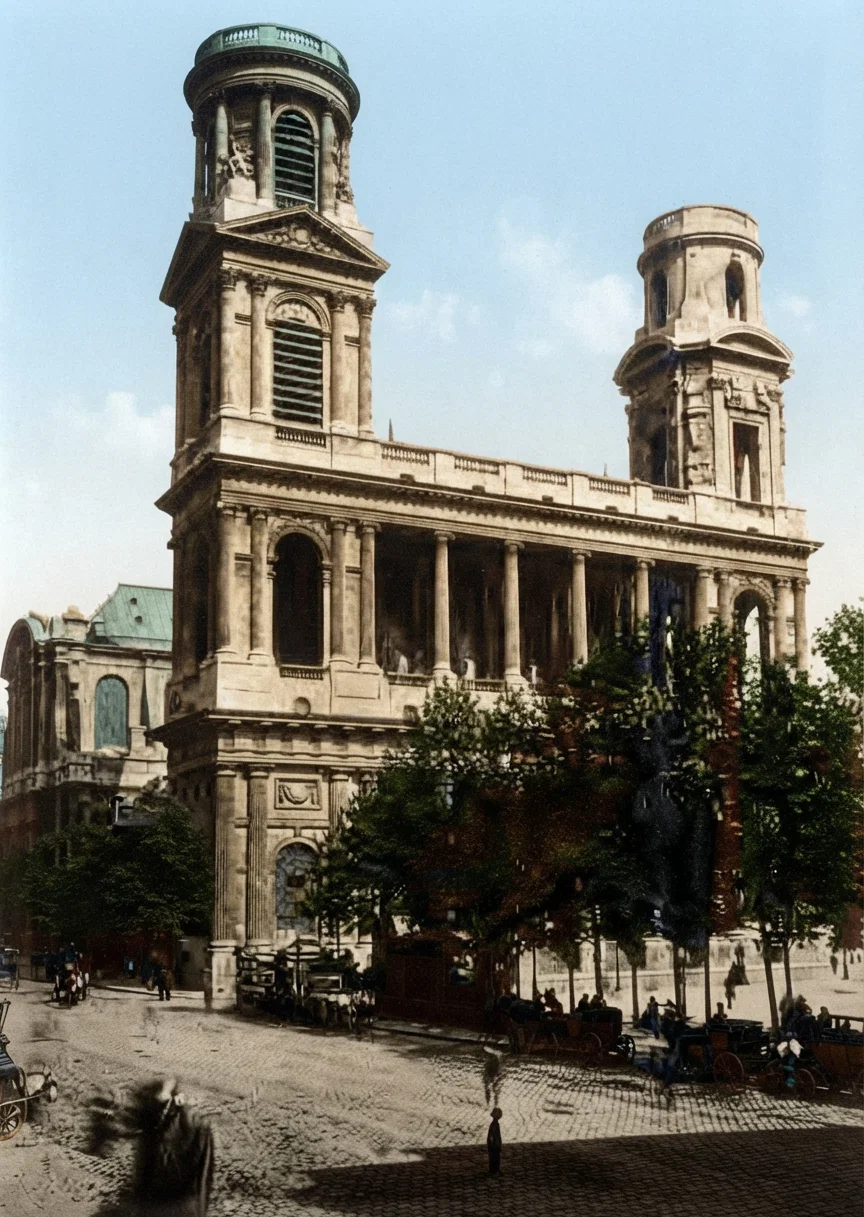
The Church of Saint Sulpice, Paris.
And the same journal quotes from the Gaulois, the clerical organ of France, the following words from the Pope Pius X., which states his position:
"It is not I who condemned the law, but Christ, of whom the pope is simply the vicar. The Saviour granted the church a constitution and a doctrine, against which no human law can prevail. The sep-
aration law is contrary to Catholic doctrine and opposed to divine rulings. It is an unjust law, and therefore carries no obligations to obey it. Providence will decide the future and fix the mundane consequences. My resolution was taken in pursuance of the will of God."
It would be difficult for the pope, or any other Catholic to prove from the great Christian standard, the Bible, that Christ taught the union of church and state. It is easy to prove that He condemned it. It seems to us that Minister Clemenceau has stated very well the true civil idea in the following:
"I see the people seek to foresee what action the government will take. What more simple? Rome has refused the law of privilege made for her profit. She said all or nothing. The time is past when she had all. She ought to be content to-day with the right of everybody to a regime of liberty. We offered privileges. She haughtily refused. We are asked to negotiate.
With whom? A foreign power? On what?—On the French law. There is no foreign power on French soil. We stand on the French right not to tyrannize, but to liberate. We shall know how to resist all factitious enterprises. We are sure that time and the evolution of the human disposition toward the diffusion of knowledge will work for us. Our force is in the right and the resolution of all France is to maintain it."
The true Protestant idea is thus stated by Luther:
"Christians fight, not with sword and arquebus, but with sufferings and the cross."
To the Elector of Saxony he said:
"This protest opposes two faith: each one should believe at his own risk and peril."
The Protestant historian thus summarizes the Protest at the Diet of Spires:
"This protest opposes two abuses of man in matters of faith; the first is the intrusion of the civil magistrate, and the second is the arbitrary authority of the church. Instead of these abuses, Protestantism sets up above the magistrate the power of conscience, and above the visible church the authority of the Word of God. It declines in the first place the civil power in divine things, and says with the prophets and apostles, 'We must obey God rather than man.' In presence of the crown of Charles the Fifth it uplifts the crown of Jesus Christ."—D'Aubigne, Hist. Ref., bk., 13.
The Master Himself said:
"My kingdom is not of this world." "If any man hear My words and believe not, I judge him not; for I came not to judge the world, but to save the world."
Insomuch as Protestants have departed from these principles they have departed from true Protestantism and true Christianity and have placed themselves on papal ground. They are not consistent Protestants.15
Holding these principles, the true Protestant has never defended prosecutions for religion's sake or conscience' sake, never has sought to hide "Protestant" persecutions or expunge them from the pages of history. He is willing that the story may be told, that men may be warned against the fatal error, fatal ever to both, a union of church and state. It is for this reason that the Protestant historian writes down so faithfully Zwingli's awful error of uniting the Protestant movement in Switzerland with the state, or even sanctioning the movement. We close with his eloquent words, beseeching our readers to trust in Christ alone, in His Word, in His power, and utterly and forever repudiate all union of church and state:
"Thus the Reformation, that had deviated from the right path, was driven back by the very violence of the blow into its primitive course, having no other power than the Word of God. An inconceivable infatuation had taken possession of the friends of the Bible. They had forgotten that our warfare is not carnal; and they had appealed to arms and to battle. But God reigns; He punishes the churches and the people who turn aside from His ways. We have thus taken a few stones, and piled them as a monument on the battlefield of Cappel, in order to remind the church of the great lesson which this terrible catastrophe teaches. As we bid farewell to this sad scene, we inscribe on these monumental stones, on the one side, these words from God's Book: 'Some trust in chariots, and some in horses; but we will remember the name of the Lord our God. They are brought down and fallen; but we are risen and stand upright.' And on the other, this declaration of the Head of the Church: 'My kingdom is not of this world.' If, from the ashes of the martyrs at Cappel, a voice could be heard, it would be these very words of the Bible that these noble confessors would address, after three centuries, to the Christians of our days. That the church has no other king than Jesus Christ; that she ought not to meddle with the policy of the world, derive from it her inspiration, and call for its swords, its prisons, its treasures; that she will conquer by the spiritual powers which God has deposited in her bosom, and, above all, by the reign of her adorable Head; that she must not expect upon earth thrones and mortal triumphs; but that her march is like that of her King, from the manger to the cross, and from the cross to the crown;—such is the lesson to be read on the blood-stained page that has crept into our simple and evangelical narrative."