Sunday-Law Agitation in New York—A Question of National Interest—Religion Enforced by Law—The Rights of Free Americans at Stake
By John S. Wightman
An Important and Typical Meeting---No. 1
Reported by John S. Wightman, Religious Liberty Secretary of New York
[Mr. Wightman attended and reported for other papers the Inter-Church Conference on Federation in New York; and also attended and reported for the SIGNS OF THE TIMES the late annual meeting of the American Federation of Catholic Societies in Buffalo, and was also in attendance at the meeting in Elmira for this journal. He is a student of the great principles involved, and his report is worthy of careful consideration by every American citizen. Ed.]
Sunday-Law Agitation in New York—A Question of National Interest—Religion Enforced by Law—The Rights of Free Americans at Stake.
THE Sixteenth Anniversary of the New York State Sabbath Association, representing fourteen denominations, took place at Elmira, N. Y., October 28, 29, 30, 31. It was, in fact, the state convention of the New York association, which is auxiliary to the American Sabbath Union, and while the convention was local so far as representation was concerned, it was, and must be, national in interest. It is well understood that the scope of its frankly-avowed purpose and intention is the securing of stricter compulsory legal Sunday observance. This must be so understood because of the character and tone of the public utterances of the convention, and because Dr. Stanley, secretary of the American Sabbath Union, was present, and made it quite apparent that he was the prime-moving spirit and director of the state convention, as he is likewise, and beyond question, of the American Sabbath Union. He stands for a strict religious interpretation of the Sunday statutes of the various states. He is the veritable “Stonewall Jackson” of the Sunday-law enforcement crusaders of the twentieth century.
The Character and Statements
of the convention, and a purely local phase and condition of the Sunday-law issue entered so widely into the discussions, and the fact that the strong arm of the national body practically controlled the auxiliary, makes the convention and its transactions worthy of much more than passing notice.
Long previous to the time set for the convention, cordial invitations were sent to the county auxiliary to presbyteries, synods, conferences, associations, young people’s societies, Y. M. C. A., Y. W. C. A., labor unions, and all other organizations “that favor men having a rest day and everybody having a day of rest and worship,” asking that these bodies might send two accredited delegates, and, as far as possible, all individuals and friends of
“the Lord’s Day, or Sabbath,”
attend the sessions of the convention. It must be noted, however, that at the convention, labor organizations were alone conspicuous by their absence! Not one delegate from these put in an appearance from city, county, or state!
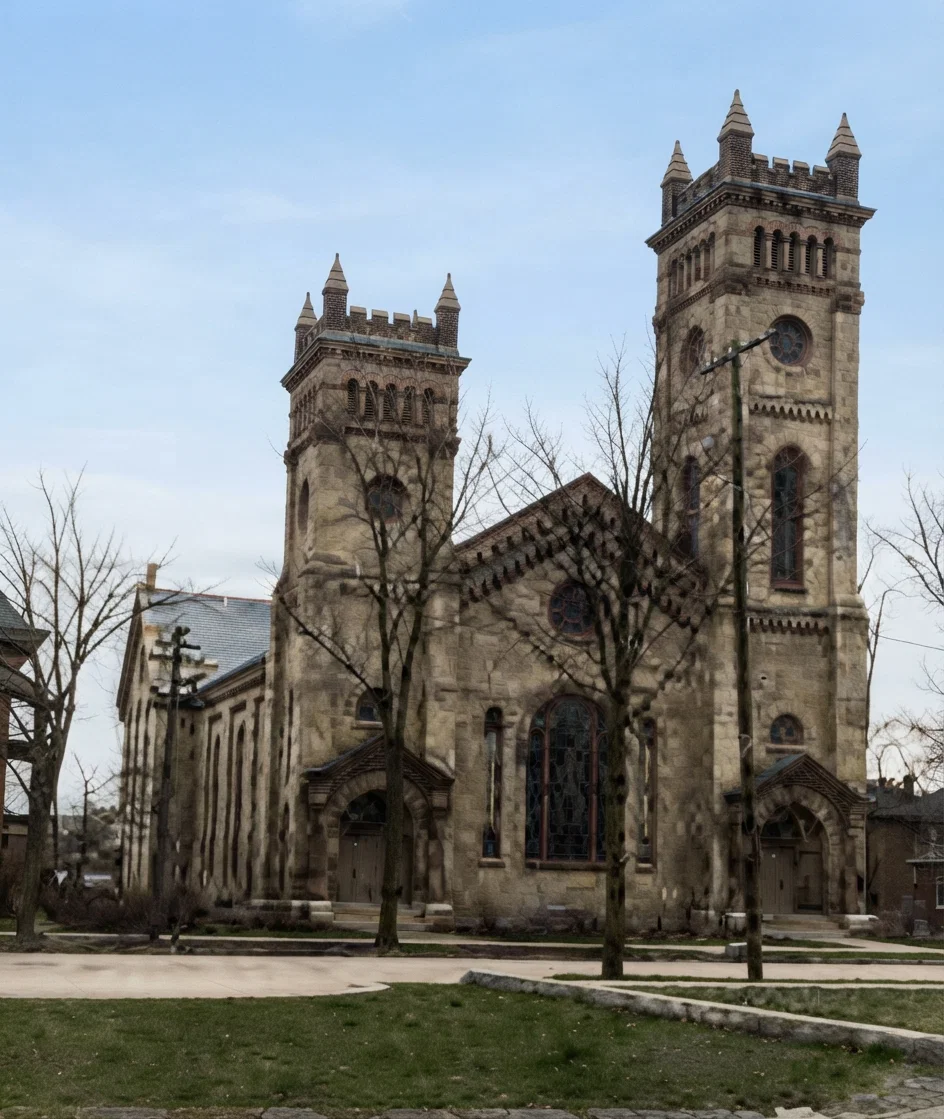
First Presbyterian Church, where convention was held.
Briefly stated, the New York State Sabbath Association is an organization having objects, as stated in a pamphlet giving constitution and by-laws, as follows:
“1. To conserve legislation and the enforcement of law, for the protection of the sabbath as a day of rest and worship.
“2. To protect the rights of labor to a day of rest and religious uses.
“3. To resist all encroachments upon the sacred character of the sabbath day.
“4. To hold public meetings, and for the publication and distribution of literature in the interest of sabbath observance.”
Article II. of the constitution reads as follows:
“Recognizing the sabbath as a divine institution, ordained for the glory of God and the well-being of man, we seek:
“1. To prevent any change in existing laws, in so far as they protect the first day of the week, ‘for rest and religious uses,’ and to secure such amendments thereof as experience shall show to be necessary for the protection of the day for such uses.
“2. In all ways by which public sentiment may be legitimately influenced to encourage respect for the rights of labor and of conscience in respect to the observance of the first day of the week ‘for rest and religious uses.’”
Section 3 of Article II. of the by-laws reads:
“3. Standing Committees:
“(a). On Use of the Press and Circulation of Literature.—It shall be the duty of this committee to secure the publication of articles and the diffusion of information relating to sabbath observance through the newspapers, to superintend the issue of sabbath documents, and to secure the distribution of sabbath literature among the people, subject to the approval of the Executive Board.
“(b). On Legislation.—This committee, under the direction of the Executive Board, shall, in all possible ways, procure wise and prevent unwise sabbath legislation both in state and nation. It shall keep the Executive Board advised of all changes in the laws of the state and the nation relating to sabbath observance.”
From these statements it is apparent that the main object of the association is to secure legislation in both state and nation in the interest of and for compulsory observance of the “first day of the week.” This would be purely religious legislation, for it would be solely in the interest of a religious institution.
Secondarily, the purpose is to educate the people, through the newspapers and by literature and other public work, to favor compulsory legal Sunday observance.
Dr. David J. Burrell is president of the state association, and Dr. Frederick J. Stanley is secretary; while twenty noted divines and legal lights of the state, selected from as many cities having more than 30,000 inhabitants, are the vice-presidents. There is an executive committee of sixteen members, and, so far, sixty-seven county representatives. While the actual membership could not be ascertained, it is safe to say that it is represented comparatively by the constituency of the fourteen denominations of New York state, which, in the matter of sabbath observance, is in sympathy with the association. At least, this was the information given to me by one of the vice-presidents, resident in Elmira. Col. Alexander S. Bacon, of the New York bar, is the chief legal representative of the state association.
The convention proper, which opened on Tuesday evening, October 30, and continued through Wednesday, had been preceded by what the writer may very properly term a three-days “whirlwind campaign” in favor of Sunday observance and compulsory Sunday observance laws, and for the stringent enforcement of present laws. Sunday was called “field-day” in the interests of the “Christian American Sabbath,” or, “Lord’s Day,” and in all the forty-four churches and missions of Elmira, the Catholic and Congregational excepted, sermons were delivered for the “American Christian Sabbath” by noted speakers and eloquent platform orators, who literally poured into the city during Saturday and Saturday night. It was, in fact, a great effort for the “American Sabbath,” and a public demand on the part of the ministers for a strict and unyielding enforcement of civil laws for the protection of the religious institution.
In this connection it must be noted that in all these sermons in the interest of securing civil aid for the enforcement of Sunday observance, the day—the institution itself—was put upon a strictly religious basis; the civil law must see to it that the religious day be kept, and due reverence paid to the institution by the people, because
the Voice of God Demanded It.
The fourth commandment of the Decalogue was invariably appealed to as final and conclusive authority for the demand.
There were one or two notable exceptions. It was held in at least two of the pulpits of the city that the law of God had been abolished; there was no fourth commandment demanding and commanding the observance of the seventh day, therefore Sunday could supplant and rightfully take the place of the “old Jewish day,” as the “new Lord’s day”—a Christian institution designed to10keep alive the memory of our Lord’s resurrection, the grand, overshadowing event of the divine plan of salvation.
AN IMPORTANT AND TYPICAL MEETING. (Continued from page 9.)
As three o’clock in the afternoon, at a mass meeting in the Y. M. C. A. assembly hall, Rev. Dr. J. Milton Thompson, of Troy, and Dr. Stanley engaged in a joint plea for “one day in seven.” It was necessary for physical, moral, ethical, and many other reasons, that “one day in seven” should be observed with uniformity. That the stability of the nation should be conserved, and American Christian citizenship perpetuated, it was necessary. The “one day in seven” must be Sunday, the American Christian Sabbath, in order that there should be complete Christian uniformity! Enlarged advertising effort, great personal activity, specially fine music, oratorical display and effort—every device possible—were employed to make the opening of the sixteenth anniversary of the State Sabbath Association a “red-letter day” in the history of the religious experience of Elmira.
A Mass Meeting.
Monday night, October 29, a mass meeting was announced and held in the Lake Street Presbyterian Church. The “popular” lecture, “God’s Footprints in the Oriental Crisis of To-day”—the new Japan, new China, new Manchuria, and new Russia—was given by Dr. Stanley. The lecture may be briefly described in a paragraph:
There is an Oriental crisis; yet all will end well and ultimate world-wide peace ensue as the result of American influence and American arbitration. And the new conditions coming into the national life of these great heathen nations—the change, sure and gradual, from darkened heathenism to enlightened Christian civilization—is the result of the Christian influence of the Occident, and in particular to the influence of the American Christian Sabbath, “the real sign of the power of God to transform and to control the destiny of the nations.”
Tuesday night another mass meeting was announced for the Hedding M. E. Church. It was expected that Colonel Bacon, of New York, would address this meeting upon the topic, “The American Sabbath the Bulwark of Home, Church, and Nation,” but he failed to appear. Dr. Stanley explained that “Colonel Bacon, as a candidate for judge of the Supreme Court of New York on the Prohibition ticket, was so busy attending to the speech-making and incidental work of the campaign for the success of the ticket, that it was absolutely impossible for him to fill the appointment;” therefore he (Dr. Stanley) very reluctantly must fill his place. He did so with the presentation of the subject, “The White Flag with the Blue Cross.”
His remarks were based upon Isa. 58:13, 14. With this text he coupled Eze. 20:20 and Rev. 1:10. He opened his address with an exposition of the influence of the Christian religion on the Japanese nation. It was turning Japan and its heathenism, rapidly and with unerring certainty, into a Christian nation like our own. Dr. Stanley adroitly made the “American Christian Sabbath” stand for the Christian civilization of the West in Japan and the Orient in a preeminent sense. It was the flag of the government of God, representing all that was spiritual and elevating, and having an influence upon the yellow races such as nothing else was, or could. The Christian sabbath, in fact, was practically doing the work of winning the world to Christ! That little white flag with the blue cross in time of peace floated from the masthead of the admiral’s ship above everything else, even the President’s flag, and so ought the American Sabbath, as a sign of the authority of God, be put above everything else and speak with power. His was a plea for
Civil Government
to arrange itself upon the side and in the defense of this great Christian institution. This was a Christian nation—it had been so decided by the highest tribunal of the land—and in that was the right to make Christian laws and enforce them upon the populace.
The speaker displayed a large map of the United States. States where Sunday laws were comprehensive and provided severe penalties for a violation of the statutes were white; those where the laws were less stringent and penalties not so severe, were a trifle shaded, while California, Idaho, and Arizona, where there were no general Sunday laws, were painted as black as night. “We are going to keep on working,” he declared, “until that whole map is made as white as can be, and Sabbath [Sunday] laws will be enforced upon the whole people of this country. That time is bound to come. We shall surely be successful.”
It is needless for the writer to state that not a word about conversion and the power of God to transform the individual appeared in this or any other of Dr. Stanley’s public lectures. All, all, was upon civil enactments and magisterial enforcement, and fines and punishments, and sheriffs, and the power and right of the civil law to regulate the observance of the institution of Sunday, which Dr. Stanley and the American Sabbath Union had put upon a strictly religious basis. And it was for that reason, primarily—because the day was religious—that it was doubly the duty of the state to enforce it as a civil institution as well! Such are the position and the logic of the arguments of the American Sabbath Union!
[This report grows in interest to the end. We trust our readers, however they may look upon Mr. Wightman’s report and review, will read to the end. More will appear next week.]