ECUADOR

6%

Pacific Press Publishing Company · Mountain View, California · Nov 28, 1906

FromSigns of the Times, Vol. 32, No. 46.

Read the full edition

ECUADOR.

SINCE 1895, when the Liberal party took the reins of government headed by General Alfaro, evangelical work has been slowly progressing here in Ecuador. The Congregational Church has been operating here some ten years, and has a small church established in Guayaquil. They also have opened missions quite recently among the Quichua and Jivoro Indians, the former being half civilized while the latter tribes are savage.
The Methodists are doing some work also. They have a representative here in Guayaquil, and have furnished English teachers for the high schools of Quito, the capital, which works well, so Bishop Wood says, who visited them lately.
About the last of 1905 a Dunkard missionary came here from the United States, and, while on his way to work among a savage tribe of Indians, took fever and died. This man of faith, a self-supporting missionary, while making his way afoot to his field of labor, with only a few natives to attend his wants, had to give up his long desired labor, before it was really begun.
Brother G. W. Casebeer and wife and myself have just returned from a missionary trip along the coast. From Santa Rosa we took a two-days' trip to Zeruma by mule. At our first stopping place for the night, after Brother and Sister Casebeer had played and sung, I gave the small audience a talk on the soon coming of our Lord. One elderly man became much interested and bought a Bible. The next day we arrived early at the foot of the mountain which consumes about three hours in ascending to the summit. The road on the mountain is noted for its roughness.
Las Tres Esculeras (the Three Ladders) is the worst of the climb. As one man said, it is a ladder without rounds. About half way up this hill there is a brass cross placed in the side of the high embankment, where our horsemen lighted candles. On asking them what this was for they replied that it was to help them on their way. Some who do not have candles along put money in there.
As we neared the summit, which is nearly six thousand feet above the sea-level, one of the most beautiful views was presented before us. As we were above the clouds, the sun shining on them thousands of feet below, they looked like the great foaming ocean.
As now is the dry season here, we could get over the roads quite easily; however, Sister Casebeer's mule stumbled, landing her on the ground. In the winter season many a pack-mule drops down never to rise again. One man told me that on one trip, he counted forty dead pack-animals on the road.
At Portovelo, near Zeruma, where the South American Developing Company have a forty-stamp quartz-mill, Brother Casebeer preached in English on the second chapter of Daniel, showing from history how the great nations of earth, from Babylon to Rome, have fulfilled the prophecy to the letter, and that the kingdom of God will soon be set up. Sister Casebeer played our Bilhorn organ, which was appreciated in the camp, as no organ or piano had ever been taken in there.
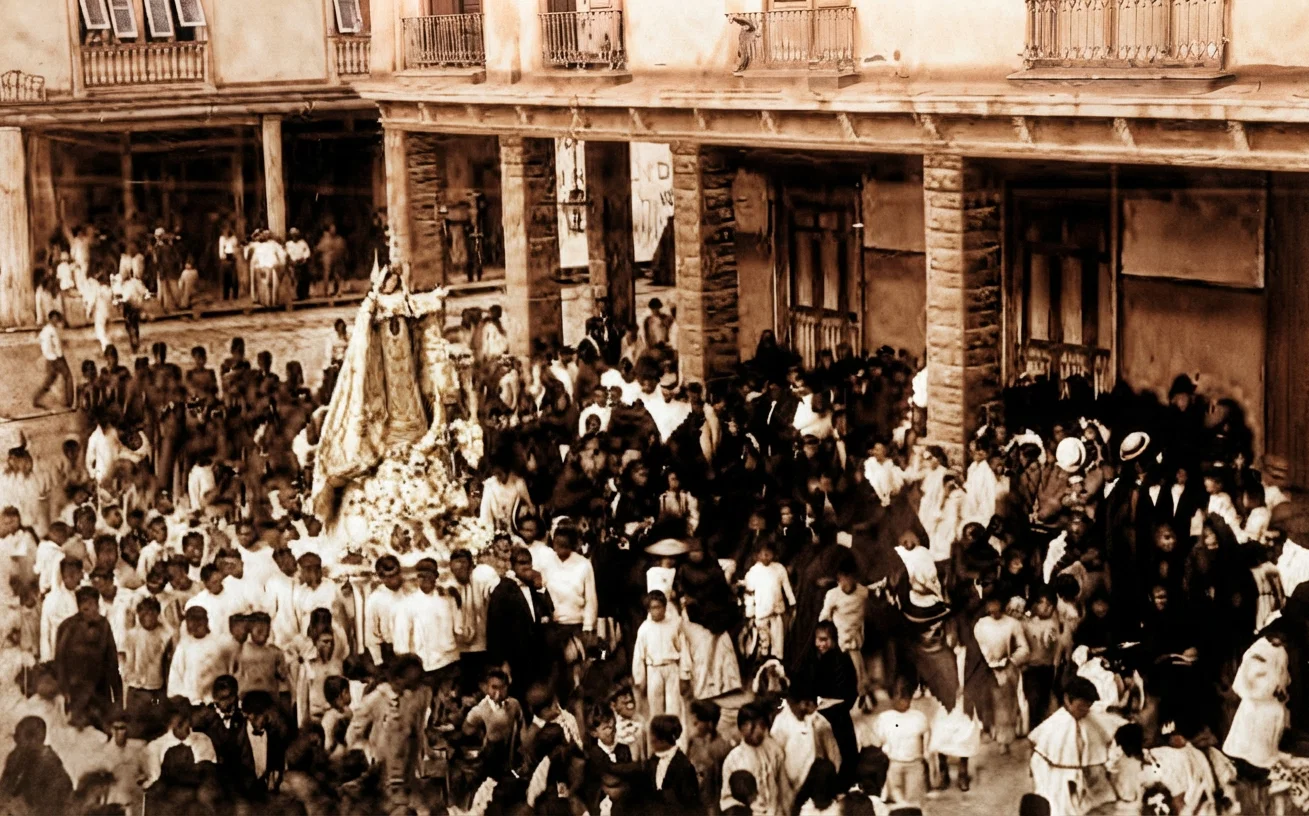
"Our Lady of Mercedes" in Procession, Guayaquil, Ecuador.
At Zeruma, where the Gospel had never entered before, we found very comfortable lodgings. After we had sold a good number of Bibles and Testaments, the priest condemned our books and work, telling the people to burn them. Most of the people, especially the women, were quite worked up over the matter. One man who had quite a large store bought a Testament, then poured coal oil on it and set it afire in the street near our quarters. Quite late in the evening the proprietor of our house sent for us and ordered us to vacate at once, as we were committing a great scandal with our Bibles. As we had nowhere to go, we saw one of the authorities, who, after an hour or two of persuasion, got consent from the
man to let us stay. We could see that the priest was losing his hold on the people, as many would come to see us and buy Bibles.
Soon after we arrived in this place there was a heavy earthquake, and we were told that the priest preached from the pulpit that we were likely the cause of it. The good Lord surely protected us as the comisario said the people were ready to stone us. A few stones were thrown, but no damage done. This is Catholicism in what is called a free republic. We surely ought to sympathize with the missionaries where Rome holds sway.
Ecuador has her doors open for the Gospel of the Third Angel's Message, and many are anxious to read our literature. I am thankful to be here, trying to get the light before the people. The largest number of orders for subscription books and the largest sale of papers I ever made in one day was here. One half-day's work gave me twenty orders for the Spanish "Patriarchs," and in one short day I sold 105 Señales, our missionary Signs of the Times for South America.
What Ecuador needs are some active Christian workers to sound the Gospel throughout this field.
THOMAS H. DAVIS.