It hardly need be said that the Japanese as a people possess a good degree of energy and thrift. The first sight of their shores bears evidence of this. Fishing boats throng the coasts; and every available plot of land is carefully cultivated, even steep mountain-sides being terraced to their summits, and verdant with growing crops. And a closer examination of the country, and a better knowledge of the people sustain the first impression.
Labor Methods.
And yet, in Japan, as elsewhere, varying standards seem to exist in different lines of work as to what constitutes a day's labor. To illustrate: The Japanese carpenter seems to have reached or even passed the goal of the eight-hour day. He begins work anywhere from half past seven to eight o'clock, spends considerable time in sharpening his tools, stops work three or four times in a half day for a smoke, and in cold weather frequently stops to warm himself at a fire of shavings. At the other extreme of the laboring class are the factory hands, often mere children, who work from early morning till night for a very small wage indeed.
One curious custom among some workmen in the Orient is that of concert work. It is interesting and amusing to see twenty or thirty men and women working a pile-driver with rhythmic movements, to the accompaniment of a kind of chant, in which all join. In this instance the unison of effort is necessary.
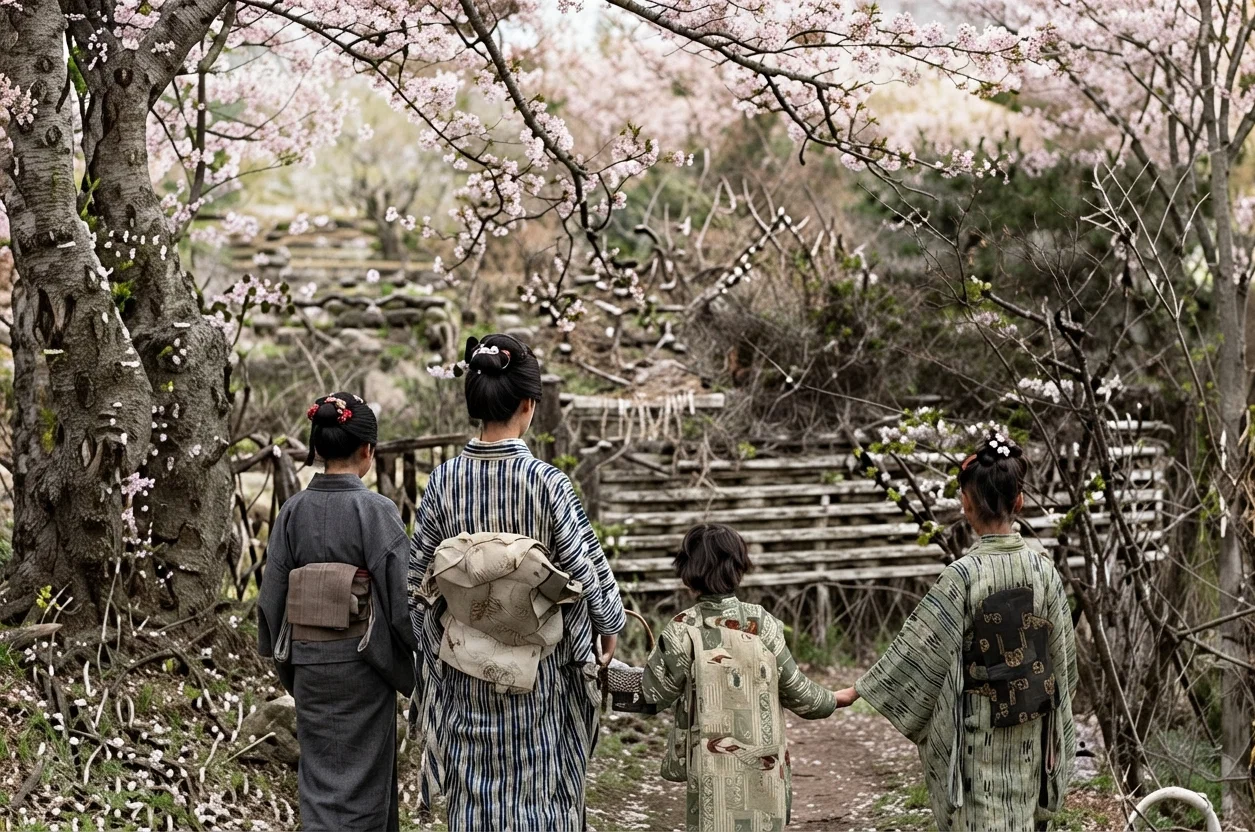
Viewing the Cherry Blossoms.
Not so, it would seem, in the case of a squad of railway section hands, all raising their picks at the same time and letting them fall together. It has been pointed out that this mechanical method of labor necessarily detracts from the excellence that results from more individual effort. But of course this method of working can only be applied to certain forms of unskilled labor.
The Artistic and Poetic.
The more recent history of Japan has convinced the world that the Japanese are to be taken seriously, and no longer regarded as "pretty, interesting, artistic little dolls or children, fantastic and whimsical." And yet this artistic, playful vein in their character lies very near the surface, which fact doubtless accounts for its having been discovered by foreigners earlier than their sterner traits. The cares of life seem to rest lightly upon them, and their highly developed artistic sense responds to all the beauties of nature. It is difficult for foreigners to appreciate their keen enjoyment of these. A Japanese will walk miles to see a display of red maple leaves in the fall, or a pond full of lotus blooms in summer. In April the resorts famous for cherry blossoms are literally thronged with sightseers. In June the morning-glories are at their best. Here in Tokyo there is one place famous for these flowers. Throngs of people come to see them in the early morning, and return home by way of the lotus pond, to feast their eyes on the pink and white beauties that stud the surface of the water. The full moon on a clear night offers attractions that draw many admiring spectators, and furnish the topic for many a poem.
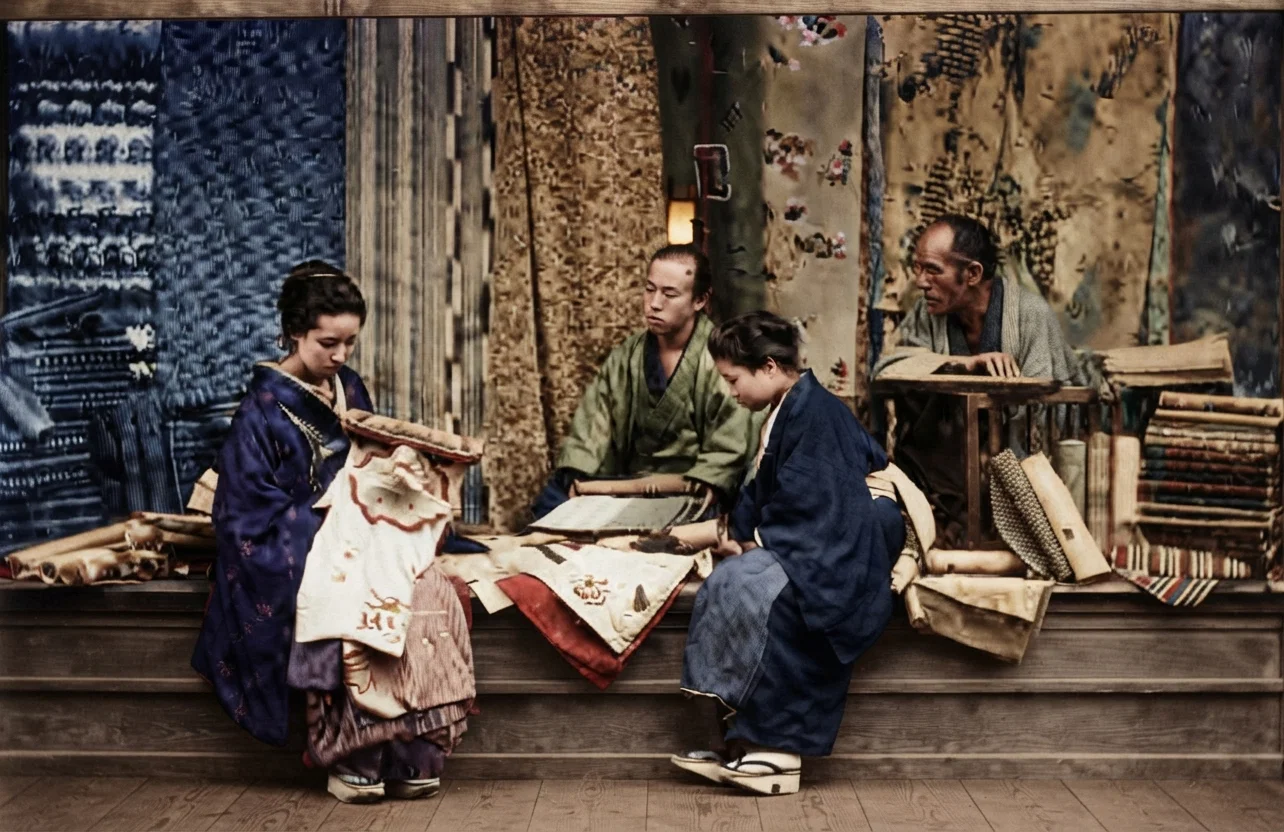
Interior of a Japanese Shop.
With this keen appreciation of the beauties of nature, it is natural that the people should be much given to outdoor excursions and pastimes. Long trips are made on foot to noted shrines, and to places famous for their scenic beauty. Frequent outings to parks and groves are planned for the school children. Old and young of all classes seem to enjoy such recreation very much.
But for all this, and with all their holidays and festivals, the Japanese really have few true rest days; for there is no weekly Sabbath. Workmen in factories and other establishments are allowed two rest days in a month, commonly the first and fifteenth days, regardless of the day of the week.
Among artisans and shop-keepers generally business is carried on without any regular interruption. In some parts of the country the farmers rest half a day every fifth day—at times when their work is especially taxing upon their strength.
The Principal Holidays.
The principal holidays of the year are the New Year's season, the festival for girls on the third of March, the boy's festival on the fifth of May, and the emperor's birthday on November 3. The most popular religious festival comes in mid-summer, and is held in honor of the souls of the departed dead, who are believed to return to their former abodes during this time. Festivals at the various Buddhist and Shinto temples are common, but the time of these varies for different temples.
Until the early days of the present era, the Japanese reckoned time by the old lunar calendar, still in vogue in China, and in the rural and more remote parts of Japan. The beginning of this year occurs in February, several weeks after the rest of the world have begun a new year. The year is composed of twelve lunar months, with an occasional intercalary month. The months have no specific names, but are known by their numbers.
Lost Account of the Week.
It has already been observed that the Japanese have no weekly rest day. And it is interesting to note that until their recent contact with Europeans, they had practically lost all account of the week. Yet there are customs and traditions which prove quite conclusively that they once had a knowledge of the week, and observed a weekly rest day or holiday. Among physicians it was common to prescribe a course of medicine for one mawari. The literal meaning of this word is "a turn; revolution; rotation;" but as used above it meant, and still means, "one turn or a period of seven days." It is also said that among priests a similar period of seven days was assigned to the13performances of certain ceremonies and prayers. There is also a tradition among the people that in ancient times their ancestors observed a rest day or festival once every seven days.
But the most remarkable and convincing proof on this point pertains to their old calendar. In their calendars as issued from year to year, from time immemorial the Chinese character for the sun was written in regularly recurring intervals of seven days. The reason for this became lost, even to scholars. But in time, when the Japanese came in contact with Europeans, and compared calendars, the days in their calendar to which the character for the sun was attached were found to coincide exactly with Sunday, the first day of the week. The candid reader is left to decide the bearing of this remarkable fact upon the "lost time" question.
Early in the present era the Japanese government adopted the Julian calendar; and with this change came the complete recognition of the week. Specific names were attached to the days of the week. The first day of the week was named for the sun, the second for the moon, as in our calendar. The remaining days were named for the planets Mars, Mercury, Jupiter, Venus, and Saturn, in the order given.
Sunday in Japan.
Through contact with foreigners, it has come about that Sunday is observed as a sort of legal holiday or "civil sabbath." All schools are closed on Sunday. Also all government offices, and such government establishments as the arsenal in Tokyo and the government paper mills at Oji; but the work in these is continued on Sunday when urgent. But with these and similar exceptions, the work-a-day world in Japan pays little attention to the "venerable day of the sun," except that the day is coming to be regarded as a day of recreation and pleasure. It is said that the Sunday receipts of theaters, restaurants, tea-houses, and other resorts in the cities, are twice what they are on other days. The day is often chosen for celebrations and other large gatherings. The triumphal procession of the army through the streets of Tokyo after the war was set for a Sunday.
When the missionaries came to Japan with the Gospel, the Japanese had no weekly rest day, as has been shown. Under existing conditions a low standard of Sunday observance has been accepted or tolerated in the churches. Sunday is observed much as it was during the early centuries of the Christian era. Japanese Christians commonly attend church on Sunday, but, having done this, the great majority then feel free to carry on their usual work. It is exceptional for a Christian shop-keeper to close his shop on Sunday. Even among the native pastors the standard is surprisingly low. The case of a pastor sending out on Sunday morning to buy bread for communion service will serve to illustrate.
Wanting a Divine Command.
Some of the leaders in the churches, both natives and foreigners, are quite exercised over the situation; and a few years ago an organization was formed, called the Japan Sabbath Alliance, having for its object the furtherance of Sunday observance. The principal obstacle met has been the indifference of the native believers. The chief drawback in the furtherance of such a work is the lack of a divine command for Sunday observance.
And not only this, but the people are being taught the binding obligation of the fourth commandment, just as it reads. And a little company of believers has been brought out to observe the true, seventh-day Sabbath. Literature on the subject is being circulated, and personal work is being done, to turn the people from every false way to the obedience of all God's commandments. This work has had a small beginning, but it is growing like the mustard of the parable. It is a work of faith, as the Lord's work always is; and so we are confident of the final triumph of truth over error in the Land of the Rising Sun.